


Our computer vision development services
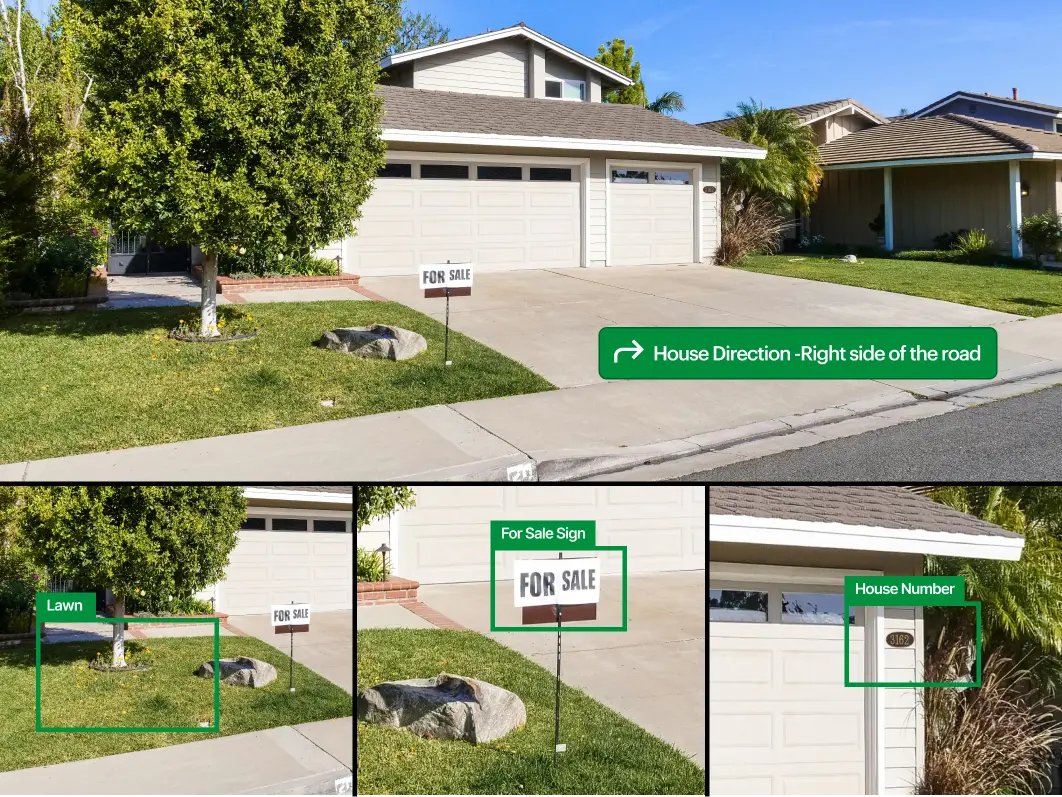
Reduced Inspection Times for Property Inspectors with a Computer Vision Solution
- Deep learning and computer vision driven image data extraction
- GPT-based NLP chatbot for enhanced customer experience
- Improved work efficiency by 80%
- Image classification for detecting anomalies

Computer Vision-Powered Blueprint Analysis for Improved Construction Workflow
- Reduced marking errors by up to 90%
- Accurate identification of blueprint regions using edge detection
- Lowered Project Completion time by 30%
- Automated labeling and coloring aligned with construction notes
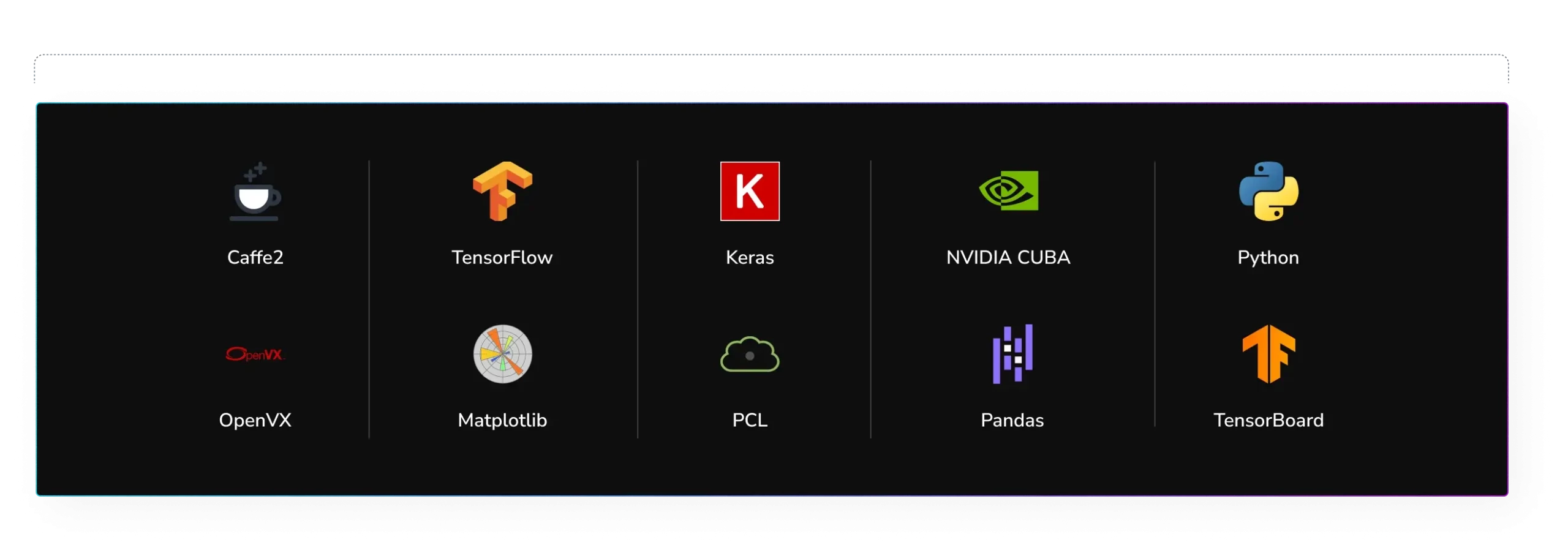
Computer vision tools and frameworks we use
Leading brands we’ve worked with

Image Preprocessing
Our team excels in designing robust preprocessing pipelines tailored to specific tasks and datasets. We ensure optimal normalization, resizing, and enhancement to improve model performance and generalization.
Feature Extraction
Leveraging a deep understanding of traditional feature extraction methods and state-of-the-art deep learning architectures, we extract meaningful features crucial for accurate object recognition, classification, and segmentation.
OCR and ICR
Leveraging advanced OCR and ICR techniques, we extract text from images and documents accurately, enabling automated data extraction and analysis in domains like finance, healthcare, and document management.
Image Generation with GANs
Our proficiency in GANs empowers us to generate synthetic data for augmenting training sets, creating diverse datasets for training robust models, and generating realistic imagery for various applications.
Image Segmentation
Our expertise in semantic and instance segmentation enables precise delineation of objects in complex scenes, facilitating applications like medical image analysis, autonomous navigation, and industrial automation.
Object Detection
With extensive experience in object detection frameworks such as Faster R-CNN, YOLO, and SSD, we develop custom solutions for real-time detection in various scenarios, from surveillance to autonomous vehicles.
Intelligent Video Analysis
With expertise in video processing and deep learning, we develop intelligent solutions for video summarization, activity recognition, and real-time object tracking, enabling actionable insights from video data.
Tracking and Labeling
Our team excels in designing scalable tracking algorithms and automated labeling pipelines, facilitating efficient data annotation and enabling high-quality labeled datasets for training and validation.
Data Augmentation
We develop sophisticated data augmentation strategies to enrich training datasets, mitigating overfitting and enhancing model robustness in the face of real-world variability.
Transfer Learning
Leveraging pre-trained models and transfer learning, we accelerate development cycles and deliver cost-effective solutions tailored to specific customer needs, even with limited labeled data.
Our computer vision development process
Requirements Gathering & Problem Definition
Data Collection and Annotation
Exploratory Data Analysis (EDA)
Model Selection and Architecture Design
Training, Validation and Evaluation
Deployment and Integration
Requirements Gathering & Problem Definition
Data Collection and Annotation
Exploratory Data Analysis (EDA)
Model Selection and Architecture Design
Training, Validation and Evaluation
Deployment and Integration
What our clients say:

“An impactful AI solution for enhanced coding accuracy, claims, and revenue”
“Markovate quickly understood our vision to improve clinical coding accuracy and streamline revenue cycle workflows. Their team delivered a robust, HIPAA compliant AI-powered solution that reduced coding errors, improved claims acceptance rates, and accelerated reimbursement timelines. They operated like an extension of our team—highly responsive, accountable, and solution-driven. The impact on operational efficiency and revenue outcomes was both immediate and measurable.”

“Brought speed and precision to property inspections”
“Thanks to Markovate and their solution, our inspection accuracy has skyrocketed, significantly reducing our operational costs and improving customer satisfaction.”

“Enhanced retail operations with strategic tech guidance”
“As a retail business, finding the right technology partner was crucial. We partnered with Markovate, who expertly guided our product development from concept to launch. Their recommended innovative solutions have significantly enhanced our operations and reduced our costs.”

“Improved accessibility and efficiency in transit services”
“Partnering with Markovate to enhance our paratransit transportation system was a remarkable experience. We are deeply impressed by the precision and effectiveness of their solution.”

“Helped accelerate takeoff and estimation process”
“The automation of blueprint analysis has significantly reduced errors and saved us both time and costs. Markovate’s support and ability to customize the solution to our needs have made them an invaluable partner in our projects.”

“Delivered a seamless mobile app journey - start to scale”
“In every sense, working with Markovate has been amazing. The experience & outcomes were excellent from conception to creation & throughout the evolution phase. We are grateful that we could find Markovate to assist us as our mobile application met our expectations.”

“Added real business value to our product launch”
“Worked with Markovate and Mansi Takyar for our software launch in Canada. She has excellent business sense and truly added value to our product’s success. We highly recommend Markovate.”

“Delivered a smarter, more scalable app experience”
“Worked with Rajeev and Mansi both for Hawaii Revealed app development and launch. Excellent people with a thorough understanding of their business. Experts in providing solutions for scalability and product modernization.”

“Trusted experts in end-to-end digital product creation”
“I recommend Markovate to owners looking to design a new product or planning to develop it. Their team is fully skilled in building mobile applications and web solutions.”
Computer vision development services
What is Computer Vision?
How do you address privacy and security concerns in computer vision solutions?
We leverage secure cloud platforms with access controls to safeguard your computer vision data throughout its lifecycle. Our team ensures compliance with data privacy regulations (GDPR, HIPAA) and prioritizes transparency with clear communication on data usage, deletion options, and user-controlled privacy features within your application.
What level of accuracy can be expected from the computer vision solution?
Our deep learning experts tailor Convolutional Neural Networks (CNNs) to your specific task, like facial recognition or object detection. Additionally, we employ advanced techniques like data augmentation, creating variations of existing data (like different pothole severities in road images), to enhance the model’s ability to handle unforeseen situations.
Rigorous validation with computer vision-specific metrics like mAP for object detection ensures exceptional performance and identifies any potential biases. This collaborative approach guarantees a computer vision solution that delivers top-notch accuracy in real-world scenarios.
How does Computer Vision Software Development separate itself from conventional image processing?
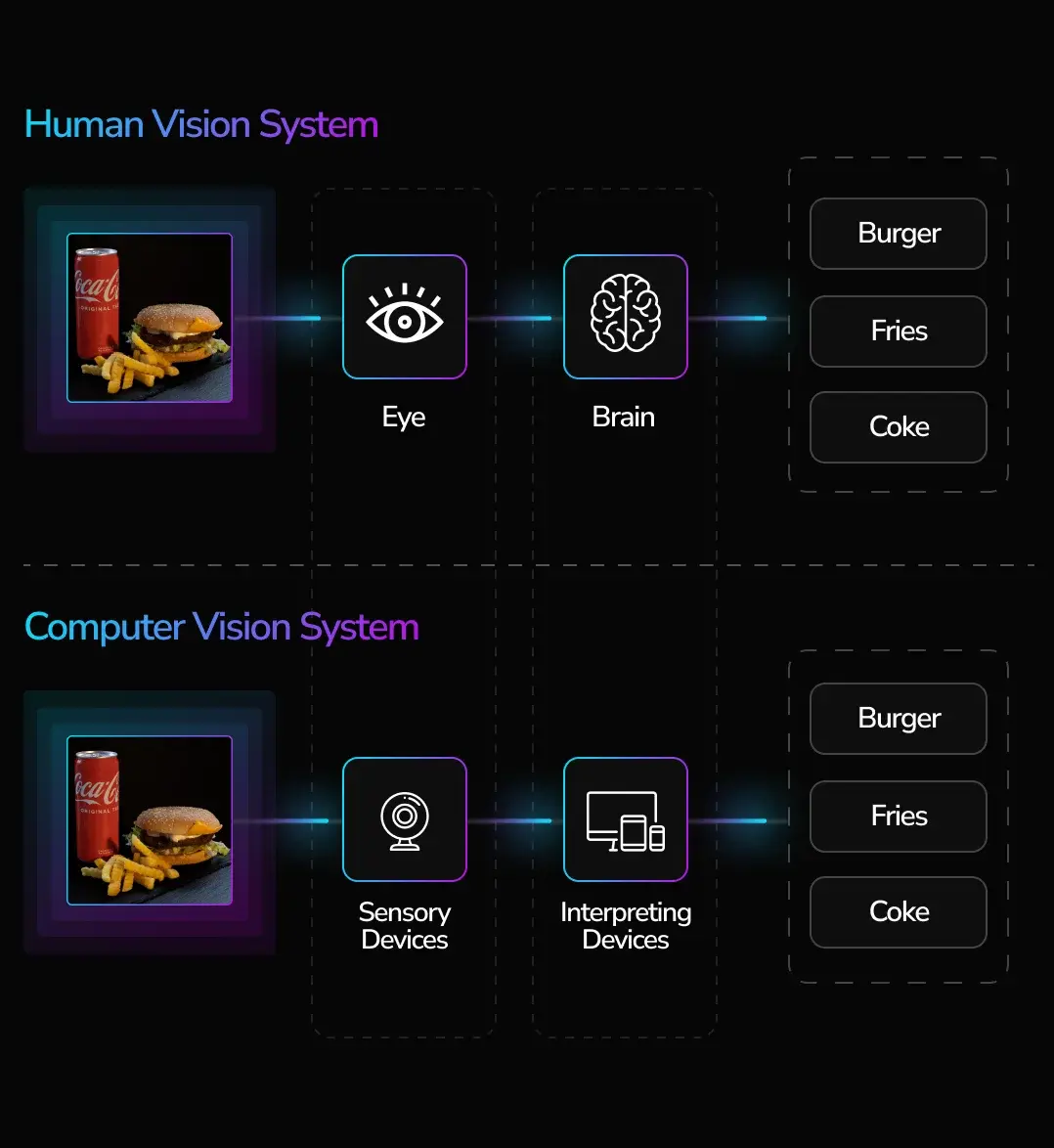
Computer vision software development goes beyond conventional image processing by focusing on semantic understanding, contextual analysis, machine learning integration, robustness to variability, diverse applications, and real-time processing needs. It extracts meaningful information from visual data, recognizes patterns, and enables intelligent decision-making, distinguishing it from basic image manipulation techniques.
Our expertise lies in building software that leverages machine learning, specifically CNNs, to make machines truly “see” by extracting meaning from images and videos. Our solutions analyze the context, not just individual pixels, and are robust to real-world variations. This, combined with real-time processing capabilities, unlocks a vast array of applications, from self-driving cars to medical analysis, empowering machines to understand and interact with the world around them.
Which industries stand to gain from Computer Vision Software Development?
We’re at the forefront of developing groundbreaking solutions to facilitate these computer vision applications. Our solutions, using computer vision capabilities, help automate the analysis of complex medical scans (advanced image analysis), optimize production lines with visual inspection systems, and create frictionless checkout experiences (object recognition).
How do you perform data annotation in computer vision projects?
We use bounding boxes to precisely define the location of the objects, or even employ segmentation masks to differentiate the object from the background scenery. Additionally, keypoint annotations can pinpoint specific features of the objects, while attribute annotations capture details like color, size, or material. The type of annotation used depends entirely on the specific task the model is designed for. By providing this rich and granular data, we ensure our models “learn” from the most accurate information available, leading to exceptional performance.
What kind of support and maintenance do you provide post-deployment?
Point of view

AI Image Validation Solutions: Automating Quality Checks
In today’s dynamic, evolving world, industries like real estate, healthcare, manufacturing, and many others are experiencing increased demands for quality control, accuracy, and efficiency. According to a report by McKinsey, AI-driven technologies could add up to $2.6...

AI Object Detection: A Revolutionary Solution for Heavy Work
As industries face increasing demands for efficiency and safety, AI object detection stands as one of the best innovations. Object detection identifies and localizes objects in images or videos. It has advanced so much due to AI and machine learning integration with...
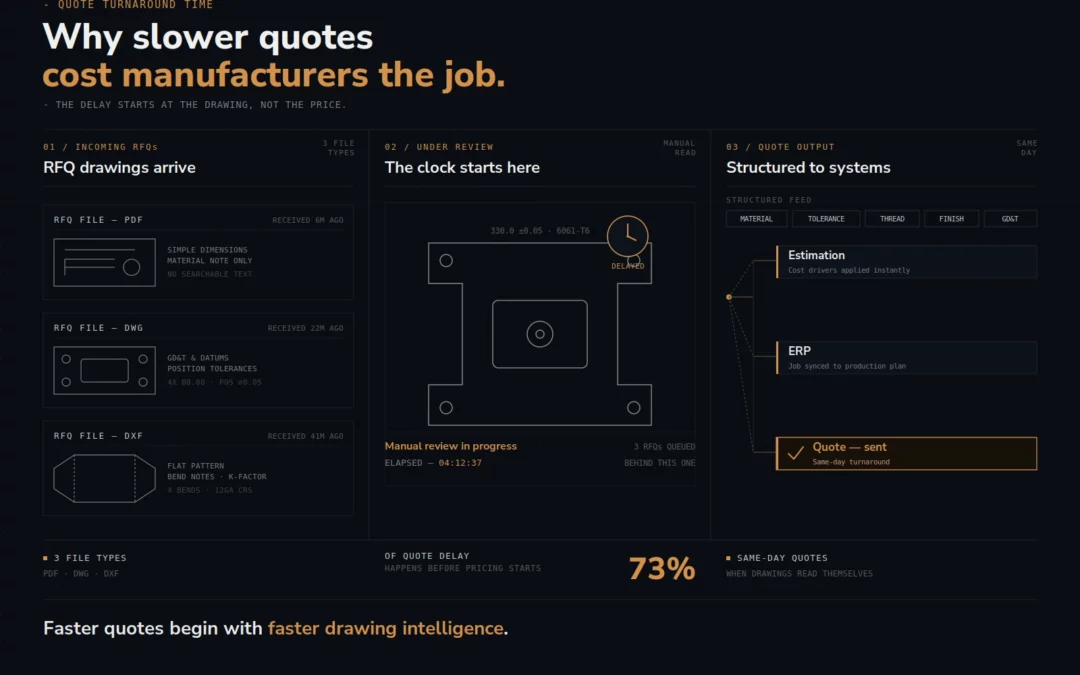
Quote Turnaround Time: Why Slower Quotes Are Costing Manufacturers the Job, Not Just the Hours
Quote turnaround time gets blamed on pricing. In most shops, that's not where the delay actually comes from. The RFQ usually waits on the experienced estimators who can read the print correctly. Tolerances need checking. A casting might only have a 2D drawing to work...
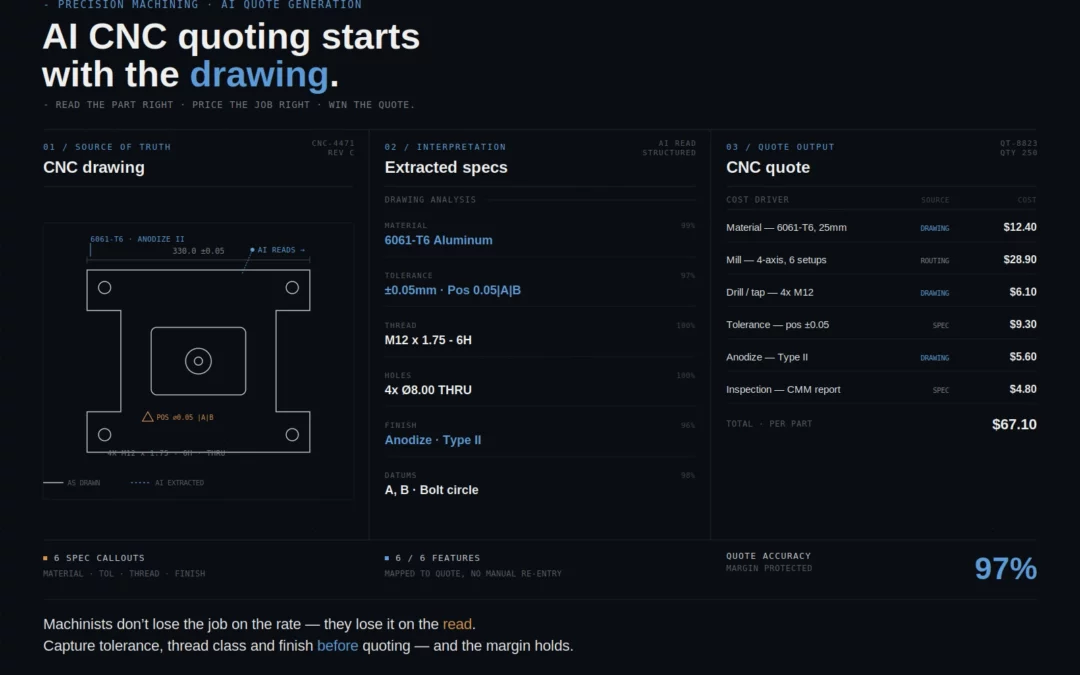
Quoting Software for CNC Machining: Why the Estimate Still Breaks on Complex Jobs
A shop wins an RFQ for a part that starts as a permanent mold casting. It gets machined next, then moves to assembly. The quoting software prices the machining step well. It has no framework for the casting cost or the assembly labor. Another shop gets a different...