
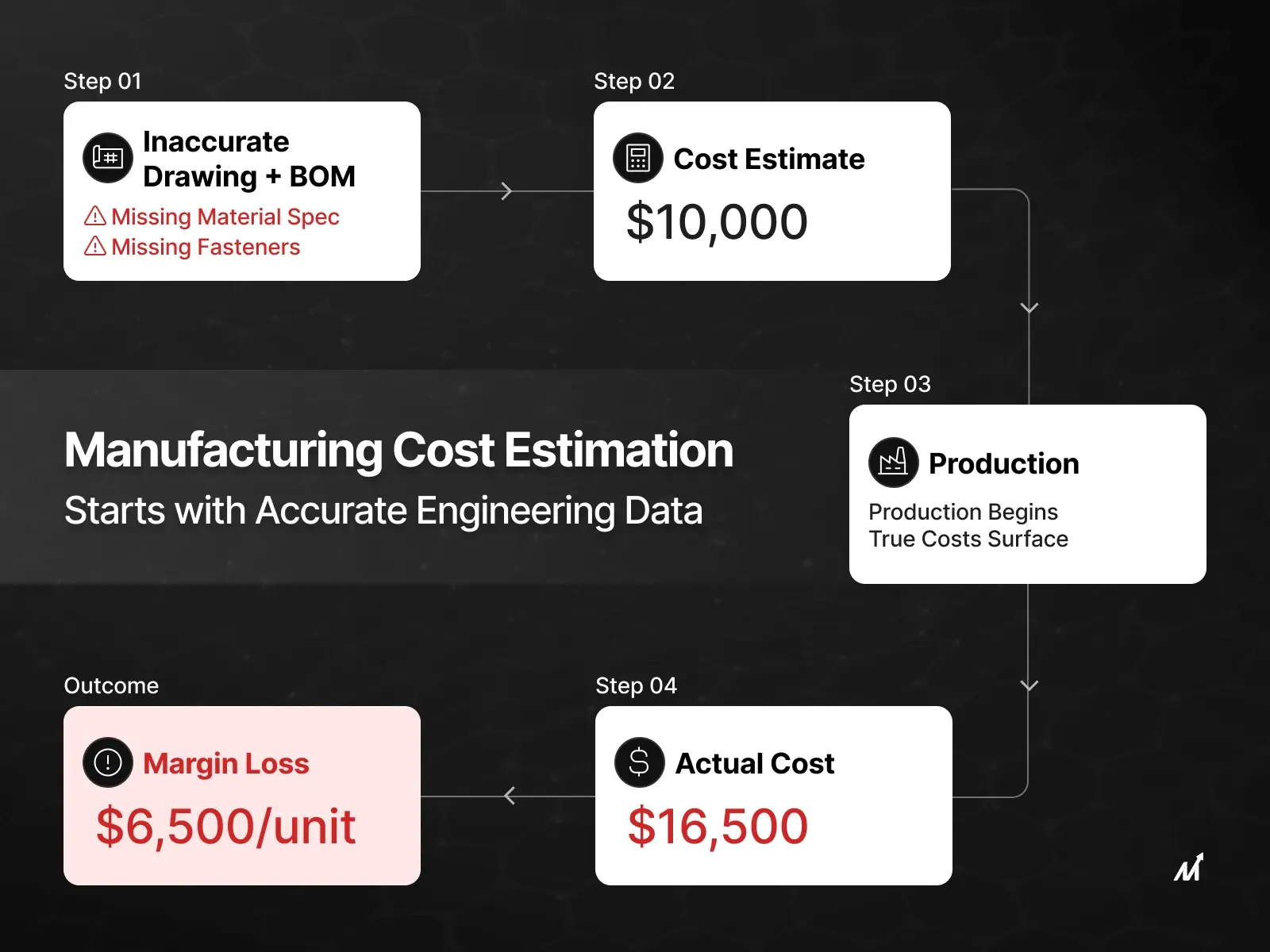
A few months ago, a heavy-industry contractor approached us with an urgent request. They had received a multi-million-dollar project opportunity and needed to turn around a budget estimate quickly. The drawings were ready. The deadline wasn’t flexible. What they didn’t have was time to manually review hundreds of pages of blueprints to extract materials and validate quantities.
Their concern wasn’t just speed — it was risk. Missing a component, misreading a tolerance, or working off an outdated revision could mean underpricing the job and absorbing losses later.
This is a common challenge in manufacturing cost estimation.
Cost estimation affects every major decision in heavy-industry projects, from how RFQs are priced to how margins are protected. However, estimation problems rarely begin in the costing software itself. In practice, they start earlier, in engineering drawings and Bills of Materials (BOMs).
Unclear tolerances, inconsistent quantities, revision mismatches, or manually compiled material lists can distort material costs, machining time, and labor assumptions. As a result, even advanced costing tools generate unreliable outputs when the underlying data is flawed.
Before improving estimation models, heavy-industry organizations must improve the accuracy and structure of the engineering data feeding them.
This blog explores how drawing and BOM quality directly impact manufacturing cost estimation, and why upstream accuracy plays a critical role in protecting margins.
Manufacturing cost estimation is the process of calculating the expected cost to produce a part, assembly, or product before it goes into full production. It helps organizations determine pricing, evaluate feasibility, compare sourcing options, and decide whether a project meets margin targets.
In heavy industries, cost estimation typically includes:
Cost estimates are used across multiple functions. Engineering teams evaluate design decisions. Procurement compares supplier options. Sales teams prepare competitive quotes. Operations assess production viability.
Modern cost estimation tools often analyze CAD models and manufacturing parameters to predict cycle times and resource usage. However, these systems depend heavily on accurate inputs, including geometry, tolerances, materials, and complete component lists.
If engineering drawings are unclear or BOMs are incomplete, cost estimates may not reflect real manufacturing complexity. Even small inaccuracies in quantities, specifications, or tolerances can affect machining time, inspection effort, and material usage.
In other words, manufacturing cost estimation is only as reliable as the engineering data behind it.
Even with structured costing systems in place, estimates often fail because the underlying engineering data is inconsistent, incomplete, or manually interpreted.
Here are the most common causes.
Cost estimation depends on precise inputs: material grade, tolerances, surface finish, dimensions, welding notes, coatings, and secondary processes.
When drawings are missing specifications or contain unclear annotations:
Estimators are then forced to make assumptions. Those assumptions directly affect pricing accuracy.
In heavy industries, drawings and BOMs frequently go through multiple revisions during RFQ cycles.
If:
The estimate no longer reflects the actual build requirement.
Even small design changes, such as tighter tolerances or added features, can significantly impact machining time and tooling complexity.
A cost estimate is not just about one part. It depends on a complete and aligned Bill of Materials.
Common issues include:
When the BOM structure does not match real manufacturing requirements or BOM discrepancies are present, procurement pricing and labor calculations become inaccurate.
Many estimation processes still rely on engineers manually reviewing drawings and extracting information.
This introduces risks such as:
Manual review slows down RFQ turnaround and increases variability in cost outcomes.
When inputs are wrong, quotes are wrong.
The result is either:
In heavy industries where projects are high-value and long-cycle, even small miscalculations can affect profitability.
Manufacturing cost estimation often focuses on labor rates, material prices, and overhead structures. But in heavy industries, a significant portion of cost is already embedded in the engineering drawing itself.
Small technical decisions, sometimes just a single note or tolerance adjustment, can meaningfully change machining time, inspection effort, and production risk.
Material selection directly influences machining behavior, tooling wear, processing time, and supplier availability. A shift from a standard carbon steel to a hardened alloy doesn’t just increase raw material price; it may require different cutting strategies, heat treatment steps, or longer lead times.
If the drawing and BOM are not fully aligned on material grade or processing requirements, the cost model begins with incorrect assumptions.
Tolerance strategy is one of the most underestimated cost drivers. Tighter dimensional control increases machining precision, slows cycle times, and raises inspection requirements.
Complex GD&T callouts may require additional setups or advanced metrology equipment. Even a small change in the tolerance band can push a part from standard machining to high-precision manufacturing, thus significantly affecting the estimated cost.
Surface finish requirements, coatings, welding notes, plating, or heat treatments are often embedded in drawing annotations. These details may appear minor, but they introduce additional operations, supplier coordination, and quality checks.
When these requirements are overlooked during estimation, they surface later as unplanned cost additions.
Part geometry determines how efficiently a component can be produced. Deep cavities, thin walls, tight internal radii, or multi-axis features increase setup complexity and cycle time.
Even with standard materials and tolerances, geometric complexity can significantly influence production cost.
In heavy industry projects, revisions are common. A tolerance adjustment, added weld requirement, or finish update may seem minor from a design perspective. However, these changes can alter machining strategy, inspection scope, and production sequencing.
If such updates are not captured accurately during cost estimation, margin assumptions become unreliable.
If engineering drawings define how a part is built, the Bill of Materials defines what is built. Manufacturing cost estimation depends on both being complete and aligned.
When BOM data is inaccurate, even the most advanced cost model produces unreliable results.
Read our blog on BOM accuracy to know more in detail.
In heavy industries, the Engineering BOM (EBOM) reflects design intent, while the Manufacturing BOM (MBOM) reflects how the product will actually be fabricated and assembled.
Misalignment between the two creates cost distortion.
For example, an EBOM may group components logically by design function, while the MBOM reorganizes them by production sequence. If the cost estimate is based on an engineering structure that does not reflect real assembly flow, labor time and overhead allocation can be miscalculated.
Without structured synchronization between engineering and manufacturing data, estimation accuracy suffers.
Small quantity errors create large pricing gaps.
If fasteners, brackets, fittings, or consumables are undercounted or duplicated, the total cost shifts. In complex assemblies common to construction, energy, aerospace, and industrial equipment projects, even minor quantity discrepancies can scale quickly across production runs.
These mismatches often happen when BOMs are manually extracted from drawings or when spreadsheets are used during RFQ cycles.
Not all cost drivers are high-value components. Frequently, smaller hardware, secondary brackets, or process-specific items are overlooked during early estimation.
When subcomponents are missing from the BOM:
The impact is usually discovered during production, not during quoting.
Heavy industry projects operate with frequent revisions. Design updates may affect part dimensions, materials, tolerances, or assembly structure.
If cost estimation is based on an outdated BOM revision while procurement and engineering move forward with updated documentation, pricing quickly becomes disconnected from reality.
Version control issues are especially common when BOMs are manually maintained across multiple systems.
Manufacturing cost estimation relies on structured, complete data. When BOMs are incomplete, estimators compensate with assumptions or buffer margins.
This creates two risks:
In competitive heavy industry environments, neither outcome is acceptable.
In many heavy industry organizations, manufacturing cost estimation still begins with manual drawing review.
Engineers or estimators open PDF drawings, examine multiple sheets, interpret tolerances, identify materials, cross-check revision notes, and extract BOM details — often under tight deadlines.
This process creates three major challenges.
First, it is time-intensive. Complex assemblies may require hours of review before costing even begins. During high RFQ volume periods, this slows quoting cycles.
Second, interpretation varies by individual. Two estimators reviewing the same drawing may interpret tolerance requirements, welding symbols, or finishing notes differently. This creates inconsistency in cost assumptions.
Third, manual extraction increases the risk of missing embedded details, secondary processes, hidden notes, or revision updates that materially affect production cost.
In competitive heavy industries, speed and accuracy both matter. If cost estimation is delayed, sales teams respond more slowly. If drawing details are misinterpreted, margins are exposed.
Manufacturing cost estimation does not fail only because of poor cost models. It often fails because the input process itself is manual and fragmented.
Improving manufacturing cost estimation does not start with better spreadsheets or more complex pricing formulas. It starts with better input data.
When engineering drawings and BOMs are structured, searchable, and synchronized, cost modeling becomes faster and more reliable.
Instead of manually reviewing PDFs and extracting specifications line by line, teams can work with structured engineering intelligence, where material callouts, tolerances, GD&T, finishes, and component data are automatically identified and organized.
This creates three measurable improvements.
First, estimation speed increases. Structured drawing interpretation reduces the time required to review complex assemblies during RFQ cycles.
Second, consistency improves. Standardized extraction reduces variation between estimators and minimizes subjective interpretation of technical details.
Third, pricing confidence increases. When cost models are built on complete, revision-aligned engineering data, margin assumptions are based on reality, not approximation.
In heavy industries where projects are high-value and long-cycle, these improvements directly affect competitiveness.
Manufacturing cost estimation depends on how accurately engineering data is interpreted. When drawings and BOMs are reviewed manually, errors and delays are common, especially in complex heavy-industry projects.
AI improves accuracy by transforming unstructured engineering documents into structured data that cost models can use directly.
AI systems can analyze engineering drawings, identify material specifications, tolerances, GD&T symbols, and process notes, and extract them consistently. This reduces reliance on manual PDF reviews and minimizes interpretation gaps.
Read this blog to learn more about AI blueprint interpretation!
AI can capture part references, quantities, and subassembly relationships directly from drawings. Structured extraction improves alignment between engineering documentation and cost estimation inputs.
By standardizing how technical details are interpreted, AI reduces variability between estimators and lowers the risk of missing critical cost-driving specifications.
When data extraction is automated, pre-estimation review time decreases. Estimators can focus on cost strategy rather than document parsing, enabling faster and more confident quoting.
Let’s further read how Markovate can help you with this!
As RFQ volumes grow and product complexity increases, many heavy-industry organizations face the same operational pressure:
Engineering data is expanding faster than their estimation teams.
From conversations with global manufacturers and EPC-driven firms, we consistently hear challenges like:
These are not software problems. They are workflow bottlenecks that directly affect manufacturing cost estimation accuracy and quoting speed.
Before cost modeling begins, teams often:
This manual sorting slows delivery. It also increases the risk of missed specifications, quantity mismatches, and interpretation gaps, all of which affect cost accuracy.
Markovate’s AI Blueprint Classifier converts engineering drawings into structured, machine-readable data.
Instead of manually extracting information from PDFs, teams can automatically:
For one U.S.-based industrial manufacturer, this meant reducing pre-estimation review time and improving alignment between engineering, procurement, and estimating teams.
The impact was immediate:
As drawing volume grows and projects become more complex, scaling manual review is not sustainable. Structured engineering intelligence is.
Manufacturing cost estimation is only as reliable as the engineering data behind it.
In heavy industries, inaccurate drawings, misaligned BOMs, and manual document reviews create pricing risk and slow RFQ cycles. As project complexity and quote volume increase, manual workflows become harder to scale.
Organizations that structure and standardize engineering data before cost modeling gain a clear advantage: faster turnaround, improved consistency, and stronger margin control.
Accurate estimation starts with accurate inputs.
So, ready to improve the accuracy and speed of your manufacturing cost estimation process?
Contact our team to see how AI-driven blueprint interpretation can strengthen your quoting workflow.
Manufacturing cost estimation is the process of calculating the expected cost to produce a part, assembly, or product. It typically includes material, labor, machining time, tooling, overhead, and secondary operations.
Estimates often become inaccurate due to incomplete engineering drawings, BOM discrepancies, revision mismatches, and manual interpretation errors during RFQ review.
Drawings define material specifications, tolerances, surface finishes, and geometry. These details directly influence machining time, inspection requirements, and production complexity, all of which impact cost.
An Engineering BOM (EBOM) reflects product design, while a Manufacturing BOM (MBOM) reflects how the product is built. Misalignment between the two can cause labor and material miscalculations during estimation.
AI can automate blueprint classification, extract structured BOM data, identify tolerances and material specifications, and reduce manual review time, improving both cost accuracy and RFQ turnaround speed. And our proprietary solution does the same, check in detail here.
AI in preconstruction is already moving from experimentation to practical use as companies have started…
A drawing lands in an RFQ inbox. Someone runs it through an OCR tool, or…
Quote turnaround time gets blamed on pricing. In most shops, that's not where the delay…
A shop wins an RFQ for a part that starts as a permanent mold casting.…
A PDF drawing and a CAD file arrive in the same package. Both represent the…
A CAD-PLM Manager at a global ceramics manufacturing company recently described their quoting challenge in…


