

In heavy industries such as construction, energy, aerospace, and industrial equipment, projects depend on accurate material and component data. A Bill of Materials (BOM) defines what needs to be built, procured, assembled, and maintained. But not all BOMs serve the same purpose.
Engineering teams structure BOMs differently than manufacturing or project teams do. What works for design documentation may not work for fabrication planning or procurement execution. This is why multiple BOM types exist — including Engineering BOM (EBOM), Manufacturing BOM (MBOM), Project BOM, etc.
When these BOMs are not aligned, heavy industries face common challenges: material mismatches, production delays, version conflicts, and procurement errors. Many of these issues originate from manual data extraction from CAD files, blueprints, and disconnected systems.
In this blog, we will break down the main types of BOMs used in heavy industries, explain their differences, and explore how structured, AI-driven workflows can reduce discrepancies and improve cross-team coordination.
What Is a Bill of Materials (BOM)?
A Bill of Materials is a structured list of all components, assemblies, subassemblies, raw materials, and quantities required to build a product or complete a project.
In heavy industries, a BOM does more than list parts. It acts as a central reference point across multiple teams:
- Engineering uses it to define design intent.
- Procurement uses it to source materials.
- Manufacturing or fabrication teams use it to plan assembly.
- Project managers use it to track material allocation and cost.
A typical BOM includes:
- Part numbers
- Component descriptions
- Quantities
- Units of measure
- Revision information
- Hierarchical structure
In large-scale projects, such as industrial equipment builds, energy systems, or infrastructure developments, BOMs can contain thousands of line items across multiple tiers. Even small BOM discrepancies can lead to material shortages, over-ordering, or costly rework.
Because heavy industries rely on engineering drawings and CAD files to define components, BOM accuracy often depends on how well data is extracted and structured from those technical documents. When this process is manual or disconnected, inconsistencies between teams become common.
This is why understanding different BOM types and how they interact is critical for operational efficiency.
Why Heavy Industries Use Different Types of BOMs
Heavy industries involve complex designs, multiple stakeholders, long lifecycles, and diverse execution requirements. A single BOM format cannot serve all these needs effectively. Different teams — design, fabrication, procurement, project planning, and maintenance — use BOMs for specific purposes, and each requires a tailored structure and detail level.
For example:
- Design and engineering teams need a BOM that reflects design intent and relationships between parts and assemblies derived from CAD models.
- Manufacturing or fabrication teams need information about how assemblies are produced, including tooling, process steps, and sequence.
- Procurement teams require a BOM that supports sourcing, costing, and supplier communication.
- Project and construction teams need a BOM structured around phases, deliveries, and site assembly logistics.
Because these functions use BOMs differently, conflicts often arise when information does not translate clearly from one format to another. In heavy industries, where mistakes can cost millions of dollars and significant delays, this misalignment creates risk.
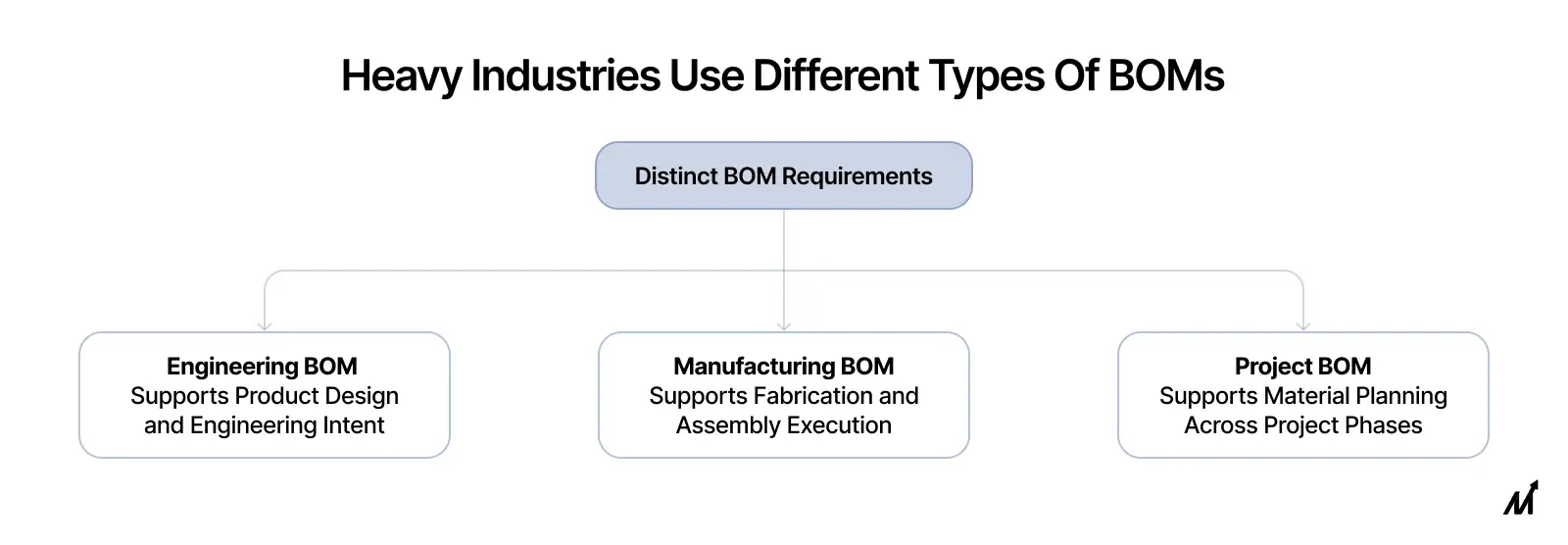
Different BOM types, such as Engineering BOM, Manufacturing BOM, and Project BOM, help separate concerns and align material data with specific job functions. Understanding these distinctions enables better planning, fewer errors, and smoother handoffs between teams.
In the next sections, we will break down each BOM type and show how they fit into the broader heavy industry workflow.
Types of BOM
Heavy industries use multiple types of Bill of Materials (BOM) structures, each tailored to specific stages of design, manufacturing, and project execution.
Engineering Bill of Materials (EBOM)
An Engineering Bill of Materials represents a product as it is designed. It is typically generated from CAD models, 2D engineering drawings, or PLM systems and reflects the structure defined by the engineering team.
In heavy industries such as industrial equipment, energy systems, aerospace, and infrastructure projects, the EBOM captures design intent. It includes:
- Assembly structure and component hierarchy
- Part numbers and revision levels
- Material specifications
- Dimensions and technical annotations
The EBOM answers one key question:
What components are required according to the design?
Because EBOMs are often derived from engineering drawings and CAD files, accuracy depends heavily on how well design data is structured and transferred into downstream systems. In complex projects with thousands of components, manual extraction from drawings or spreadsheets increases the risk of omissions, duplication, and version mismatches.
While the EBOM is essential during design and validation, it typically requires restructuring before production or project execution begins.
Manufacturing Bill of Materials (MBOM)
A Manufacturing Bill of Materials represents a product as it will be built. While the EBOM reflects design intent, the MBOM restructures that information to support fabrication, assembly, and production workflows.
In heavy industries, including industrial equipment manufacturing, modular construction, aerospace fabrication, and energy systems, the MBOM aligns material data with how components are actually sourced, assembled, and delivered. It typically includes:
- Production-ready part numbers
- Assembly sequences
- Fabrication groupings
- Hardware and consumables
- Packaging or handling components
The MBOM answers a different question:
How will this product be manufactured or assembled?
One of the most critical steps in heavy-industry operations is the transformation from EBOM to MBOM. During this process, design-based structures are reorganized to reflect shop-floor realities, supplier constraints, and scheduling requirements.
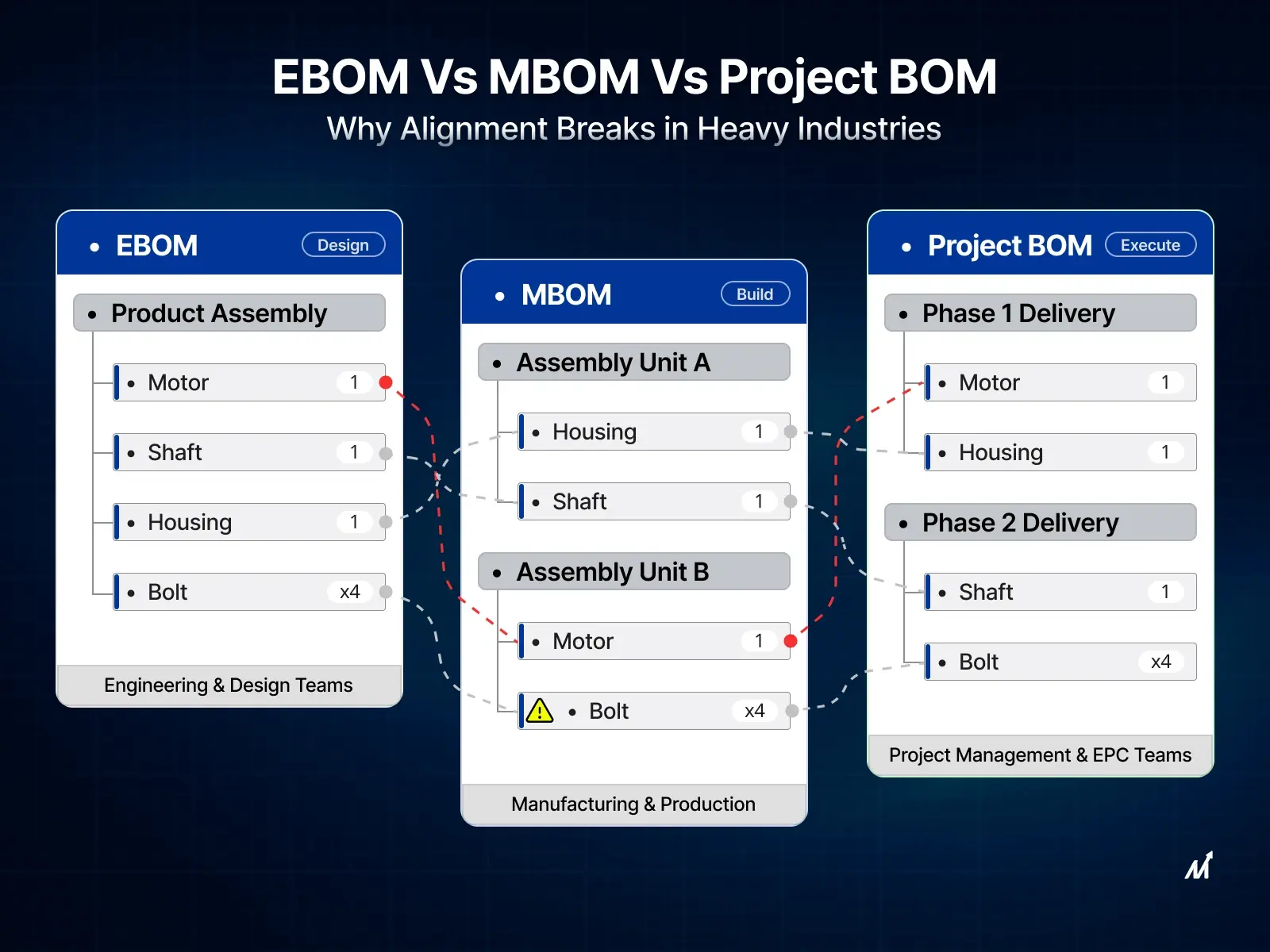
Misalignment between EBOM and MBOM is a common source of delays. Differences in structure, missing components, or outdated revisions can impact procurement, material planning, and production timelines. In large-scale projects, even minor discrepancies can create cascading operational issues.
This is why maintaining synchronization between engineering and manufacturing BOMs is essential for efficiency and cost control.
Project Bill of Materials (Project BOM)
A Project Bill of Materials is structured around the execution of large-scale projects rather than a single product assembly. It is commonly used in construction, EPC (engineering, procurement, and construction), infrastructure development, energy plants, and industrial installations.
Unlike EBOMs and MBOMs, which focus on product structure, the Project BOM organizes materials based on project phases, site requirements, and delivery schedules. It typically supports:
- Phase-based material allocation
- Contractor and supplier coordination
- Bulk material planning
- On-site installation sequencing
- Budget tracking and cost control
The Project BOM answers a different operational question:
What materials are required for each stage of the project, and when?
In heavy industries, projects often involve multiple vendors, subcontractors, and geographically distributed teams. Without a clearly structured Project BOM, coordination challenges can lead to material shortages, duplication of orders, or delays in site execution.
Version control is particularly critical. Design changes, scope adjustments, and engineering revisions must be reflected accurately to prevent procurement errors and scheduling conflicts.
Because many Project BOMs rely on data extracted from engineering drawings and documentation, maintaining consistency across systems is essential for keeping large-scale projects on track.
Process Bill of Materials (PBOM)
A Process Bill of Materials connects materials to the operational steps required to produce or deliver a product. Instead of focusing only on what components are needed, it defines how they move through manufacturing or processing workflows.
PBOMs are commonly used in heavy industries such as oil & gas, chemicals, energy generation, and complex industrial manufacturing, where routing, compliance, and operational sequencing are critical.
A PBOM typically supports:
- Production routing and work centers
- Operational steps and task sequences
- Compliance and regulatory documentation
- Resource allocation and equipment usage
The PBOM answers a different operational question:
What process steps are required, and which materials are consumed at each stage?
In asset-heavy industries, inaccurate process mapping can result in inefficiencies, compliance risks, or increased operational costs. Maintaining alignment between engineering intent, manufacturing structure, and process execution is essential for performance and traceability.
Other Types of BOM (Brief Overview)
Configurable BOM (CBOM)
It is used when products have multiple variants or customization options. Common in industrial equipment, defense systems, and large machinery, where modular configurations must be managed without duplicating full BOM structures.
Service BOM
It focuses on spare parts, maintenance components, and lifecycle support. It is critical in asset-heavy industries where uptime, field service, and aftermarket operations drive long-term profitability.
EBOM vs MBOM vs Project BOM: Differences in Types of BOM for Heavy Industries
While all three structures define product-related information, they serve very different purposes across the lifecycle of heavy-industry projects.
1. Purpose & Lifecycle Stage
- EBOM supports product design and engineering intent.
- MBOM supports fabrication and assembly execution.
- Project BOM supports material planning across large-scale project phases.
Each BOM becomes relevant at different operational stages — from design to production to on-site execution.
2. Stakeholders Involved
| BOM Type | Primary Owners | Key Users |
| EBOM | Engineering & Design Teams | Product Development, Quality |
| MBOM | Manufacturing & Production | Procurement, Planning, Operations |
| Project BOM | Project Management & EPC Teams | Procurement, Site Teams, Finance |
In heavy industries, misalignment often occurs because different teams own different BOM views.
3. Structural Differences
- EBOM is structured around product hierarchy and CAD assemblies.
- MBOM reorganizes components based on manufacturing sequence and fabrication groups.
- Project BOM structures materials by project phase, delivery schedule, or work package.
Even when referencing the same components, the structure and grouping logic differ significantly.
4. Where Mismatches Typically Occur
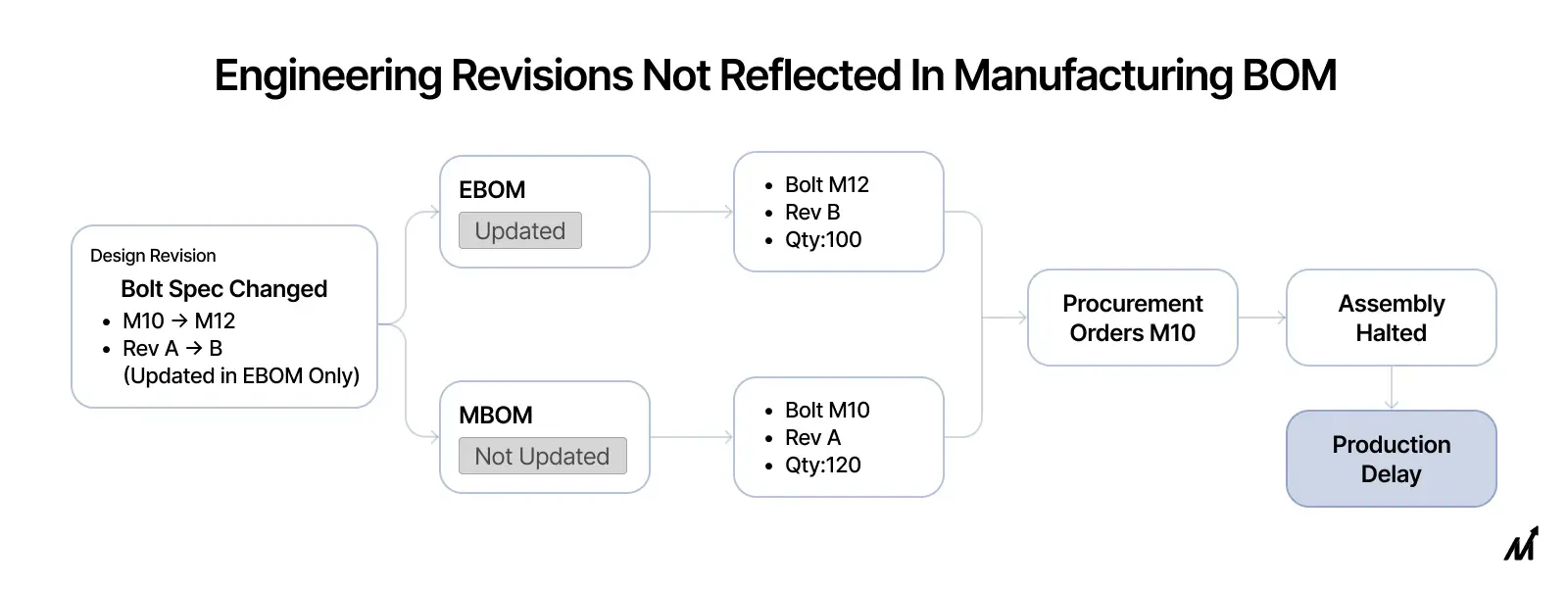
In complex heavy-industry environments, discrepancies commonly arise during:
- EBOM to MBOM transformation
- Design revisions not reflected in procurement data
- Manual extraction of components from drawings
- Phase-level updates are not synced across project systems
These mismatches can lead to material shortages, duplicate orders, rework, or schedule delays, especially in large, multi-vendor projects.
Types of BOM: Common BOM Challenges in Heavy Industries
In heavy industries such as construction, energy, aerospace, and industrial manufacturing, BOM complexity increases rapidly due to large assemblies, multi-tier suppliers, and continuous design revisions.
Below are the most common challenges organizations face:
1. Manual Data Extraction from Drawings
Many BOMs are still created or validated by manually reviewing engineering drawings and PDFs. This process is time-consuming and prone to:
- Missed components
- Incorrect quantities
- Inconsistent naming conventions
- Revision mismatches
In large-scale projects, even small errors can cascade into procurement delays and cost overruns.
2. EBOM to MBOM Misalignment
Engineering structures do not always translate cleanly into manufacturing workflows. Without clear synchronization:
- Procurement may order outdated parts
- Production may follow incorrect assembly sequences
- Rework increases due to late-stage discovery
This gap between design and execution is one of the biggest hidden cost drivers in heavy-industry operations.
3. Version Control Across Systems
Heavy-industry projects often span:
- CAD systems
- ERP platforms
- PLM tools
- Project management software
When revisions are not reflected consistently across systems, BOM accuracy suffers. In multi-vendor environments, this risk multiplies.
4. Lack of Visibility in Large-Scale Projects
Project BOMs in EPC and infrastructure environments must align with:
- Procurement timelines
- Site-level scheduling
- Contractor deliverables
If material planning is disconnected from updated engineering drawings, teams face material shortages, duplication, or on-site delays.
5. Limited Automation in Blueprint Interpretation
Despite advances in ERP and PLM systems, blueprint interpretation often remains manual. Extracting components, quantities, and references from technical drawings requires significant engineering time.
As project volume increases, manual review becomes a scalability bottleneck.
Curious how AI improves blueprint interpretation? Read our blog for detailed information!
Strategic Implication for Heavy Industries
Accurate BOM structures depend on a reliable interpretation of engineering documentation. When drawing data is incomplete, outdated, or manually transcribed, downstream systems inherit those errors.
Improving BOM accuracy, therefore, begins at the source — the engineering drawings and blueprints that define the project. Let’s further read how AI helps.
How AI Improves BOM Accuracy in Heavy Industries — and Markovate’s Impact
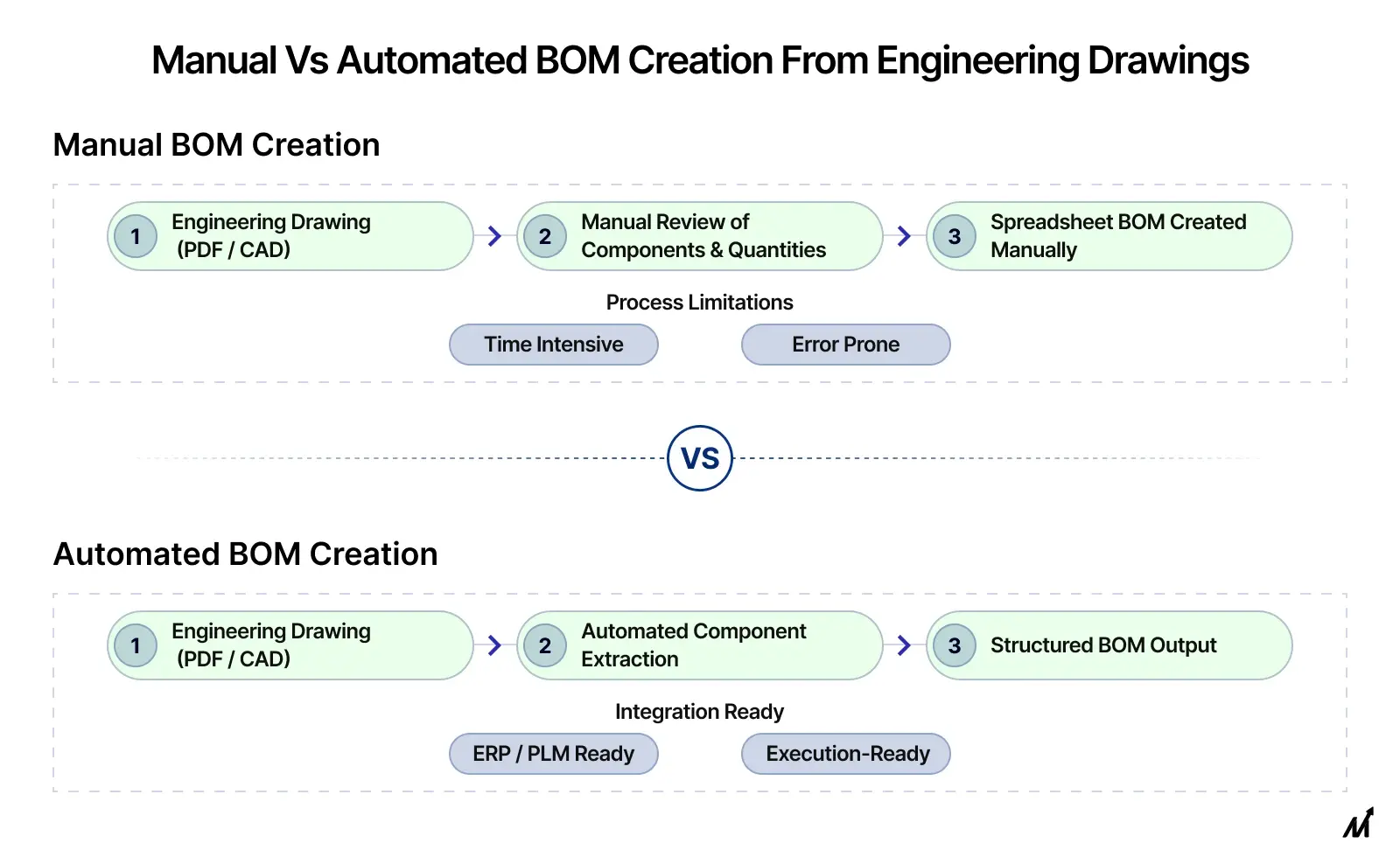
As discussed, in heavy-industry workflows, the biggest BOM challenges aren’t just structural; they stem from how engineering data is extracted, interpreted, and handed off between teams. Traditional methods rely on manual review of drawings, spreadsheets, and disconnected systems. This not only introduces errors but also slows down production planning, procurement, and execution.
AI changes this by shifting BOM creation upstream, right at the source of engineering intent.
Real-World Impact of AI-Driven Blueprint Interpretation
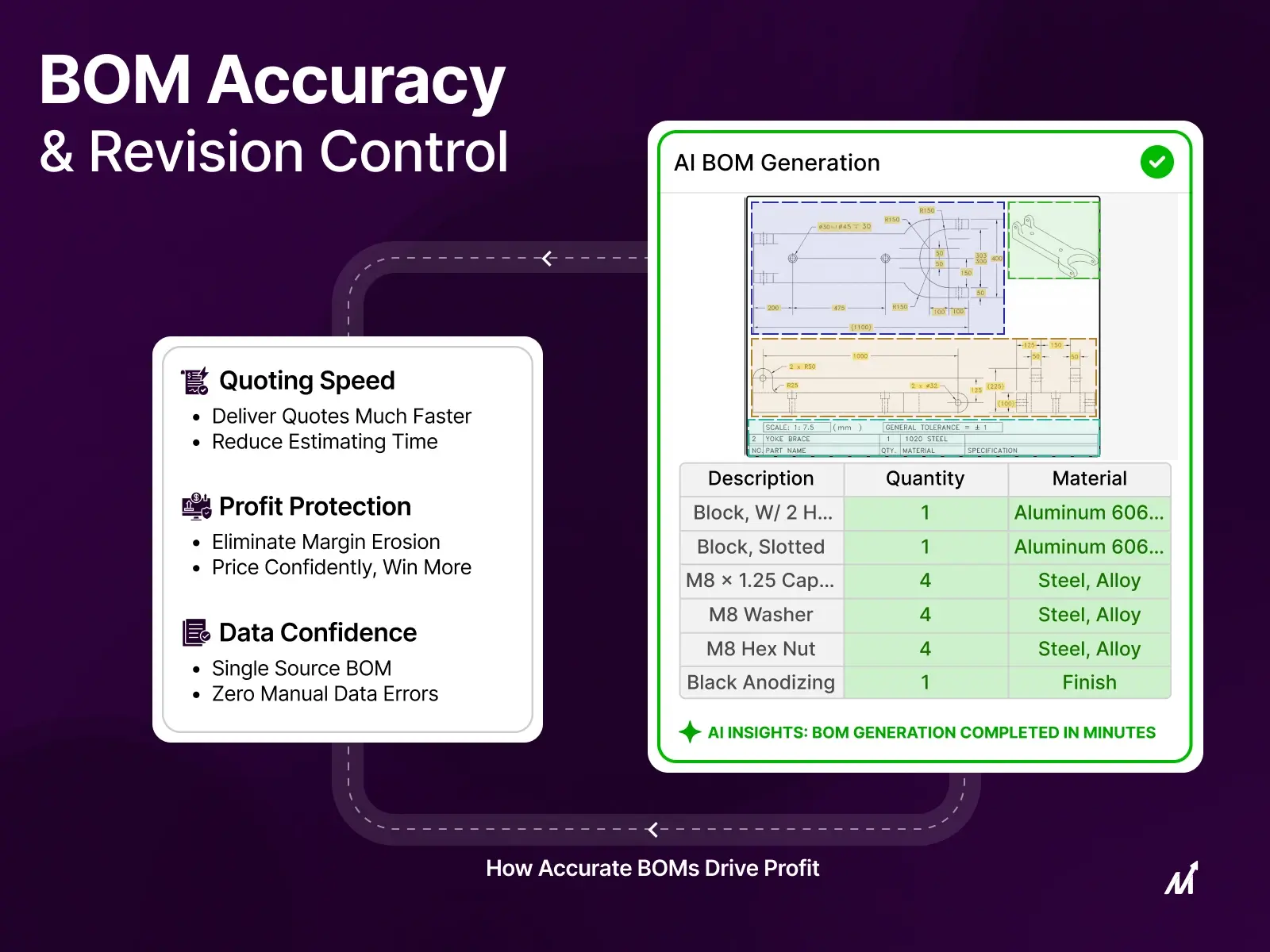
AI-based blueprint analysis systems now automatically identify components, dimensions, and annotations from complex CAD files and technical drawings — eliminating much of the guesswork that happens when this work is done manually. Rather than spending hours finding parts and quantities, teams get structured, validated outputs in minutes.
That’s where Markovate’s proprietary solution stands out.
Markovate’s AI Blueprint Classifier — Structured Data, Faster Decisions
Markovate’s AI Blueprint Classifier is designed to automate the toughest step in BOM workflows: interpreting engineering drawings at scale. Instead of relying on manual extraction or rule-based automation, it applies machine learning and pattern recognition to capture:
- Part identifiers, materials, and quantities
- GD&T callouts and critical dimensions
- Annotations and compliance checks
- Component hierarchies needed for EBOM and MBOM generation
This is especially powerful in heavy industries where drawings may be legacy, heavily annotated, or span multiple revisions.
What Heavy-Industry Teams Are Saying
Companies that have adopted Markovate’s AI Blueprint Classifier report dramatic improvements in BOM accuracy and operational efficiency:
“Markovate’s AI Blueprint Classifier helped us significantly accelerate our cost and timeline estimations. The automation and accuracy it brought to our blueprint analysis have been a major value-add to our pre-production process.”
— a US-based manufacturer producing hundreds of millions of precision parts annually
Noted measurable results are:
- Up to 80% reduction in manual marking errors
- 30% faster plan and BOM reviews
- 15% reduction in labor costs compared to traditional processes
These outcomes reflect real operational pain points, from manual BOM extraction to late design revisions, and show how automating blueprint analysis can free teams to focus on execution, not data wrangling.
A Solution Built for Heavy Industry Complexity
Unlike generic OCR or rule-based automation tools, the Drawing Intelligence Platform is purpose-built for engineering and manufacturing contexts. It:
- Handles multiple file formats (DWG, DXF, PDF, scanned blueprints)
- Interprets GD&T and standards-based annotations
- Produces structured BOM outputs ready for ERP, PLM, or costing tools
- Reduces the need for redundant manual validation
For heavy-industry teams managing complex projects with thousands of parts, this capability isn’t just a convenience; it’s a force multiplier that improves visibility, reduces rework, and accelerates planning cycles.
Driving Cross-Team Alignment
By extracting accurate component data early in the workflow, Markovate’s solution helps ensure that:
- Engineering intent flows cleanly into procurement
- MBOMs are aligned with production expectations
- Project teams avoid costly material mismatches
- BOM revision changes propagate correctly across systems
This alignment reduces risk, improves schedule reliability, and supports more predictable outcomes, critical in large-scale engineering and construction environments.
Conclusion: Types of BOM
In heavy industries, BOM errors are rarely isolated issues. They usually originate from manual blueprint interpretation, disconnected systems, and misalignment between engineering and execution teams.
Understanding EBOM, MBOM, Project BOM, and other types of BOM structures is important. But real efficiency comes from ensuring that engineering data is accurately and correctly extracted from the start.
As projects grow more complex, manual BOM workflows become harder to scale. AI-driven blueprint interpretation offers a practical way to reduce errors, improve coordination, and support more predictable project outcomes.
For heavy-industry organizations operating at scale, improving BOM accuracy is no longer optional — it’s operationally critical.
Ready to Modernize Your BOM Workflows?
If your team is still manually extracting components from drawings or reconciling BOM discrepancies across systems, it may be time to evaluate a more scalable approach.
Markovate’s AI Blueprint Classifier helps heavy-industry organizations automate blueprint interpretation, generate structured BOM data, and improve alignment across engineering, procurement, and production.
Learn how AI-driven blueprint analysis can support accurate, scalable BOM management. Explore our solution here or contact us for more details!
FAQs: Types of BOM
1. What is the difference between EBOM and MBOM?
An EBOM (Engineering BOM) reflects how a product is designed, whereas an MBOM (Manufacturing BOM) reflects how it will be built. In other words, the EBOM is design-focused, while the MBOM is production-focused.
2. Why do BOM errors happen in heavy industries?
In many cases, BOM errors occur due to manual data extraction from drawings, revision mismatches, disconnected systems, and misalignment between engineering and manufacturing teams. As a result, even small discrepancies can escalate into costly production delays.
3. How does AI improve BOM accuracy?
AI can automatically extract component data, quantities, and specifications from engineering drawings. This reduces manual errors and improves consistency across teams.
4. Why is BOM accuracy important in large projects?
In large-scale projects, even small BOM mistakes can lead to material shortages, procurement delays, rework, and cost overruns. Accurate BOMs help ensure smoother coordination and predictable outcomes.