

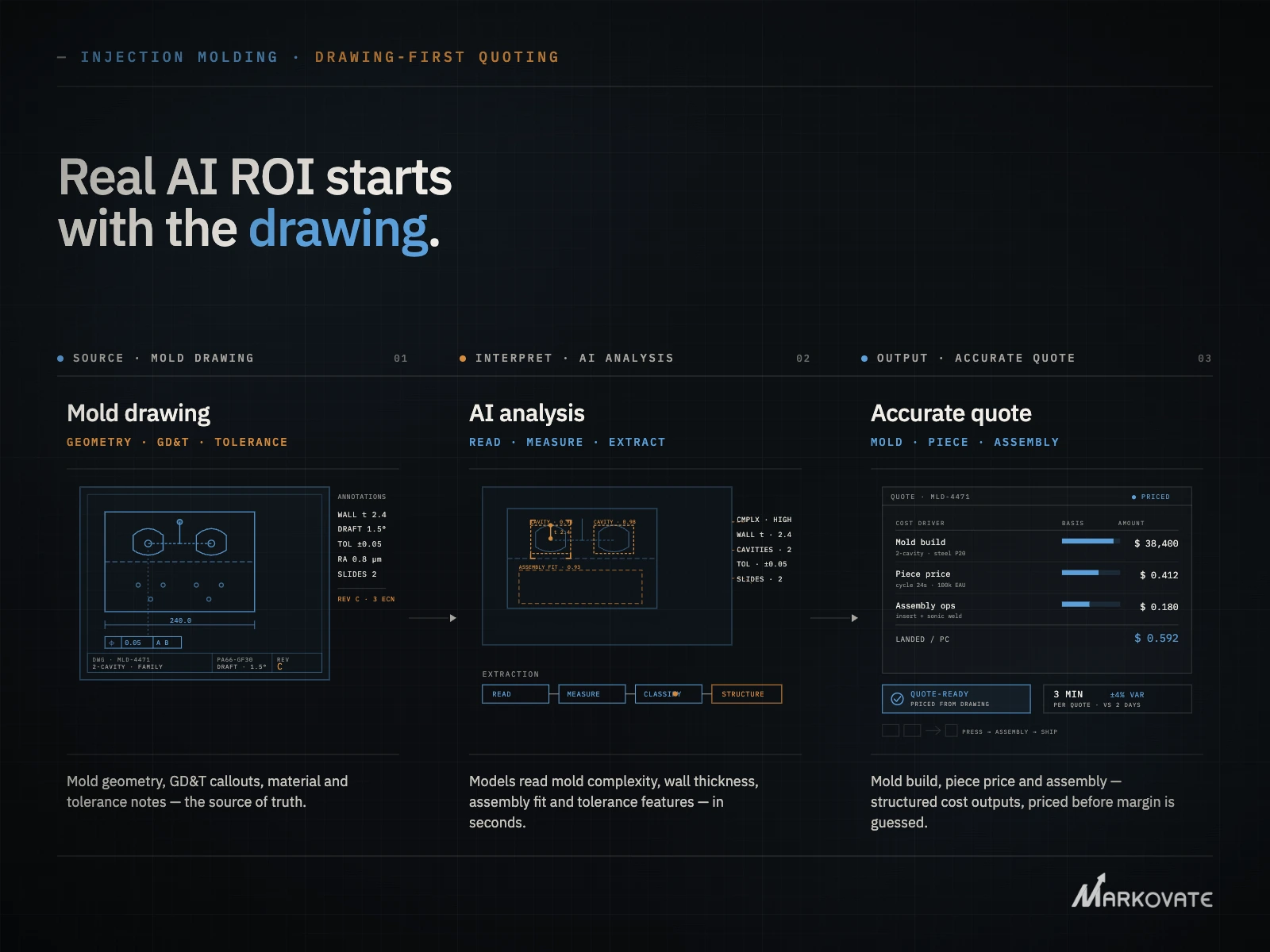
A precision injection molding operation with global reach recently described its quoting challenge plainly. They needed to expedite the quoting of injection-molded parts from data. That meant compiling pricing for assembly operations, mold builds, and piece price — all based on machine rates, labor rates, and purchased components. Not one of those three. All three, simultaneously, from the same drawing package.
That’s the injection molding quoting problem in a single sentence. It’s not one cost component that’s hard to price. It’s three interconnected ones. Each depends on what the drawing actually shows. Each affects the others. And each carries its own interpretation risk when the drawing gets misread.
Most AI quoting tools handle one of those components reasonably well. The shops that see real ROI handle all three, and get the drawing read correctly before any of them are priced.
Why Injection Molding Quotes Are Uniquely Difficult to Get Right
Injection molding is not a single-operation manufacturing process. A complete job touches mold design and build, material selection, machine selection, cycle time optimization, secondary operations, and final assembly. Each of those decisions influences cost. All of them trace back to the mold drawing.
What makes this vertical uniquely consequential is timing. Most errors surface only after the mold is already cut. In machining, a misquoted part creates a margin problem on that job. In injection molding, a misquoted job means tooling is already committed before the gap between the quote and reality becomes visible. At that point, correction isn’t a line item adjustment. It’s a tooling rework, a production delay, and a supplier conversation about who absorbs the cost.
The drawing determines that cost. Read it correctly, and the quote reflects what the job actually requires. Misread it, and the cost model is wrong before anyone opens a pricing template.
The Three Cost Components Estimators Consistently Misprice
Injection molding cost estimation isn’t a single calculation. It’s three parallel cost models- mold build, piece price, and assembly operations- running simultaneously. A misread drawing compounds the error at every level.
1. Mold build cost
The mold carries the highest upfront cost in any injection molding job. The drawing geometry drives every input. Cavity count, parting line location, cooling circuit design, side actions, lifters, and steel grade selection- all of it comes from the drawing. When an estimator misreads those requirements, or when an extraction tool transcribes a parts list that doesn’t reflect the current revision, the mold build cost is wrong before the first supplier gets contacted. Mold build is a committed cost, not a variable one. That error doesn’t average out across production volume. It sits on the job.
2. Piece price
Cycle time comes from wall thickness, cooling channel design, and gate location. Material cost follows from resin grade and shot weight. Machine rate follows from tonnage, which the projected area and injection pressure in the drawing determine. None of these inputs stand alone. Each connects to the others. An estimator working from an outdated or misread drawing prices a different part than the one that will actually run on the floor.
3. Assembly operations
Assembly pricing disappears most often from injection molding quotes. Insert molding requirements, overmolding steps, secondary finishing operations, and inspection requirements all add cost. None of them appear prominently in a standard parts list. When a quoting tool reads the parts list rather than the drawing geometry, these operations get omitted. The quote goes out without them. They show up as unplanned costs when the job runs.
Learn more about how engineering BOM errors start at the drawing read and compound through every downstream cost component.
Where the Drawing Read Breaks the Cost Model
The injection molding quoting failure most estimators experience isn’t a calculation error. It’s an interpretation error, and it happens before any numbers are entered.
Three things go wrong at the drawing stage more than anywhere else.
1. Tolerance requirements that don’t enter the cost model
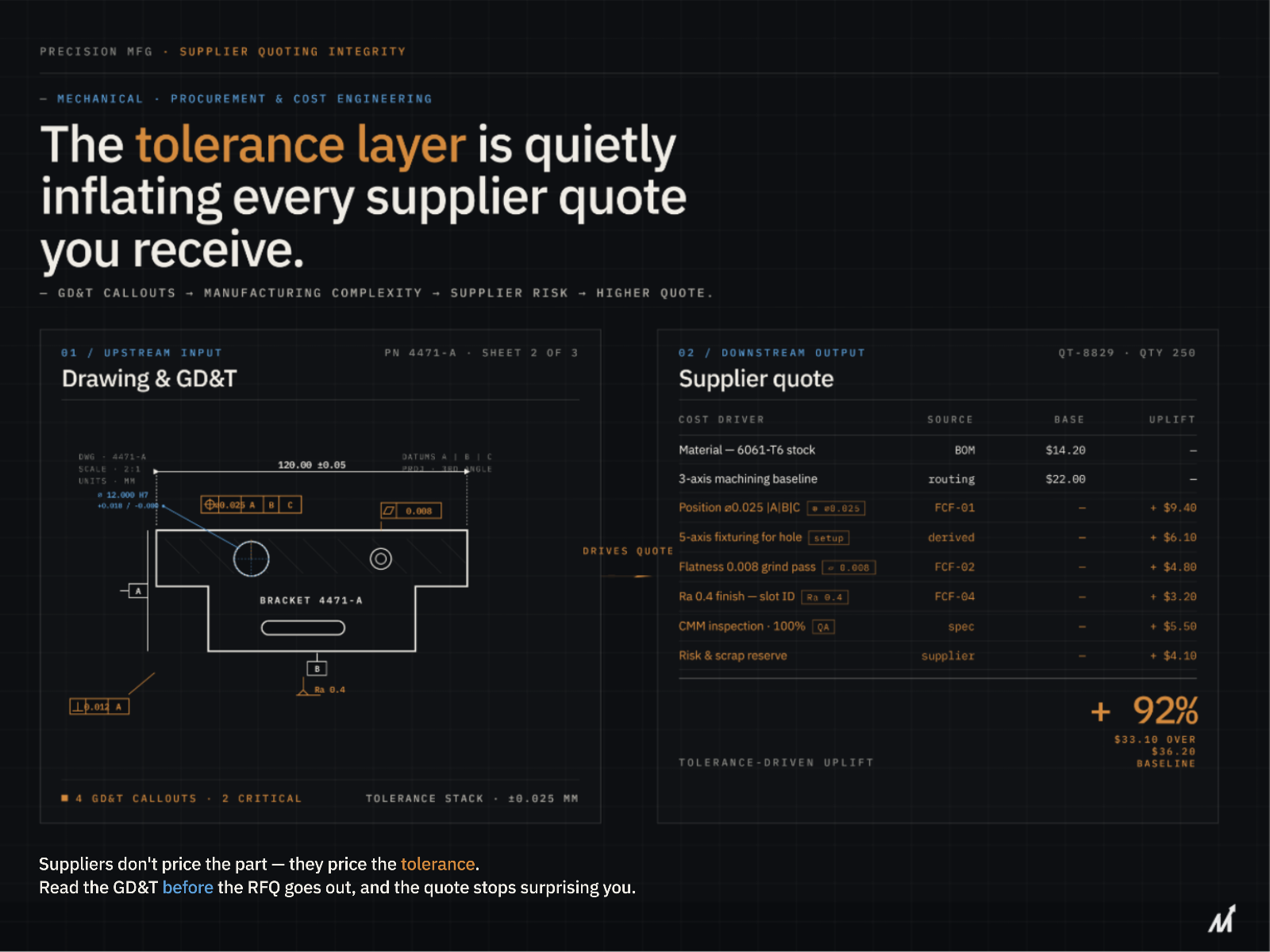
A drawing with tight tolerances on a critical mating feature carries a different cost model than one governed by general block tolerances. The part geometry may look identical. The manufacturing process and the price are not. Additional process control, slower cycle times, higher reject allowances, and more rigorous inspection all add to piece price. When an estimator reads GD&T callouts as annotations rather than cost drivers, the piece price doesn’t reflect the actual process requirement. The supplier invoices for the drawing. The quote reflects something simpler.
For a closer look at how GD&T callouts affect supplier pricing directly, see our post on what GD&T callouts are costing you in supplier quotes.
2. Revision mismatches between the drawing and the parts list
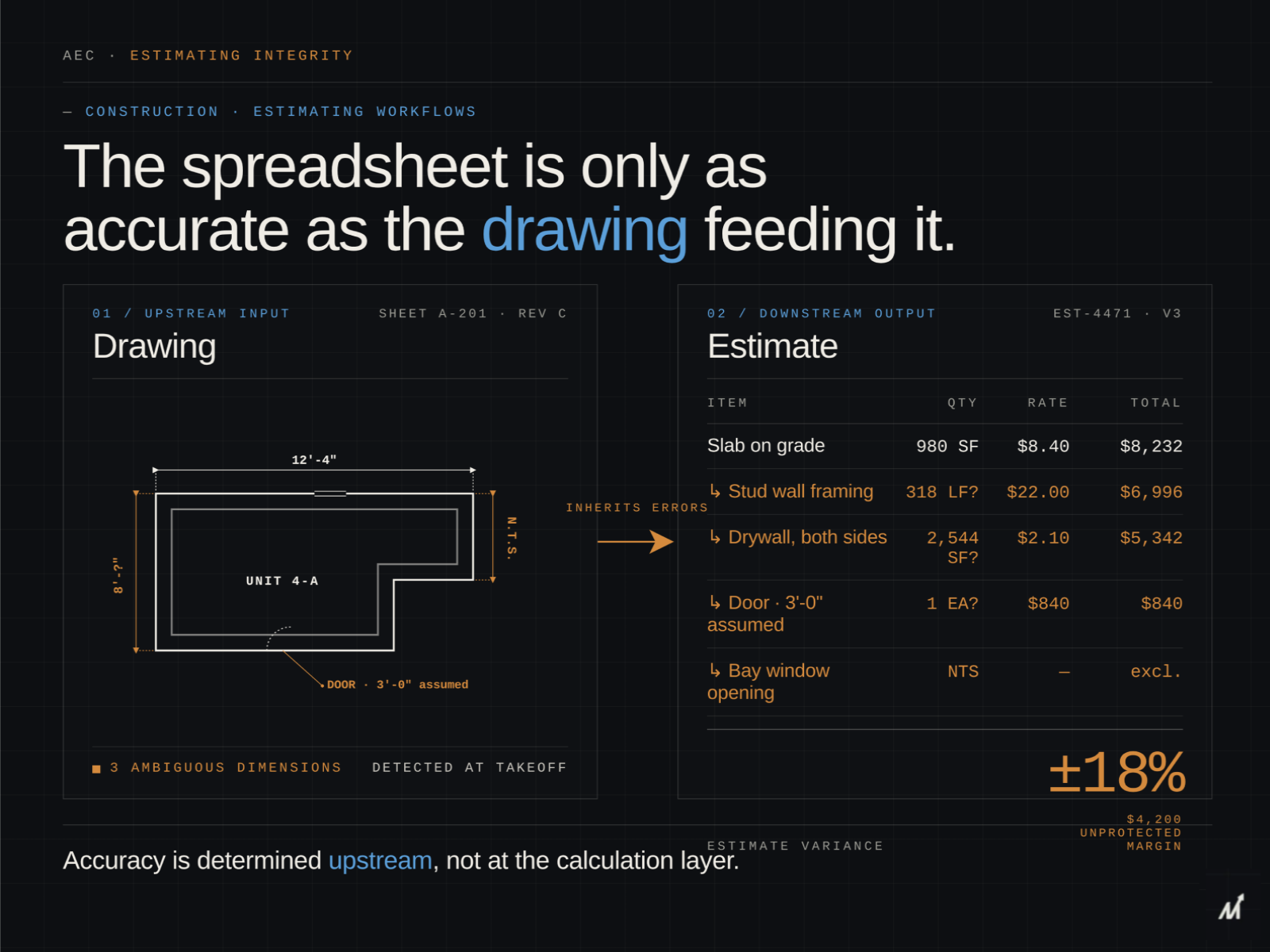
Injection mold drawings go through multiple revision cycles during design validation and tooling qualification. The mold geometry changes. The parts list, manually maintained, doesn’t always keep up. By the time a drawing reaches an estimator, the parts list may reflect a cavity count, wall thickness, or gate location from two revisions ago. The extraction tool reads the table. The table is wrong. The quote builds on outdated geometry.
Read more on how BOM discrepancies from revision mismatches create downstream production problems that cost far more to fix than the original quoting error.
3. Multi-component assemblies read as individual parts
A complex injection molded assembly — housing, insert, overmold, secondary component — requires the complete drawing set to be read as a connected assembly. When an estimator reads each sheet in isolation, the relationship between components gets missed. An insert that requires a secondary molding step doesn’t get priced. An overmold that affects the base part’s gate location doesn’t get flagged. The estimator doesn’t know the assembly quote is incomplete until it’s too late.
How AI Reads Injection Mold Drawings Differently
Standard AI quoting tools identify features. They detect a hole, map it to a drilling operation, apply a cycle time, and move on. Injection molding cost doesn’t work that way. It comes from the interaction between features, the tolerances that govern them, and the assembly context that surrounds them.
AI that reads drawing geometry rather than parts list tables takes a different approach. It reads the mold drawing as a connected engineering document. Wall thickness gets cross-referenced across the part. Gate location constraints come from the geometry, not assumptions. Tolerance callouts get processed as manufacturing requirements. Assembly operations that appear in the drawing but not in the parts list get surfaced before the quote is built.
The result is a cost model that reflects what the drawing actually specifies — mold build complexity, piece price process requirements, and assembly operations included. Not what a manually maintained table claimed at some point in the revision history.
For a deeper look at how this connects to the broader manufacturing cost estimation process, see our dedicated post.
How AI Blueprint Classifier Powers Accurate Injection Molding Cost Estimation
Injection molding shops handling complex, multi-component assemblies with tight tolerances can’t afford quotes built on drawing misreads. The mold is too expensive. The tooling timeline is too long. The margin gap between what was quoted and what the job actually costs becomes visible only after the PO is signed.
AI Blueprint Classifier, powered by CADIAM™, bridges this gap. The platform reads and understands injection mold drawings. It processes GD&T callouts, multi-component assembly structures, revision data, and material specifications, and transforms them into structured, accurate BOMs that reflect what the drawing actually shows.
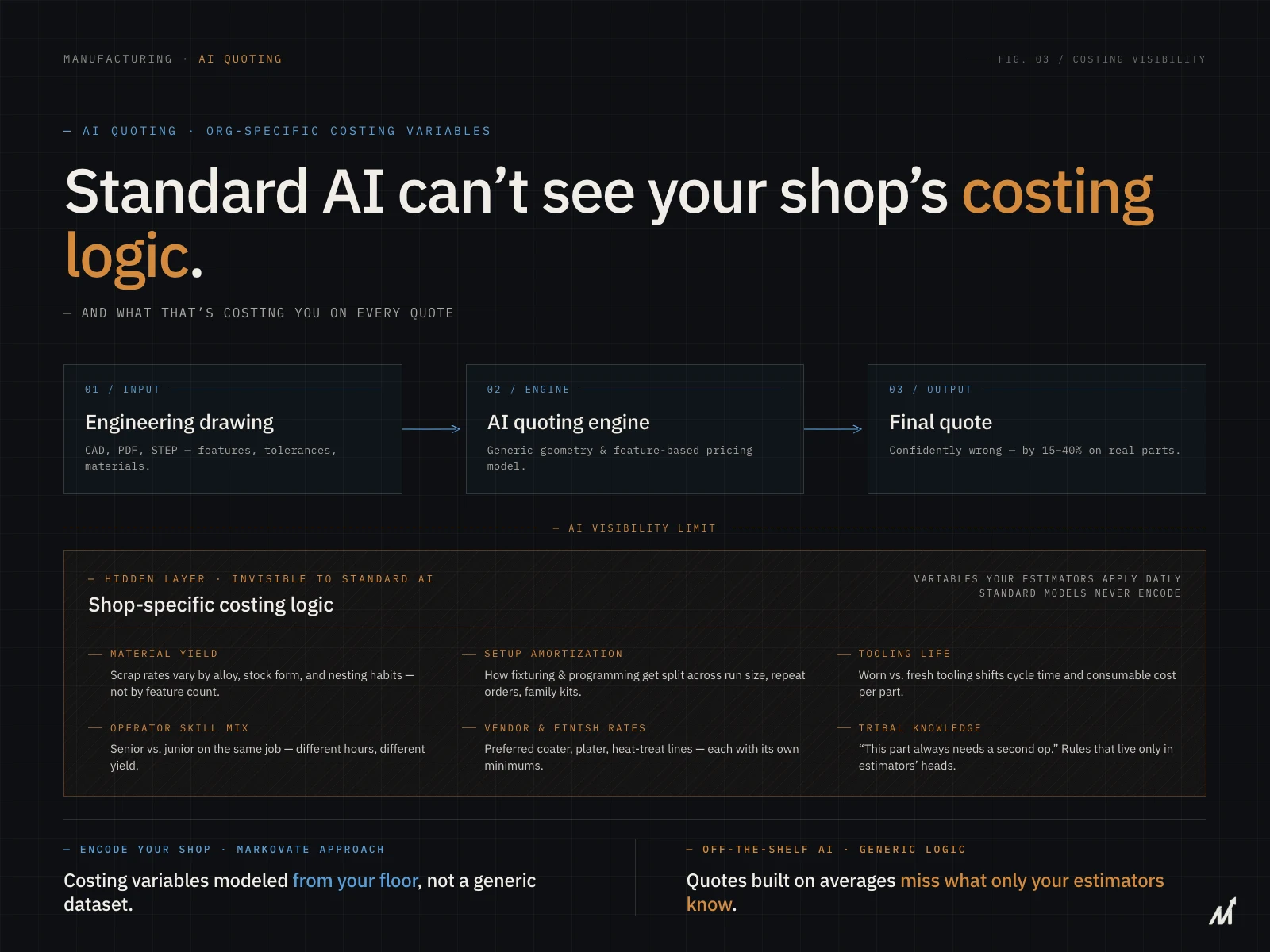
For injection molding operations with org-specific costing logic, machine rates, labor rates, and purchased component pricing, we configure the system around those variables. The output reflects how the shop actually prices work, not how a generic algorithm assumes it does.
As a U.S.-based mid-sized manufacturer producing hundreds of millions of precision parts annually, put it:
“Markovate’s AI Blueprint Classifier helped us significantly accelerate our cost and timeline estimations. The automation and accuracy it brought to blueprint analysis have become a major value-add to our pre-production process.”
If your operation handles complex injection molding packages and your quoting workflow depends on getting mold build, piece price, and assembly operations right from the drawing, schedule a demo to see how AI Blueprint Classifier reads injection mold drawings accurately across mold build, piece price, and assembly operations.
Conclusion: Accurate Injection Molding Cost Estimation Starts With the Drawing
Injection molding shops don’t lose margin because their estimators lack experience. They lose margin because teams misread the drawing before they enter the first number into the cost model.
Fixing that doesn’t start with a better pricing template or a faster algorithm. It starts with a system that reads the mold drawing the way a manufacturing engineer does. One that understands what the geometry requires, what the tolerances cost, and what the assembly operations add — before any of those requirements become line items in a quote.
That’s where ROI in injection molding quoting actually begins. Not in the algorithm. In the drawing.
FAQs: Injection Molding Cost Estimation
1. What makes injection molding cost estimation harder than other manufacturing processes?
Injection molding requires three parallel cost models — mold build, piece price, and assembly operations — that all depend on the same drawing and interact with each other. A misread drawing doesn’t create one error. It creates three, compounding at each cost component. Because teams cut the mold before most errors surface, a quoting mistake in injection molding creates far higher costs than similar errors in most other manufacturing processes.
2. How do GD&T callouts affect the injection molding piece price?
Tight dimensional tolerances require slower cycle times, additional process control, higher reject allowances, and more rigorous inspection — all of which add to piece price. When estimators read GD&T callouts as annotations rather than process requirements, the piece price reflects a simpler part than the drawing specifies. The supplier invoices for the drawing. The quote doesn’t match.
3. Why do quoting teams miss assembly operations in injection molding quotes?
Assembly operations — insert molding, overmolding, secondary finishing, and inspection — rarely appear prominently in standard parts lists. When quoting tools that rely on parts lists instead of drawing geometry, they overlook these operations during cost estimation. As production begins, teams discover the missing costs and absorb the resulting margin loss.
4. What is the difference between mold build cost and piece price in injection molding?
Mold build cost covers the upfront tooling investment required to design and manufacture the mold itself. Piece price covers the per-unit production cost, including machine rate, material, cycle time, and reject allowance for each molded part. Drawing geometry determines both costs. Estimators must price both accurately to protect the margin the quote projects.