

Most BOM errors don’t start where manufacturers think they do — not in the ERP, not in the spreadsheet, and not at data entry. They start the moment an estimator opens a drawing and begins reading it.
But the real problem isn’t where BOM errors are discovered. It’s where they begin.
Most engineering BOM errors don’t originate from bad data entry or miscommunication between teams. They originate earlier, in how an engineering drawing was read before the first line item was typed. By the time an estimator opens a spreadsheet, the error is already built into their starting point.
That’s the upstream failure that drives margin erosion across contract manufacturing, job shops, and engineer-to-order operations, and it’s the one that automation has historically failed to address.
Engineering BOM Errors Are a Quoting Problem, Not Just a Data Problem
Most manufacturers treat engineering BOM errors as a data management issue — something to fix with better revision control, tighter PLM discipline, or more careful manual review. These are real improvements. But they address the wrong stage.
The BOM enters the quoting workflow through a drawing. An estimator reads the drawing, interprets the parts list, identifies features and tolerances, and builds a cost model from what they see. Every assumption made during that reading, which revision is current, what the parts list reflects, and how GD&T callouts affect machining, becomes the foundation of the quote.
Material cost typically represents 40 to 60 percent of total job cost in manufacturing. If the BOM is wrong, the majority of your quote is wrong, and in a job shop environment where every job has a unique BOM, there is no volume to amortize the error across. One bad BOM on one job hits your margin directly.
When that foundation is wrong, no downstream data management process catches it. The BOM looks complete. The quote looks structured. The error only surfaces when production begins, and reality doesn’t match what was priced.
Read more about how BOM accuracy drives profitable manufacturing quotes.
The Real Cost of Getting It Wrong: What BOM Errors Actually Cost Manufacturers
Engineering BOM errors are not abstract risks. They carry specific, measurable price tags that appear at different points in the production lifecycle.
For example, a decimal point error in a BOM transfer — 15mm steel plates ordered instead of 1.5mm — can result in $23,000 in unusable materials, two weeks of production delay, and rush orders at premium prices to recover the schedule.
A revision control failure that sends a medical device production floor working from outdated specifications for three days can generate $45,000 in rework costs and 80 hours of quality control review. A quote turnaround delay caused by manual BOM preparation, while a competitor using integrated systems responds in hours, can cost a $500,000 contract outright.
These are not worst-case scenarios. They are documented outcomes from manufacturers who relied on manual drawing interpretation at the quoting stage.
The underlying dynamic is consistent: approximately 70 percent of product cost is determined during the early development and quoting stages. Errors introduced at this point compound in cost at every stage that follows. An error caught at the drawing review stage costs minutes. The same error caught at procurement costs a change order. Caught at production, it costs rework, scrapped material, and schedule disruption. Caught post-delivery, it costs the customer relationship.
Understanding where engineering BOM errors originate is the first step to stopping them before they reach any of those stages.
BOM Extraction vs BOM Generation: Why the Difference Matters
There are two fundamentally different approaches to producing a bill of materials from an engineering drawing. Understanding the gap between them explains where most engineering BOM errors come from.
BOM Extraction
BOM extraction reads what is already written on the drawing, the title block, the parts list table, the ballooned callouts, and transcribes it into a structured format. Most tools on the market, including many that describe themselves as AI-powered, operate this way. The output is a cleaner version of whatever existed on the page.
BOM Generation
BOM generation reads the drawing’s geometry, the shape data, feature relationships, GD&T callouts, and assembly structure across all sheets, and derives what the BOM should contain from the drawing’s actual engineering intent. The output is not a transcription of a manually maintained table. It is an interpretation of what the part requires.
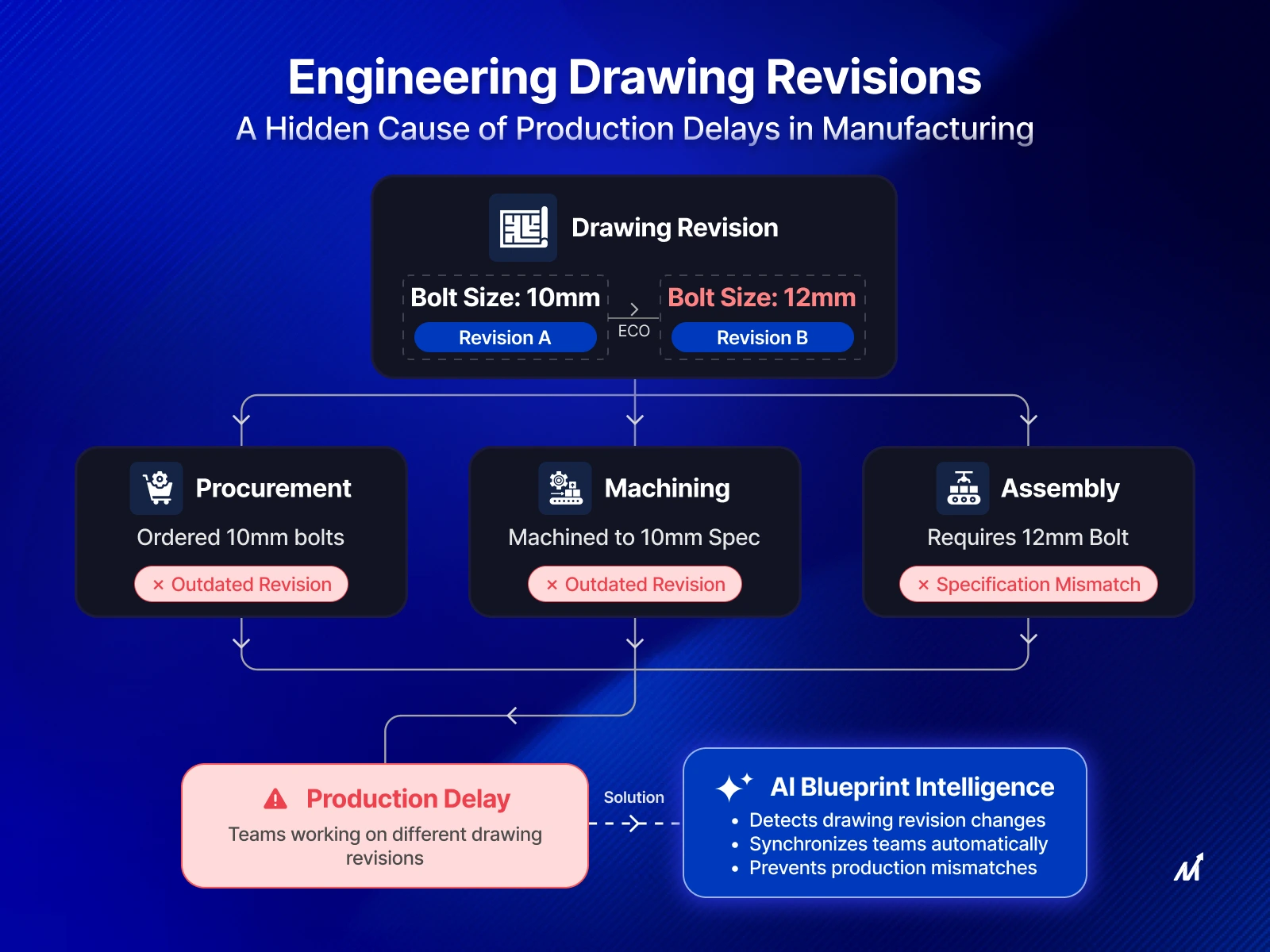
The distinction matters because drawings are frequently inconsistent with themselves. Parts list tables in 2D drawings are maintained manually. When a designer updates the geometry, updating the table is a separate step, one that gets skipped under deadline pressure. The drawing ships with Rev B geometry and a Rev A parts list. An extraction-based tool reads the Rev A table and produces a Rev A BOM. The estimator quotes the wrong version.
It is also worth noting that CAD system output is not automatically a reliable engineering BOM. CAD exports often include modeling artifacts, omit non-modeled items such as adhesives, fasteners, and consumables, and do not reflect supplier or manufacturing realities. Treating CAD output as a finished EBOM introduces its own category of engineering BOM errors — items that exist in the geometry but were never modeled, and items that were modeled but have no production equivalent.
A generation-based approach reads what the drawing actually shows — not what someone typed into a table during a previous revision cycle. That difference determines whether the BOM that enters your quoting workflow reflects today’s design intent or an outdated snapshot of it.
Learn how AI-powered blueprint interpretation compares to traditional automation.
The Places Engineering BOM Errors Actually Originate
Once you understand the extraction vs generation gap, the three most common sources of engineering BOM errors become predictable.
1. The parts list was not updated with the latest revision
This is the single most frequent root cause. A drawing goes through multiple engineering change cycles. The geometry is updated each time. The manually maintained parts list is updated inconsistently. By the time the drawing reaches an estimator, the parts list may be one, two, or three revisions behind the geometry.
Revision confusion is one of the most consistently cited causes of BOM failures across manufacturing operations. When revision history is tracked across spreadsheets, shared folders, and loosely named files — “v3,” “final,” “final-final,” “revB-updated” — there is no reliable way to confirm which version is current. Estimators under RFQ pressure default to the most recently accessed file, not necessarily the most recently approved one.
An extraction-based approach reads the table and reports what it says. A generation-based approach compares the table to the geometry and flags the mismatch. Most manufacturing operations have no process to catch this gap before quoting begins. The estimator trusts the table because there is no visible signal that it is wrong.
2. Small components are systematically omitted
This is the category of BOM error that accumulates invisibly. Consumables — cutting fluid, welding gas, thread-locking compound, sandpaper — are used on virtually every job but rarely appear in manually built BOMs. Fasteners, washers, seals, and O-rings get listed as “hardware” without specific quantities. Packaging materials, secondary brackets, and process-specific items are overlooked during early estimation because they are not prominent in the drawing and require domain knowledge to identify.
These omissions do not look like errors in the BOM. The BOM appears complete because nobody knows what is missing. The gap only surfaces during kitting and procurement, when the missing items are ordered on expedite at premium rates and absorbed as unplanned cost. Over time, especially in high-volume quoting, these small misses keep eating into profits on jobs that originally looked profitable.
3. Multi-sheet drawing sets are not read as a complete assembly
Complex machined assemblies and fabricated structures routinely span 10 to 20 drawing sheets. Each sheet covers a subcomponent, a detail view, or an assembly sequence. The BOM only makes sense when all sheets are cross-referenced as a connected set.
Most extraction tools process sheets individually. They surface what appears on each page. They do not detect when the same part number carries different material specifications on sheet 4 versus sheet 14, or when a subassembly referenced on sheet 8 references a fastener that appears nowhere in the parts list. These cross-sheet inconsistencies are invisible to single-sheet extraction and entirely routine in multi-component drawing packages.
You can read more about how BOM discrepancies drive costly change orders and how to prevent them upstream.
4. GD&T callouts are treated as annotations rather than cost drivers
This is where the most margin is lost. GD&T tolerances determine how a part must be manufactured — what equipment is required, what inspection process applies, and what a supplier will charge.
A flatness callout of 0.005mm on a large mating surface requires surface grinding, not standard milling. A true position tolerance of ±0.01mm at maximum material condition requires CMM inspection on every unit produced. Tightening a tolerance from ±0.005″ to ±0.001″ can double the production cost of a precision feature.
Missing tolerance data and vague material specifications in BOM line items create a specific and common failure mode: the quote goes out with general block tolerance assumptions, the supplier quotes to the actual drawing tolerances, and the gap between the two figures becomes the margin loss.
For suppliers receiving RFQ packets that contain incomplete or inconsistent BOM data, the standard response is to price to the worst-case interpretation — protecting their own margin by assuming the tightest requirements apply. This means a BOM that understates tolerance requirements can simultaneously cause the manufacturer to underprice the job and cause suppliers to overprice their component contributions.
When an extraction-based tool reads GD&T callouts as text annotations rather than manufacturing requirements, the cost model is built on a simpler part than the one on the drawing.
For a deeper look at GD&T cost impact, see our post on AI for GD&T interpretation.
How the Cost of a BOM Error Grows at Every Stage
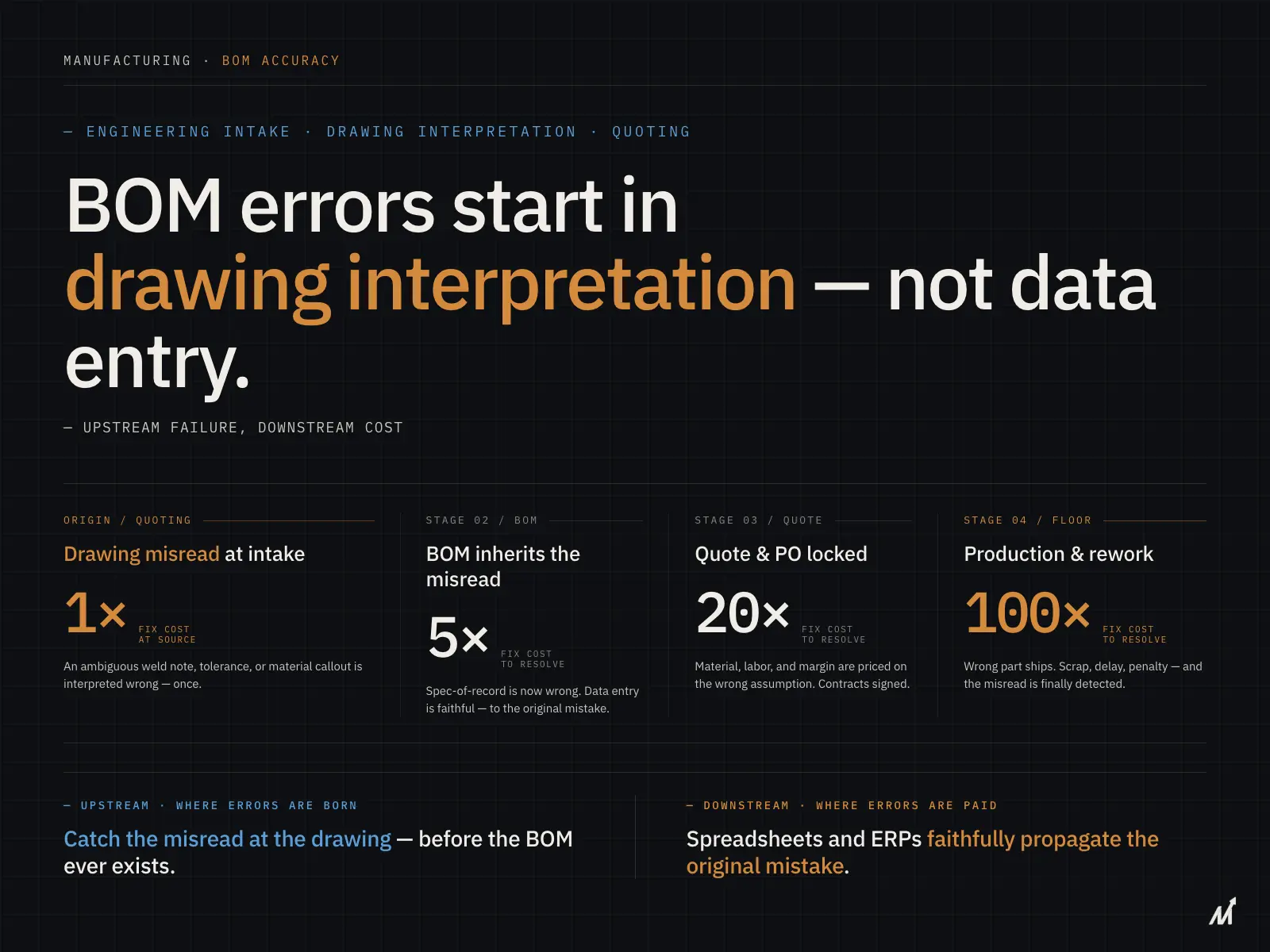
The cost to correct an engineering BOM error is not fixed. It scales with how late in the production cycle the error is discovered, and the relationship is not linear.
At the drawing review stage, correction costs minutes. An estimator or engineer identifies the inconsistency, updates the line item, and the quote reflects the correct specification. No downstream impact.
At the procurement stage, correcting costs involves a change order. A purchase order has been issued based on incorrect specifications. Cancelling or modifying the order involves supplier communication, potential restocking fees, and revised delivery schedules. Engineering review time is consumed. The timeline for production start shifts.
At the production stage, correction costs include rework, scrapped material, and schedule disruption. Parts manufactured to the wrong specification cannot be used. Rush procurement at premium rates restores the material supply. Production schedules shift downstream, compressing delivery windows and sometimes triggering penalty clauses.
At the delivery or post-delivery stage, correction costs the customer relationship. Defective or non-conforming products that reach the customer generate warranty claims, replacement shipments, compliance documentation complications, and reputational damage that affects future bid opportunities.
This cost escalation pattern is well established across discrete manufacturing operations and is the primary argument for addressing engineering BOM errors at the quoting stage rather than treating them as a production quality problem. The manufacturing cost estimation process depends entirely on the quality of the BOM that enters it.
How Markovate’s AI Blueprint Classifier Eliminates BOM Errors at the Source
Leading manufacturers face increasing pressure from complex assemblies, frequent engineering changes, and tighter quoting cycles. Traditional PLM and ERP systems manage files, but they cannot interpret the intent behind blueprints, detect hidden errors, or flag BOM issues before they reach the quoting stage.
Markovate’s AI Blueprint Classifier bridges this gap. Our solution reads and understands engineering drawings, including GD&T callouts, material specifications, and revision data, transforming them into structured, accurate BOMs that reflect the latest design intent. This ensures that estimating teams work from reliable, actionable data rather than assumptions built on manually maintained parts lists.
The result is fewer post-award surprises, faster RFQ turnaround, and cost models that reflect what drawings actually require — not what a table said during a previous revision cycle.
A U.S.-based precision manufacturer summarised it well: “Markovate’s AI Blueprint Classifier helped us significantly accelerate our cost and timeline estimations. The automation and accuracy it brought to our blueprint analysis have been a major value-add to our pre-production process.”
Connect with us to see how it applies to your quoting workflow.
Conclusion: Build Quotes on Drawing Intelligence, Not Manual Interpretation
Engineering BOM errors are not a process discipline problem. They are a reading problem. The drawing contains the correct information. The error enters the workflow in the step where a human, or an extraction tool, interprets what the drawing says.
Manufacturers who have moved to geometry-based BOM generation report fewer post-award surprises, more consistent margins across RFQ cycles, and estimating teams that spend time on cost strategy rather than document parsing. The BOM they quote from reflects what the drawing requires today, not what a parts list said during a previous revision cycle.
The question worth asking is not whether your team is careful enough. In most manufacturing operations, the estimators are experienced and diligent. The question is whether the tools they depend on read drawings the same way a manufacturing engineer does, or whether they read a table that a designer updated inconsistently under deadline pressure three revisions ago.
If the answer is the latter, the cost is already built into your margin structure. And it compounds with every RFQ cycle.
Ready to see how the AI Blueprint Classifier generates BOMs from drawing geometry across multi-sheet packages? Schedule a demo here.
FAQs: Engineering BOM Errors
Q1. What causes engineering BOM errors in manufacturing?
Most engineering BOM errors start with manual drawing interpretation — estimators work from outdated parts lists that nobody updated after the last revision, read multi-sheet drawings page by page instead of as a connected assembly, and treat GD&T callouts as annotations rather than the cost-driving manufacturing requirements they actually are.
Q2. How do BOM errors affect manufacturing quotes?
Since material cost typically makes up 40–60% of total job cost, a BOM error puts the majority of your quote wrong before pricing even begins. Your team orders omitted components on expedite, revision mismatches trigger change orders, and tolerance errors push suppliers to invoice at rates your quote never accounted for.
Q3. What is the difference between BOM extraction and BOM generation?
BOM extraction reads and transcribes what is already written on a drawing — the parts list table, title block, and callouts. BOM generation reads the drawing’s geometry and derives what the BOM should contain from actual engineering intent. When a designer skips updating the parts list after a revision, extraction produces an outdated BOM while generation reflects the current drawing state.
Q4. At what stage is a BOM error cheapest to fix?
At the drawing review stage, fixing a BOM error costs minutes. The same error reaching procurement becomes a change order. By production, it triggers scrapped material and a schedule disruption — and if it reaches the customer, it damages the relationship and generates a warranty claim.