


Procurement leaders today face a constant squeeze – rising material costs, volatile supply chains, and the pressure to move faster without sacrificing accuracy. In fact, 9 out of 10 supply-chain leaders expect supplier and material costs to rise significantly in the coming year, intensifying the urgency to remove inefficiencies from sourcing and quoting processes.
Yet for many manufacturers, the RFQ (Request for Quotation) process remains a major bottleneck in operations. Manual workflows, scattered communications, and inconsistent supplier data slow decisions and inflate costs.
The traditional RFQ process is outdated and manual, and is often not integrated with other business systems, leading to inefficiencies and data inconsistencies. As organizations deal with global suppliers, complex bills of materials, and shorter production timelines, even small inefficiencies in the RFQ cycle can lead to missed opportunities and margin erosion.
This is where RFQ automation with AI is creating a measurable impact. Artificial intelligence enables smarter, faster procurement by analyzing, understanding, and learning from data to streamline RFQ workflows. By transforming how teams develop, compare, and approve supplier quotes, AI helps manufacturers cut cycle times, uncover savings, and turn procurement into a strategic advantage rather than a cost center.
AI-powered automation provides advanced capabilities over standard RFQ automation, such as interpreting documents and supplier bids for smarter decision-making. These advancements are allowing companies to proactively manage procurement challenges and improve overall efficiency.
In the following sections, we will explore how AI is reshaping RFQ automation, the benefits it delivers, and how custom-built solutions are empowering manufacturers to stay ahead.
Understanding RFQ Automation: The Foundation of Smarter Procurement
In the broader sourcing lifecycle, businesses often deal with three key processes – RFI (Request for Information), RFQ (Request for Quotation), and RFP (Request for Proposal). While RFIs help gather supplier capabilities and RFPs focus on detailed project proposals, the RFQ process is where actual pricing and supplier comparisons happen, thus making it the most data-intensive and time-sensitive stage of procurement.
That’s why RFQ automation has become a central focus in digital procurement transformation. It uses AI-powered tools to streamline the quotation process from creation to supplier selection, with minimal manual effort.
Interested in a deeper dive on how AI is being used for quotations and cost estimation in manufacturing?
Read our blog: AI for Quotations and Cost Estimation!
Key features of RFQ automation tools include automated quote generation, real-time supplier communication, centralized document management, analytics dashboards, and seamless integration with existing procurement systems. These functionalities enhance efficiency and accuracy throughout the procurement process.
Traditional Approach: Manual and Inefficient
- Procurement teams create RFQs manually using spreadsheets or templates.
- Supplier communication occurs via email, often without version control.
- Quote comparison and evaluation are time-consuming and error-prone.
- Data is scattered across systems, thus making it hard to track performance or spot trends.
These manual workflows result in inconsistent data, slow turnaround times, and higher operational costs, negatively affecting all procurement activities.
Automated Approach: Standardized and Intelligent
- An automated RFQ system digitizes and standardizes RFQ creation, distribution, and evaluation.
- AI models extract and structure supplier data automatically, minimizing repetitive manual input and streamlining the process of collecting responses from suppliers.
- The system compares quotes instantly based on defined criteria such as price, lead time, or compliance.
- Teams gain unified, real-time visibility across all sourcing activities.
Organizations adopting RFQ automation report faster sourcing cycles, more transparent supplier communication, and stronger cost control. This shift enables procurement to evolve from reactive, manual operations to a strategic, data-driven function built for scalability.
How AI Transforms RFQ Automation into Strategic Procurement Intelligence
AI has fundamentally redefined what RFQ automation can achieve. What once served as a digital workflow is now evolving into a strategic intelligence layer – one that learns, predicts, and optimizes sourcing decisions in real time. AI enables automated bid analysis and interpretation of RFQ responses, leading to better decision-making in procurement.
In manufacturing, this shift is not about replacing procurement teams; it’s about equipping them with the precision, speed, and foresight that manual systems can’t deliver.
a. Automated Data Extraction and Processing
Natural Language Processing enables systems to read and interpret supplier quotes across multiple formats – emails, PDFs, spreadsheets, or portal uploads.
By converting unstructured data into standardized fields, AI eliminates manual data entry and ensures every quote is instantly comparable. The system can handle and standardize multiple quotes, organizing them into a uniform format for easy side-by-side comparison.
Result: Faster data readiness and greater accuracy in quote evaluation.
b. Smart Supplier Matching
Machine learning algorithms analyze supplier performance, delivery timelines, quality ratings, and pricing behavior.
Instead of relying on static vendor lists, the system intelligently recommends best-fit suppliers for each RFQ.
Over time, it refines these insights, ensuring every sourcing cycle is more accurate than the last.
Result: Consistent supplier quality and reduced sourcing risk.
c. Predictive Pricing and Cost Optimization
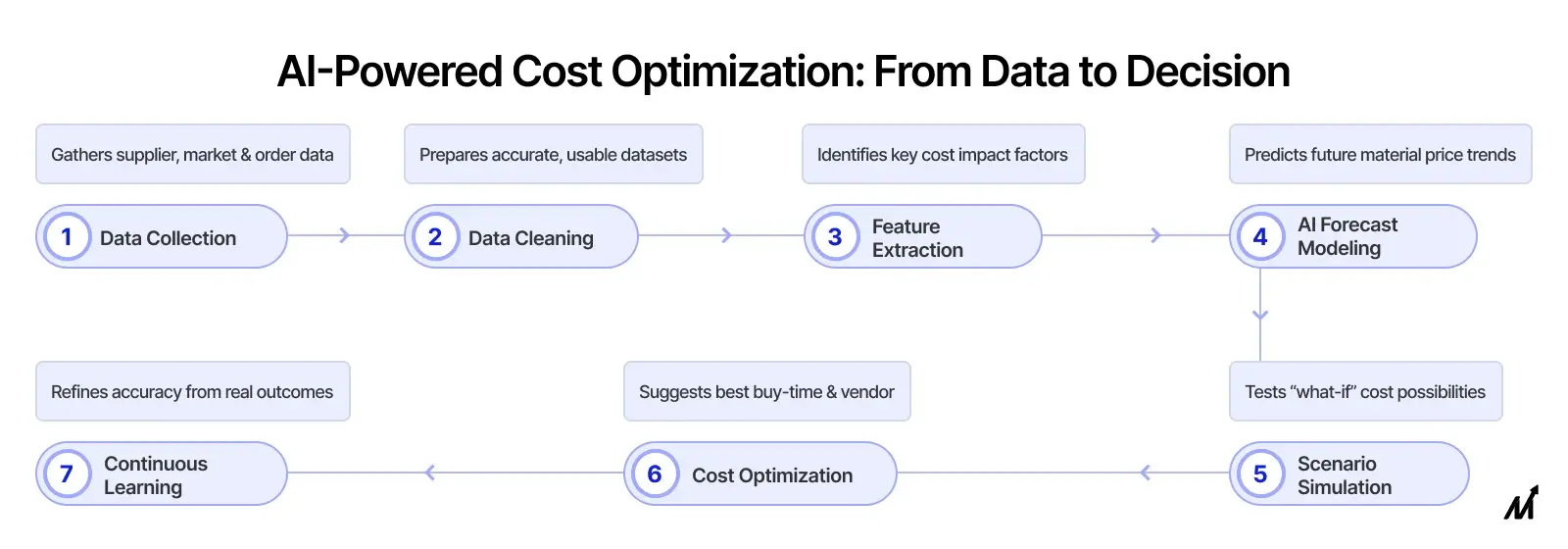
AI models forecast material costs using historical data, market indexes, and real-time trend analysis.
Procurement teams gain the ability to time purchases strategically and negotiate from a position of data-backed confidence. AI-driven cost forecasting also enables teams to secure competitive pricing from suppliers by efficiently comparing quotes and identifying the best value.
Result: Stronger cost control and proactive sourcing strategies.
d. Automated Quote Comparison
AI tools instantly compare supplier quotes using pre-set metrics such as cost, lead time, and compliance.
Instead of endless spreadsheets, teams receive structured insights, further highlighting deviations, savings opportunities, and performance gaps automatically.
Result: Objective, data-driven quote selection with higher efficiency.
e. Workflow Automation and Decision Support
AI-powered platforms integrate with ERP systems and procurement systems, offering robust integration capabilities to automate approvals, order creation, and supplier feedback loops.
Embedded analytics surface anomalies, such as pricing inconsistencies or repeated delays, before they impact timelines.
Integrated dashboards provide end-to-end visibility, surfacing anomalies such as pricing inconsistencies or repeated delays before they impact timelines.
Result: Seamless, end-to-end RFQ management and better governance across procurement.
Let’s further read some of the advantages that RFQ automation with AI can offer!
Key Benefits of AI-Powered RFQ Automation for Manufacturers
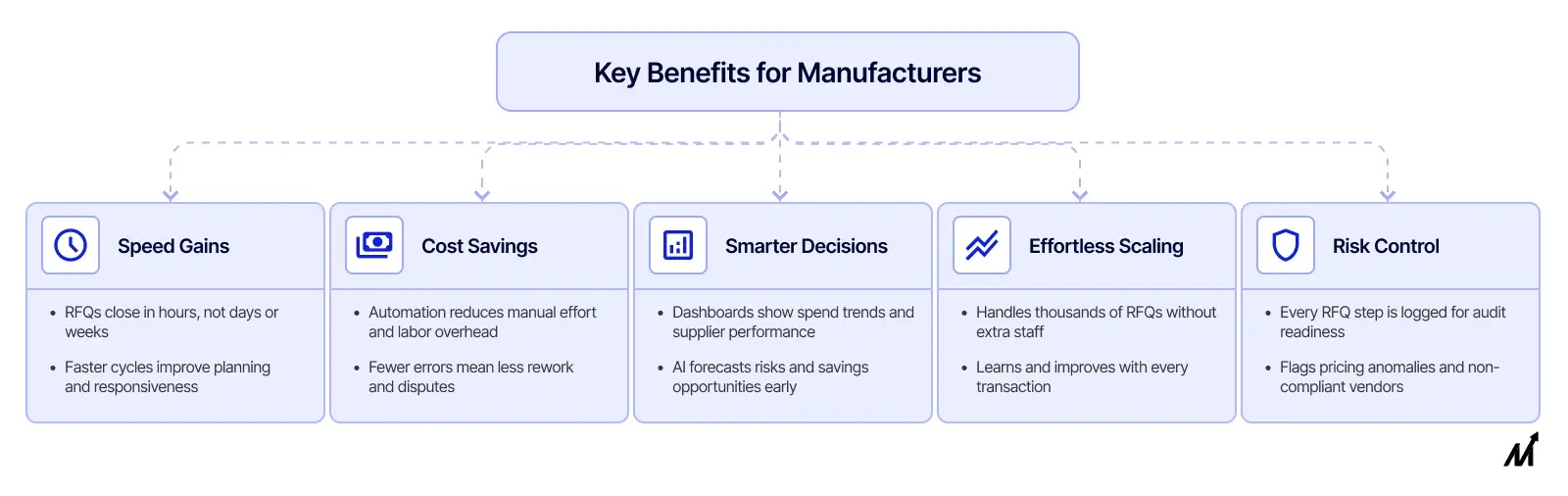
AI-driven RFQ automation goes far beyond digitization. It’s reshaping procurement into a strategic growth engine – one that drives efficiency, delivers greater efficiency for manufacturers, reduces risk, and enables smarter decision-making at scale. Here’s how forward-thinking manufacturers are realizing the impact:
1. Accelerated RFQ Cycles
AI eliminates the repetitive steps that slow traditional procurement, from document creation to supplier outreach and quote comparison.
What once took days can now be completed within hours, thus allowing teams to respond faster to production needs, material fluctuations, and customer demand.
This speed isn’t just operational; it enables manufacturers to move ahead of market shifts rather than reacting to them.
2. Lower Operational Costs
Automation reduces the dependency on manual effort, cutting administrative workloads and minimizing the risk of costly human errors.
AI-driven evaluation ensures data consistency across quotes and suppliers, preventing contract discrepancies and rework.
The outcome is leaner, more efficient operations where resources are redirected from manual processing to higher-value strategic work.
3. Deeper Insights and Decision Intelligence
AI brings visibility that traditional procurement systems rarely offer. Real-time dashboards surface insights into spend, supplier performance, and sourcing trends, while predictive analytics help teams forecast risks and identify new savings opportunities.
With this intelligence, leaders can make procurement decisions that balance cost, quality, and continuity – not just price.
4. Effortless Scalability
As RFQ volumes grow, AI platforms scale automatically without increasing headcount.
Machine learning improves with every transaction, continuously enhancing accuracy and response times.
Procurement teams can manage hundreds or even thousands of RFQs simultaneously while focusing on innovation, sustainability, and supplier development.
5. Strengthened Compliance and Risk Control
AI systems maintain a digital audit trail across every step of the RFQ process, thus ensuring transparency and readiness for internal or regulatory review.
Built-in policy checks verify that every purchase aligns with organizational and industry standards.
Additionally, anomaly detection models proactively flag issues such as irregular pricing or vendor reliability concerns before they escalate.
Ultimately, AI-powered RFQ automation helps manufacturers build an agile, intelligent, and resilient procurement function ready for the future.
Procurement Team Enablement and Approval in the Age of Automation
Empowering procurement teams is at the heart of a successful RFQ process transformation. By adopting advanced RFQ automation tools, procurement teams can shift their focus from repetitive manual data entry to high-value activities such as supplier relationship management and strategic sourcing. Automation tools streamline the entire RFQ process, allowing teams to manage more requests with greater accuracy and less effort.
One key advantage of AI-powered RFQ automation is the introduction of automated approval workflows. These workflows ensure that every stakeholder is kept in the loop, approvals are tracked in real time, and decisions are made quickly and transparently. This not only accelerates the procurement process but also reduces compliance risks and ensures alignment with company policies.
AI-powered RFQ automation enables procurement teams to make smarter supplier decisions by analyzing supplier reliability, performance history, and compliance records. This data-driven approach helps companies negotiate better pricing, select the most reliable partners, and build stronger, long-term supplier relationships. By reducing manual data entry and automating routine tasks, procurement professionals can focus on driving value, improving supplier relationships, and achieving better business outcomes.
How AI Systems Generate Manufacturing Quotes
Modern AI-based quoting software has moved far beyond template-based pricing. Today’s systems can interpret complex CAD or STEP files to understand not just geometry, but the entire production context. Here’s how it works:
When implementing a new system, it is crucial to provide comprehensive training and ongoing support for staff to ensure successful adoption. Additionally, when evaluating suppliers through an automated RFQ system, it is important to consider long-term value, including ongoing expenses and partnership stability, rather than focusing solely on initial costs.
1. File Analysis and Geometry Extraction
The process begins with uploading a CAD or STEP file. AI algorithms assess the 3D model to extract details such as part volume, surface area, weight, and dimensional tolerances. These insights help determine material usage, tooling requirements, and production complexity.
2. Process and Machine Compatibility
Based on the part geometry, the AI identifies machine requirements, for example, tonnage, shot size, barrel capacity, and material type. It recommends compatible equipment configurations, ensuring the part can be produced efficiently using available machinery.
3. Material and Production Parameters
The system factors in material density, cycle time, setup type, efficiency rates, and scrap percentage to calculate true manufacturing costs. For plastic injection molding, for instance, parameters like color changes, letdown ratio, or labor rates are also considered.
4. Automated Cost Computation
Using historical production data and AI-based regression models, the software computes mold cost, unit price, and production lead time. It can also generate price breaks based on order quantity, giving buyers greater cost visibility.
5. Predictive Optimization
AI continuously refines its accuracy using real production feedback – improving its cost and time predictions with every project. Over time, it can even forecast lead time bottlenecks or cost variations based on workload and material trends. Continuous evaluation and adjustment of the system ensures maximum value for manufacturers by optimizing performance and delivering the highest possible outcomes.
Why does this matter for manufacturers, especially mid-marketers?
Companies in manufacturing, fabrication, and assembly often handle hundreds of RFQs each month. AI quoting eliminates manual estimation, shortens response times, and improves quote accuracy – empowering teams to respond faster and win more bids without increasing engineering effort.
Launching and Monitoring Your RFQ Automation Initiative
Successfully launching an RFQ automation initiative starts with a thorough evaluation of your current RFQ process. Procurement teams should identify bottlenecks, repetitive tasks, and areas where manual work slows down operations. Setting clear objectives is essential—whether your goal is to reduce cycle times, improve supplier engagement, or achieve cost savings.
Selecting the right RFQ automation software is critical. Look for solutions that integrate seamlessly with your existing tools and systems, ensuring a smooth transition and minimal disruption. Once your automated system is live, ongoing monitoring is key. Track performance metrics, gather feedback from procurement teams and suppliers, and be ready to make adjustments to maximize value.
AI-powered RFQ automation solutions provide real-time analytics and insights, enabling companies to respond faster to market changes and make informed decisions. Regularly reviewing the effectiveness of your RFQ automation solution ensures that your procurement process remains agile, efficient, and aligned with your business goals.
Best Practices for RFQ Automation Success
To unlock the full potential of RFQ automation, companies should follow best practices to ensure seamless integration and effective decision-making. Start by defining clear objectives for your RFQ automation initiative – know what you want to achieve and how success will be measured. Establish customizable workflows that reflect your unique procurement needs and regulatory requirements.
Choose RFQ automation tools that minimize manual data entry and reduce the risk of human error. Ensure your RFQ automation system supports regulatory adherence and offers the flexibility to adapt as your business evolves. Leverage AI-powered RFQ automation to analyze supplier bids and evaluate supplier responses, enabling data-driven, informed decision-making.
Ongoing training and support for procurement teams are essential to maximize adoption and ROI. Regularly monitor and evaluate your automated system, making improvements as needed to keep your procurement process efficient and competitive. By following these best practices, companies can drive business growth and achieve long-term success with RFQ automation.
Overcoming Common Challenges in RFQ Automation
While the benefits of RFQ automation are significant, companies may encounter challenges during implementation. Resistance to change, technical integration issues, and aligning the RFQ automation solution with existing systems and business goals are common hurdles. To overcome these obstacles, clear communication with all stakeholders is vital. Provide comprehensive training to procurement teams and ensure that the new automated RFQ process is well understood and supported.
Aligning your RFQ automation solution with your business goals and existing systems helps ensure a smooth transition and reduces manual workload. Leveraging AI-powered RFQ automation enables companies to achieve faster procurement cycles, respond faster to RFQs, and negotiate better pricing. By proactively addressing challenges, companies can strengthen supplier relationships, streamline procurement, and drive business success with automated RFQ processes.
Measuring Success: KPIs and Metrics for RFQ Automation
To ensure your RFQ automation solution delivers real value, it’s essential to track key performance indicators (KPIs) and metrics that reflect the efficiency and impact of your automated system. Important metrics include RFQ response time, supplier engagement rates, cost savings, and overall procurement cycle time. Monitoring these KPIs allows companies to evaluate the effectiveness of their RFQ automation solution and identify opportunities for further optimization.
Additional metrics such as total cost of ownership, return on investment (ROI), and user adoption rates provide a comprehensive view of the automated system’s impact. By leveraging AI-powered analytics, companies can gain a competitive edge, make data-driven decisions, and demonstrate the value of RFQ automation to stakeholders. Regularly reviewing these metrics ensures your procurement process remains agile, cost-effective, and aligned with your long-term business objectives.
In the next section, we will explore how Markovate’s AI expertise brings this concept to life through our custom-built “AI Blueprint Classifier”, a solution designed for a USA-based manufacturing company, to automate bill of materials generation directly from engineering blueprints.
From Blueprints to Business Intelligence with Markovate’s Custom AI Solutions
At Markovate, our core focus is delivering Generative AI solutions that align with the strategic needs of various industries. The AI Blueprint Classifier is a prime example of this, bridging a critical gap between engineering drawings and procurement execution.
Why does it matter?
- Many manufacturers struggle to convert detailed CAD/technical drawings into actionable Bills of Materials (BOMs) and sourcing-ready documentation. This process is often reliant on manual review, error-prone interpretation, and long lead times.
- Our AI blueprint classifier solution automates and accelerates that translation from blueprint to BOM, thus making it ideal for manufacturers aiming to modernize procurement, accelerate RFQ cycles, and reduce costs.
What does the AI Blueprint Classifier do?
- It ingests CAD drawings, blueprints, schematics (DWG, DXF, PDF, or scanned formats), and uses purpose-built AI models trained on engineering drawings and manufacturing standards.
- It segments and labels blueprint elements, validates GD&T compliance (ASME Y14.5 – 1994/2009/2018) before classification, and extracts dimensions, part specifications, and tolerances.
- It automatically transforms the drawing data into structured MBOMs, BBOMs, or BoQs, ready for integration into ERP, PLM, or inventory systems in formats such as CSV, Excel, PDF, or JSON.
- For manufacturers and engineers, this means faster review, higher accuracy, and fewer manual touchpoints – up to 80% reduction in marking errors, 30% faster reviews, and 15% lower labor costs.
What’s Its Strategic advantage for RFQ automation?
Because the AI Blueprint Classifier produces clean, structured BOM data, procurement persons gain reliable inputs for RFQ automation workflows.
This enables smoother data flow, faster quote generation, and greater precision in supplier matching and evaluation.
Why Markovate?
What sets Markovate apart is our ability to custom-build AI systems aligned with each client’s sourcing environment. The AI Blueprint Classifier isn’t an off-the-shelf OCR tool – it’s engineered for compliance, accuracy, and measurable ROI.
What’s Ahead: The Future of RFQ Automation with AI
AI is set to reshape procurement far beyond automation. The next phase will be predictive and autonomous, where systems anticipate needs, generate RFQs automatically, and even conduct simple negotiations. Integrated with digital twins and IoT, sourcing decisions will happen in real time – faster, smarter, and more precise. Future systems will enable real-time collaboration between procurement teams and suppliers, allowing instant document sharing and seamless communication.
For manufacturers, this means moving from reactive processes to intelligent, data-driven procurement that fuels agility and competitive advantage. These advancements will foster better supplier relationships through improved communication and transparency, making negotiations more effective and partnerships stronger. Companies investing in AI-powered RFQ automation today will lead that shift tomorrow.
At Markovate, we help manufacturers make that leap, from blueprint analysis with our AI Blueprint Classifier to custom RFQ automation solutions. If you are ready to modernize your business with AI, let’s build it together. Talk to our AI experts!
FAQs: RFQ Automation
1. How can manufacturing companies benefit from AI-enabled RFQ workflows?
For manufacturers, AI-enabled RFQ workflows deliver faster sourcing cycles, more accurate supplier matching, stronger cost control, and fewer manual errors. This turns procurement from a time-consuming task into a growth-focused function.
2. What are the most common RFQ mistakes manufacturers make?
Many manufacturers struggle with incomplete or inconsistent RFQ data – missing BOM details, unclear specifications, undefined quantities, or outdated drawing revisions. These gaps often lead to inaccurate quotes, production delays, and supplier friction.
That’s why structured, AI-driven data extraction is becoming essential. By automatically validating and standardizing blueprint and BOM information before it reaches suppliers, solutions like our AI Blueprint Classifier help ensure every RFQ starts with clean, complete, and accurate data. This is a clear example of how AI solutions for manufacturing are reducing procurement errors and accelerating sourcing outcomes.
3. Can AI-powered RFQ automation integrate with existing ERP or PLM systems?
Yes. Modern RFQ automation solutions are built for interoperability. They can easily connect with ERP, PLM, or sourcing tools to ensure a seamless flow of supplier, pricing, and BOM data – reducing double work and improving overall sourcing visibility.