


Construction estimating involves more than finding quantities and adding costs. Estimators review drawings, interpret specifications, track revisions, check scope, assess risks, and make pricing decisions.
AI in construction estimating can take on some of the repetitive information work behind these tasks. It can help estimators review drawings faster, organize quantities, find relevant project information, and respond to changes without replacing professional judgment.
The goal is not to replace the estimator. It is to give estimators more time for the decisions that require experience and context.
This blog looks at where AI fits into the estimating workflow, what it can handle, and where the estimator’s expertise still matters.
What Is AI in Construction Estimating?
AI in construction estimating uses artificial intelligence to analyze drawings, specifications, project documents, quantities, and estimating data.
For an estimator, that can mean less time spent searching, counting, measuring, and entering information manually.
AI can support several stages of the estimating process:
- Reviewing construction drawings
- Finding and measuring quantities
- Reading specifications and project documents
- Comparing drawing revisions
- Organizing estimating information
- Preparing estimate inputs
- Checking information for inconsistencies
AI estimating does not mean that a system independently decides what a project should cost. The estimator still provides context, judgment, and final approval.
A practical way to think about it is:
AI handles more of the information-heavy work. Estimators handle the decisions that require experience and context.
That becomes clearer when we look at how AI fits into the estimator’s actual workflow.
How AI Fits Into the Construction Estimating Workflow
The most useful way to understand AI in construction estimating is to see where it fits into the estimator’s existing workflow, from drawings to final bid. AI can support several of these steps:
1. Reviewing Drawings and Project Documents
Estimators often start by working through large drawing sets and project documents. Finding the right information can take significant time, especially when drawings include multiple disciplines, schedules, notes, and revisions.
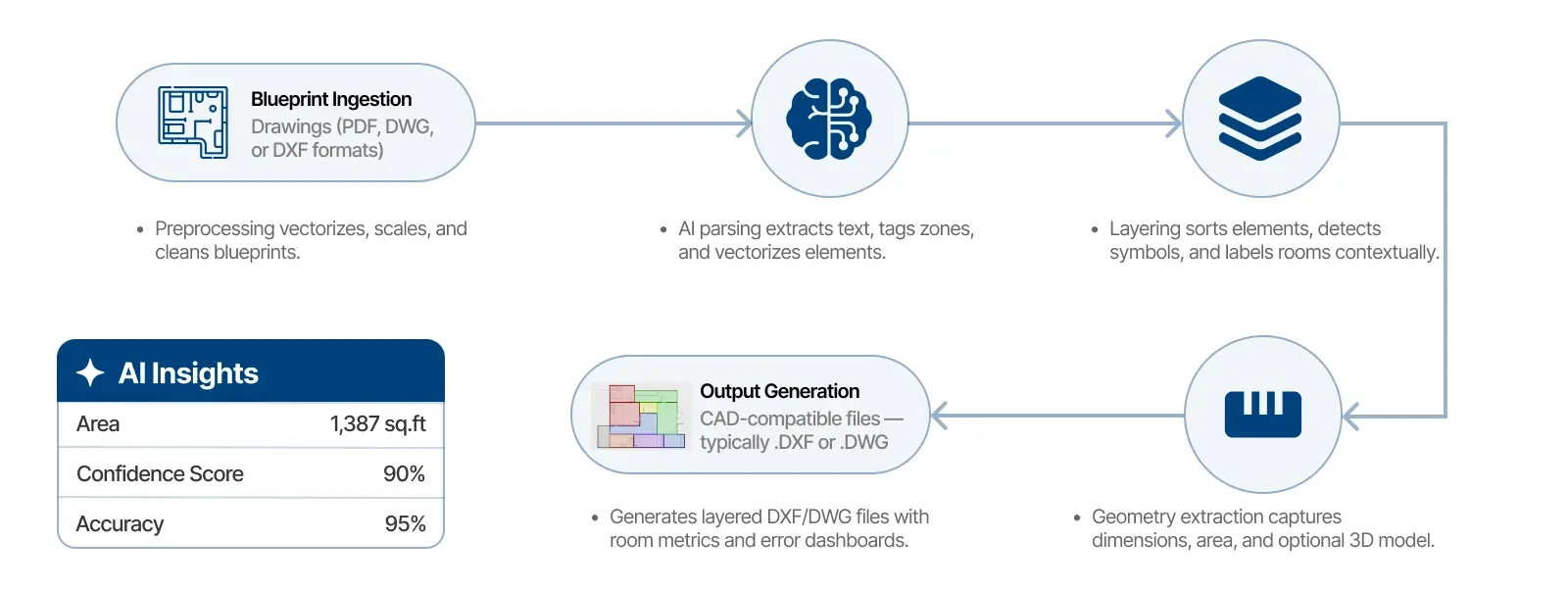
AI can support automated blueprint analysis by identifying relevant construction elements, extracting measurements, and organizing information for review.
2. Quantity Takeoffs
Quantity takeoff is one of the clearest areas where AI can support estimators. An AI system can detect construction elements and extract quantities from drawings.
Depending on the solution, this may include walls, doors, windows, flooring, or any other trade-specific quantities. This does not mean the estimator stops doing takeoffs. Instead, AI can create a first pass that the estimator reviews and validates.
That distinction matters.
A takeoff provides quantities. An estimate combines those quantities with costs, labor, scope, project conditions, and other commercial inputs. So AI takeoff is one part of AI-supported construction estimating, not the entire estimating process.
Learn more about how AI is changing construction takeoffs in our blog “AI Construction Takeoff”.
3. Reading Specifications and Other Documents
Drawings rarely tell the entire story. Estimators also work with specifications, schedules, RFQs, bid requirements, scope documents, addenda, and other project information.
AI can help extract relevant details from these documents and connect them with the information found in drawings. For example, an estimator may need to check a material specification against a drawing detail.
AI can help surface the relevant information faster. The estimator still decides how that information affects the estimate.
4. Organizing Cost and Pricing Inputs
Estimators also need cost data to turn quantities into an estimate. This can include material costs, labor rates, subcontractor inputs, historical project data, and other pricing information.
AI can help organize these inputs, match relevant information to estimate items, and surface historical data for review. The estimator still decides which rates, assumptions, and pricing conditions apply to the project.
5. Reviewing Drawing Revisions
Drawing revisions can create another layer of work. An estimator may need to identify what changed, determine whether those changes affect quantities, and update the estimate accordingly.
AI can compare drawing versions and highlight potential changes. That helps the estimator focus on areas that need attention instead of reviewing every sheet from the beginning.
The estimator remains responsible for deciding whether a detected change actually affects scope, quantities, cost, or the final bid.
6. Organizing Estimate Inputs
Estimators often move information between drawings, takeoff tools, spreadsheets, estimating platforms, and other systems.
AI can help structure extracted information before it reaches the next step in the workflow. This can reduce repetitive data entry and make information easier to review.
7. Review and validation
AI can also help flag unusual quantities, missing information, or inconsistencies for further review. These checks can give estimators another layer of visibility before they finalize an estimate.
The important point is that AI supports individual steps rather than replacing the entire estimating process. That raises a practical question: what does this support actually change for the estimator?
What Are the Benefits of AI in Construction Estimating?
For estimators, the biggest benefit is not simply faster estimating. It is reducing the repetitive work that surrounds estimating.
1. Less Time on Repetitive Work
Counting, measuring, searching, comparing, and transferring information can consume significant estimating time.
AI can handle portions of this work so estimators can focus more on analysis and decision-making.
2. Faster Access to Project Information
AI can process large drawing sets and document packages quickly. This can help estimators find relevant information without manually searching every sheet or page.
3. Faster Response to Changes
When drawings change, AI can help identify areas that need another review. Estimators can then focus on changes that may affect quantities, scope, or cost.
4. More Consistent Workflows
AI can apply repeatable extraction and organization processes across projects. This can help teams handle estimating information more consistently.
5. More Time for Estimator Judgment
This may be the most important benefit. AI can reduce information-processing work while estimators spend more time on scope, pricing, risk, and bid strategy.
In other words, the value comes from giving estimators more useful time, not simply reducing the time needed to produce an estimate.
AI Takeoff vs. AI Estimating: What Is the Difference?
AI Estimating and AI Takeoff are related, but they solve different parts of the workflow.
For example, AI takeoff focuses on identifying and measuring quantities from construction drawings. It may determine:
- How many windows appear in a drawing set
- How many doors need to be included
- How much flooring is required
- How many structural members appear
- What quantities belong to a specific trade
AI estimating goes further. It can bring those quantities together with materials, labor, specifications, costs, and other estimating inputs.
This distinction matters because a faster takeoff does not automatically produce a complete estimate. The estimator still needs to apply project context, pricing knowledge, and judgment.
This is also where Markovate’s construction AI expertise connects with the broader estimating workflow.
How Markovate Supports AI-Powered Construction Estimating
Markovate provides AI solutions for drawing-heavy construction and preconstruction workflows. Our focus is on turning information locked inside technical drawings and documents into structured, usable data.
We help contractors and estimators analyze construction drawings, extract quantities, and review results as part of the takeoff workflow. Powered by the CADIAM™ engine, AI Blueprint Classifier delivers specialized drawing intelligence, including automated AI Takeoff & Estimating, helping teams move seamlessly from raw drawing analysis to structured, bid-ready estimates.
With AI Takeoff, the system identifies and extracts quantities from drawings. With AI Estimating, those quantities can feed a broader estimating workflow that includes materials, labor, specifications, costs, and estimate preparation.
The estimator remains in the loop to review the information, apply project context, and make the final decisions.
This approach reflects a simple principle: automate repetitive information work while keeping expertise and accountability with the estimator.
What AI Still Can’t Replace in Construction Estimating
AI can process information quickly, but construction estimating requires more than information processing. In short, estimators still need to evaluate:
- Project scope
- Site conditions
- Constructability
- Labor requirements
- Subcontractor and supplier inputs
- Project risks
- Inclusions and exclusions
- Unusual project conditions
- Pricing strategy
- Final bid decisions
A drawing may show what a project should contain. It may not show everything that will affect the final cost.
An experienced estimator can recognize context that a system may miss.
For example, a drawing may show a particular material or assembly. The estimator may know that site access, local labor availability, installation complexity, or project constraints will change the actual cost.
That is why AI works best as an estimating assistant, not as a replacement for the estimator.
The Future of AI in Construction Estimating
AI in construction estimating will likely move beyond individual tasks and become more connected to the wider preconstruction workflow. See our blog, AI in Preconstruction, for a broader look at how these workflows connect.
Instead of using separate tools for drawing analysis, takeoff, document review, and estimating, teams can connect these activities into a more continuous workflow.
Future applications may include:
- Deeper understanding of construction drawings
- More connected drawing and specification analysis
- Faster quantity extraction
- Better use of historical project data
- More intelligent revision analysis
- Greater automation across repetitive estimating tasks
- Stronger connections between takeoff and estimating systems
The goal should not be to remove the estimator from the process. The goal is to give estimators better information, faster access to that information, and more time to make informed decisions.
Conclusion: AI in Construction Estimating
AI is changing construction estimating by taking on more of the repetitive, information-heavy work behind an estimate.
It can analyze drawings, extract quantities, review documents, identify patterns, and support estimate preparation. But estimating still needs human judgment.
The strongest workflow combines AI’s ability to process large amounts of information with an estimator’s understanding of scope, risk, cost, and real-world construction conditions.
As construction teams adopt AI, the opportunity is not simply to estimate faster. It is to give estimators better tools for doing their work with greater efficiency and confidence.
If you’re exploring AI for construction estimating, talk to our team about your workflow and use case.
FAQs: AI in Construction Estimating
1. What is AI in construction estimating?
AI in construction estimating uses artificial intelligence to support tasks such as drawing analysis, quantity takeoff, document review, data extraction, and estimate preparation.
2. How does AI help construction estimators?
AI can reduce repetitive work such as counting, measuring, searching documents, extracting information, and organizing data. This gives estimators more time for review and decision-making.
3. Can AI perform construction takeoffs?
Yes. AI can assist with construction takeoffs by identifying, counting, and measuring elements in digital drawings. Estimators should still review the resulting quantities before using them in an estimate.
4. Can AI replace construction estimators?
No. AI can automate and support many estimating tasks, but estimators still need to evaluate scope, site conditions, risk, pricing, and project-specific requirements.
5. Is AI construction estimating accurate?
Accuracy depends on the drawings, data, AI system, project complexity, and workflow. Human review remains important, especially for complex or incomplete project information.
6. What is the difference between AI takeoff and AI estimating?
AI takeoff focuses on identifying and measuring quantities from construction drawings. AI estimating covers a broader workflow that can include takeoff, cost data, document analysis, and estimate preparation.