

A large-scale oil and gas refinery operation reached out recently with a clear, specific problem. They needed to read and extract data from a large volume of P&IDs. Each drawing contained hundreds of lines and instrument tags. The extracted data also had to adhere to a strict parent-child asset hierarchy per internal guidelines. The volume was significant. The drawings were complex. And the team doing it manually was the bottleneck holding back every downstream decision that depended on that data.
That scenario isn’t unique to one refinery. It plays out across oil and gas operations globally — refineries, upstream facilities, EPC firms, and pipeline operators. All of them sit on decades of engineering documentation. All of it contains critical operational intelligence. Almost none of it is accessible in a usable form. The data is there. Getting to it is the problem.
The engineering document layer, P&IDs, fabrication drawings, isometrics, and line lists receive far less attention than exploration and production in most digital transformation programs. Yet it’s the foundation on which operations, maintenance, and compliance decisions all depend.
Why Legacy Engineering Documentation Is a Strategic Problem for Oil & Gas Right Now
Oil and gas companies face growing pressure from changing regulations, volatile prices, geopolitical shifts, and increasingly complex business portfolios. As those pressures increase, AI is becoming essential for future success. Most of those pressures don’t announce themselves as document problems. But they compound them.
When a refinery needs to demonstrate compliance with updated emissions regulations, the evidence lives in P&IDs and process documentation. That documentation may be stored in static PDFs, scanned drawings, or aging CAD files. Many haven’t been updated since the original plant commissioning.
When an EPC firm bids on a redevelopment project, the engineering baseline it works from is decades of drawings. Those drawings exist in formats that don’t connect to modern asset management systems.
When a production facility needs to modify a process line, the governing P&ID may exist in three different versions across two different systems. There is no reliable way to identify which one is current.
Modernization that doesn’t address the document layer first builds on an unstable foundation. The algorithms that drive predictive maintenance, digital twins, and asset performance management all depend on structured, accurate engineering data. If that data is locked in legacy drawings, the intelligence layer above it can only be as good as what it can access.
What P&IDs and Fabrication Drawings Actually Contain — And Why It Stays Locked
A Piping and Instrumentation Diagram is the authoritative record of a process system. Every valve, instrument, control loop, piece of process equipment, and safety boundary is documented in it. A major refinery may have tens of thousands of individual P&IDs. Each one contains a dense network of symbols, line connections, tag numbers, and annotations that define how the plant was built, how it operates, and the safety constraints it must follow.
Fabrication drawings carry a different but equally critical category of information — pipe spool dimensions, weld specifications, material grades, and isometric views of piping runs. Like P&IDs, they were created for print and manual interpretation, not for the data pipelines that modern operations depend on. The intelligence is in the drawing.
For a closer look at how AI reads engineering drawings differently from traditional methods, see our post on AI blueprint interpretation.
The reason this data stays locked isn’t a lack of awareness. It’s that extraction has historically required domain experts who understand both the engineering content and the data structures it needs to feed into. That combination of expertise is scarce, expensive, and doesn’t scale with the volume most large facilities manage.
Where Manual P&ID Handling Breaks Down at Scale
Manual P&ID interpretation creates three specific operational bottlenecks that compound as operations grow.
1. Data that can’t be trusted
When P&IDs are manually transcribed into asset registers or maintenance systems, transcription errors accumulate. Tag numbers get misread. Equipment relationships get recorded incorrectly. Line data gets attributed to the wrong process unit. Over time, the asset register diverges from the actual plant. The gap only becomes visible when a decision based on that data produces an unexpected outcome at the operational level.
2. Revision control that can’t keep up
Plants change. Process lines get modified, equipment gets replaced, and safety systems get updated. Each change should trigger an updated P&ID. In practice, P&ID revision cycles in large facilities run months behind actual plant changes. When engineering staff manually manage those revisions, the version control problem compounds with every modification cycle. The current state of the plant and the current state of the documentation stop matching in ways that are difficult to detect and expensive to reconcile.
3. Asset hierarchies that don’t exist
Most facilities need their P&ID data structured in a parent-child asset relationship — process unit to equipment to instrument tag to component. Building that hierarchy manually from raw P&ID data means reading every drawing, identifying every relationship, and populating a structure that no individual drawing makes explicit. It’s the kind of task that takes months for a team of engineers and produces output that’s already partially outdated by the time it’s complete.
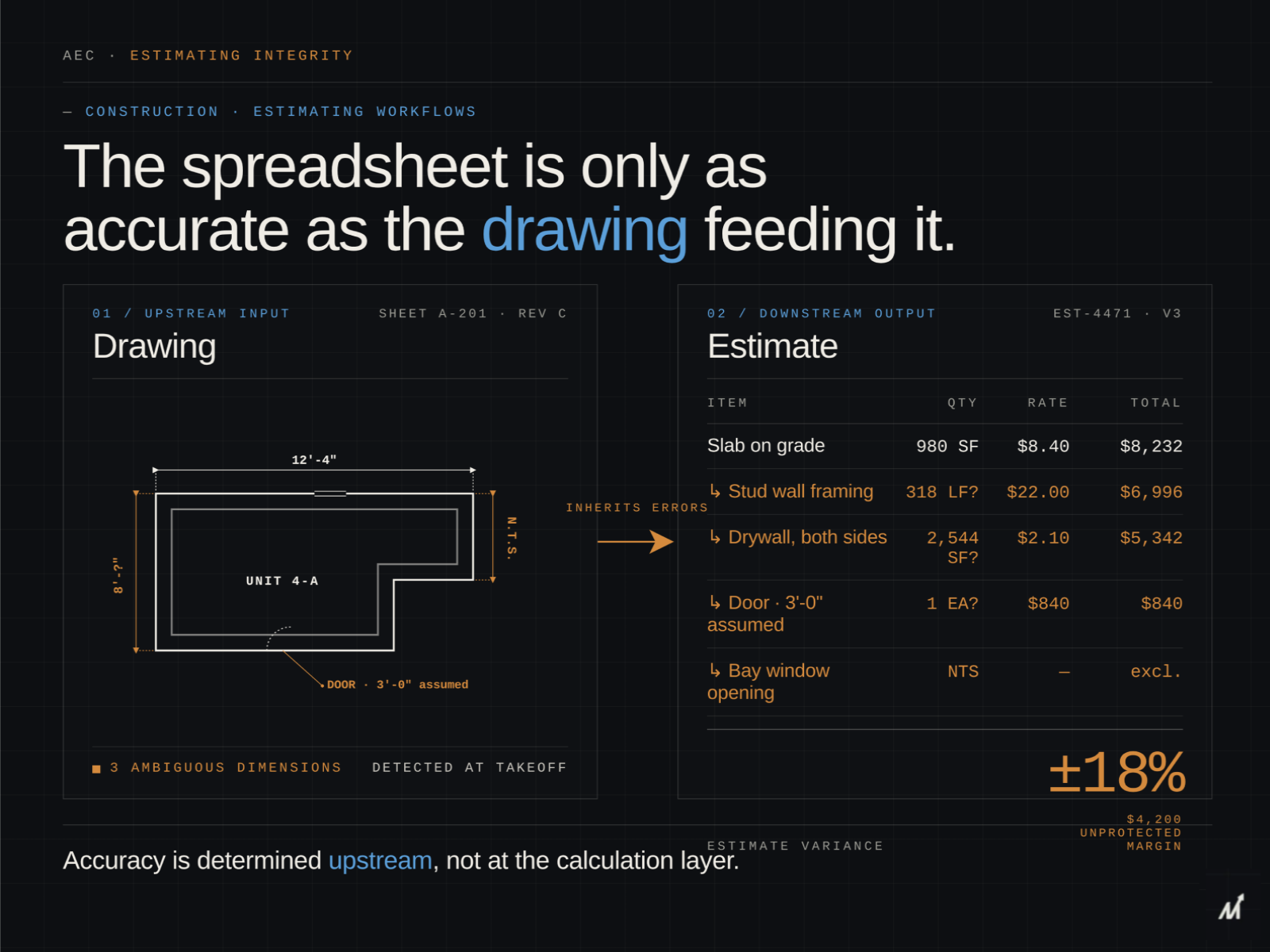
The same upstream interpretation failure that drives engineering BOM errors in manufacturing applies here. When the source document is read incorrectly, every downstream system inherits the same flaw.
How AI Extracts and Structures Data From Legacy Engineering Documents
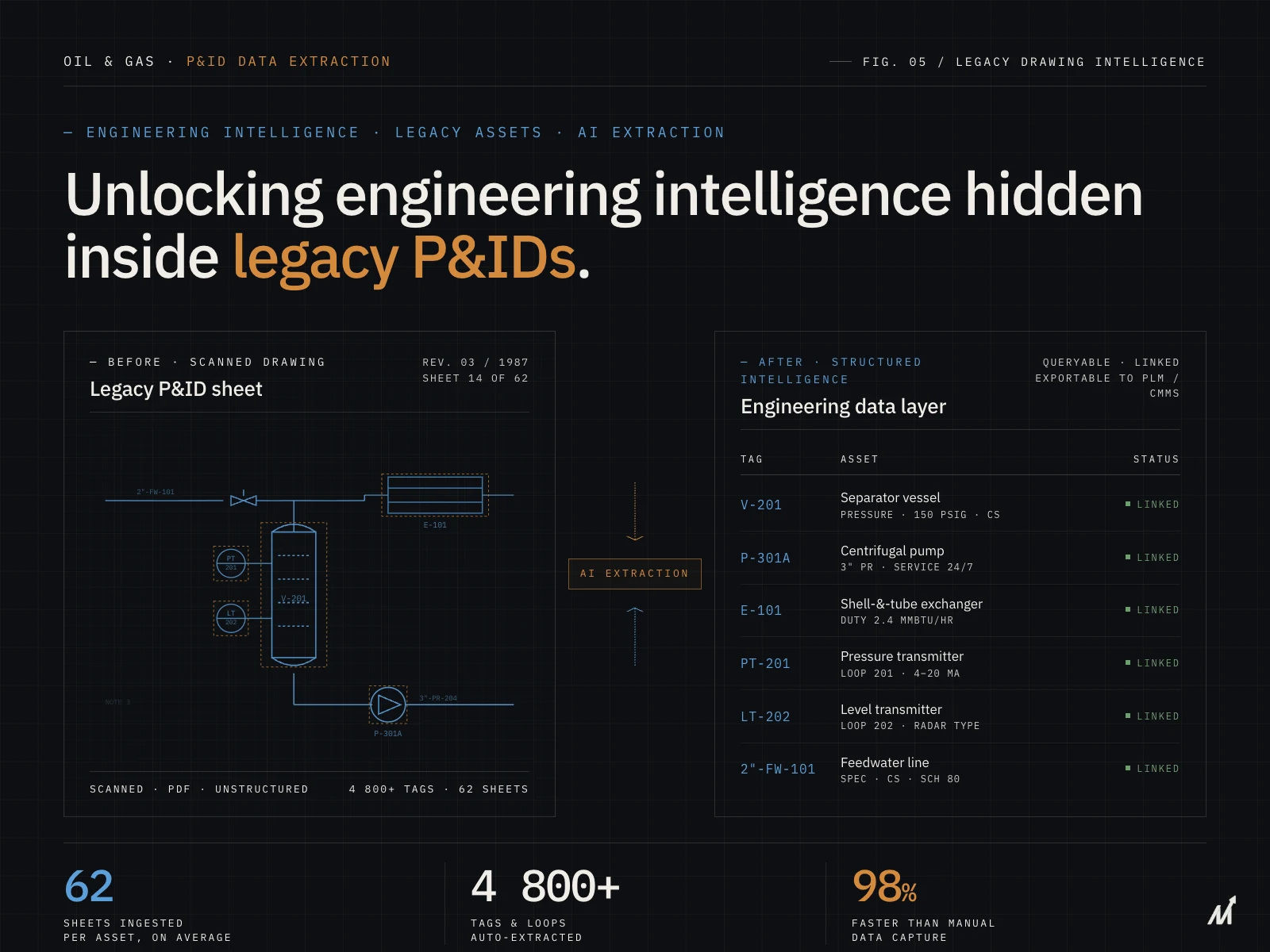
AI-powered P&ID Digitization and data extraction approach the problem differently. Instead of relying on domain experts to read and transcribe each drawing manually, the system reads the drawing directly. It recognizes symbols, detects line connections, extracts tag numbers, and understands relationships between components as part of a connected engineering network rather than a flat document.
The output of that extraction process is not just a transcription. The system structures equipment lists, instrument tags, line lists, and valve inventories into formats that integrate directly with enterprise systems such as CMMS, ERP, and digital twin platforms.
For operations that need a parent-child asset hierarchy from their P&ID data, the AI structures the extracted data according to those relationships automatically, rather than requiring engineers to construct the hierarchy manually from raw drawing content.
Fabrication drawings follow the same logic. AI extracts and structures pipe spool data, weld specifications, material grades, and isometric geometry into formats that support procurement, fabrication tracking, and quality assurance workflows. This eliminates the manual interpretation step that currently makes these documents expensive to manage at scale.
The difference between manual extraction and AI extraction isn’t incremental. A team working manually through a large P&ID package operates at a pace measured in drawings per day. An AI system processes that same package in a fraction of the time and produces structured output that feeds directly into downstream systems without a reformatting step.
How Markovate Unlocks P&ID and Fabrication Data for Oil & Gas Operations
Most oil and gas operations managing this problem aren’t looking for a generic digitization tool. They need a system that understands engineering drawing conventions, configures around their asset hierarchy requirements, and produces output that flows directly into the systems their teams already use.
AI Blueprint Classifier, powered by CADIAM™, bridges this gap. The platform reads and understands complex engineering documents — including P&IDs, fabrication drawings, and multi-sheet technical packages. Further, extracting equipment tags, line data, instrument specifications, and component relationships, transforming them into structured, standardized outputs that align with enterprise asset management and compliance frameworks.
For oil and gas operations specifically, AI processes P&ID packages with hundreds of lines and tags per drawing as connected engineering networks instead of isolated pages. The system extracts the relevant data, structures it into the parent-child asset hierarchy the operation requires, and delivers outputs that flow directly into downstream systems without a manual reformatting step.
Examples
A major oil and gas refinery operator faced exactly this challenge: extracting, structuring, and organizing large, complex P&ID packages into a strict asset hierarchy based on internal guidelines. The Drawing Intelligence Platform processed the P&ID sets, extracted the relevant tags and line data, and delivered structured outputs aligned to the refinery’s asset management framework — eliminating the manual interpretation work that had previously bottlenecked the team.
Similarly, a global EPC firm managing large-scale infrastructure programs engaged Markovate to handle drawing package complexity at the scale their existing tools couldn’t manage — focused on structured extraction and revision tracking across multi-sheet engineering packages supporting procurement and estimation workflows.
For operations that need configuration around specific asset hierarchy requirements, compliance frameworks, or integration with existing ERP environments, we scope that before any deployment begins. Book a demo to discuss what extraction and structuring look like for your drawing packages.
Conclusion: The Engineering Data Layer Is Where Digital Transformation Stalls — Or Accelerates
Oil and gas companies are investing in AI at scale. The platforms, the algorithms, and the infrastructure are in place or in procurement. What’s missing in most cases isn’t the technology above the data; it’s the structured data itself.
P&IDs and fabrication drawings contain the engineering intelligence that operations, maintenance, compliance, and capital planning all depend on. As long as that intelligence stays locked in static formats that require manual interpretation to access, the digital transformation layer above it operates on an incomplete foundation.
AI-powered extraction doesn’t just solve a document management problem. It unlocks the data layer that every other operational intelligence initiative depends on, and it does so at the scale and speed that manual workflows can’t approach.
FAQs: P&ID Data Extraction for Oil & Gas Industry
1. What is P&ID data extraction, and why does it matter for oil and gas operations?
P&ID data extraction converts information from Piping and Instrumentation Diagrams into structured digital data. The extracted information can include equipment tags, line data, instrument specifications, valve inventories, and component relationships.
For oil and gas operations, this matters because P&IDs are the authoritative record of facility design and operations. However, most of that information remains trapped in static formats that cannot integrate directly with maintenance, compliance, and asset management systems.
2. How does AI handle the complexity of oil and gas P&IDs compared to manual extraction?
Manual P&ID extraction requires domain experts to read each drawing, identify components, interpret symbol conventions, and transcribe data into structured formats. However, this process does not scale well for the volume most facilities manage.
AI systems trained on engineering drawing conventions can recognize symbols, detect line connections, extract tag numbers, and structure component relationships automatically. They can process large drawing packages with a level of speed and consistency that manual workflows cannot match.
3. What is a parent-child asset hierarchy, and how does AI build it from P&ID data?
A parent-child asset hierarchy organizes equipment and instrumentation data into structured relationships, such as process unit to equipment to instrument tag to component. Asset management and maintenance systems use this hierarchy to track operational status, schedule maintenance, and manage compliance.
Building this hierarchy manually from raw P&ID data requires teams to read every drawing and identify each relationship explicitly. AI can extract and structure that data automatically according to the hierarchy guidelines defined by the operation.