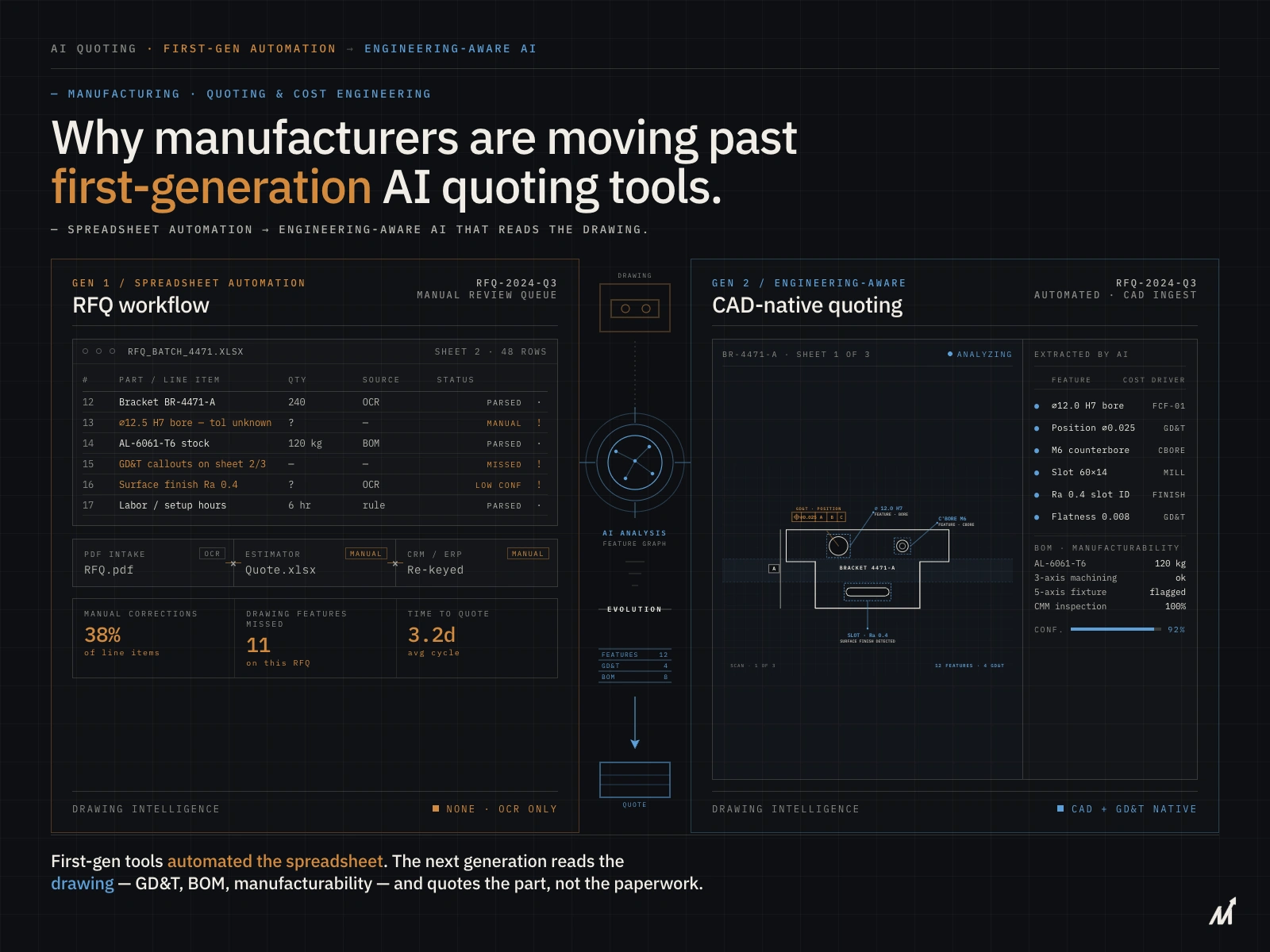


A CAD-PLM Manager at a global ceramics manufacturing company recently described their quoting challenge in precise terms. They needed automated cost estimation from CAD models, drawings, and BOMs — across machining, fabrication, and assemblies. They were already running a PLM system, generating STEP and DXF files downstream, and using a dedicated cost engineering tool. What they were looking for was something that improved speed and accuracy at the point where drawings meet cost.
That’s the metal fabrication quoting challenge at its core. The drawings exist. The data is in them. Getting to it accurately and fast enough to win the job is where most shops lose margin before production ever starts.
Metal Fabrication Is a Margin Game — And Quotes Are Where It’s Won or Lost
Metal fabrication shops compete on price. Margins are thin. Jobs go to the shop that quotes accurately, quickly, and confidently.
A quote that comes in too high loses the job. A quote that comes in too low wins the job and loses money on it.
Both outcomes trace back to the same starting point — the drawing read.
Fabrication shops that quote consistently and profitably aren’t necessarily faster than their competitors. They are more accurate at the point where the drawing enters the cost model. That accuracy compounds across every job, every week, every quarter. Shops that get it wrong consistently absorb the gap as overhead and don’t always connect it to where the cost model broke down.
It broke down at the drawing.
What a Misread Drawing Costs a Fabrication Shop
A misread drawing doesn’t announce itself. The quote goes out. It looks complete. The job gets won or lost on price. The error surfaces later, at procurement, at production, or at delivery, when the actual cost of what the drawing specified doesn’t match what was priced.
In metal fabrication specifically, three categories of drawing specifications drive cost in ways that don’t appear in a standard parts list. When they get missed or misread at the quoting stage, the gap between the quoted price and the actual job cost is predictable and preventable.
1. Alloy grade
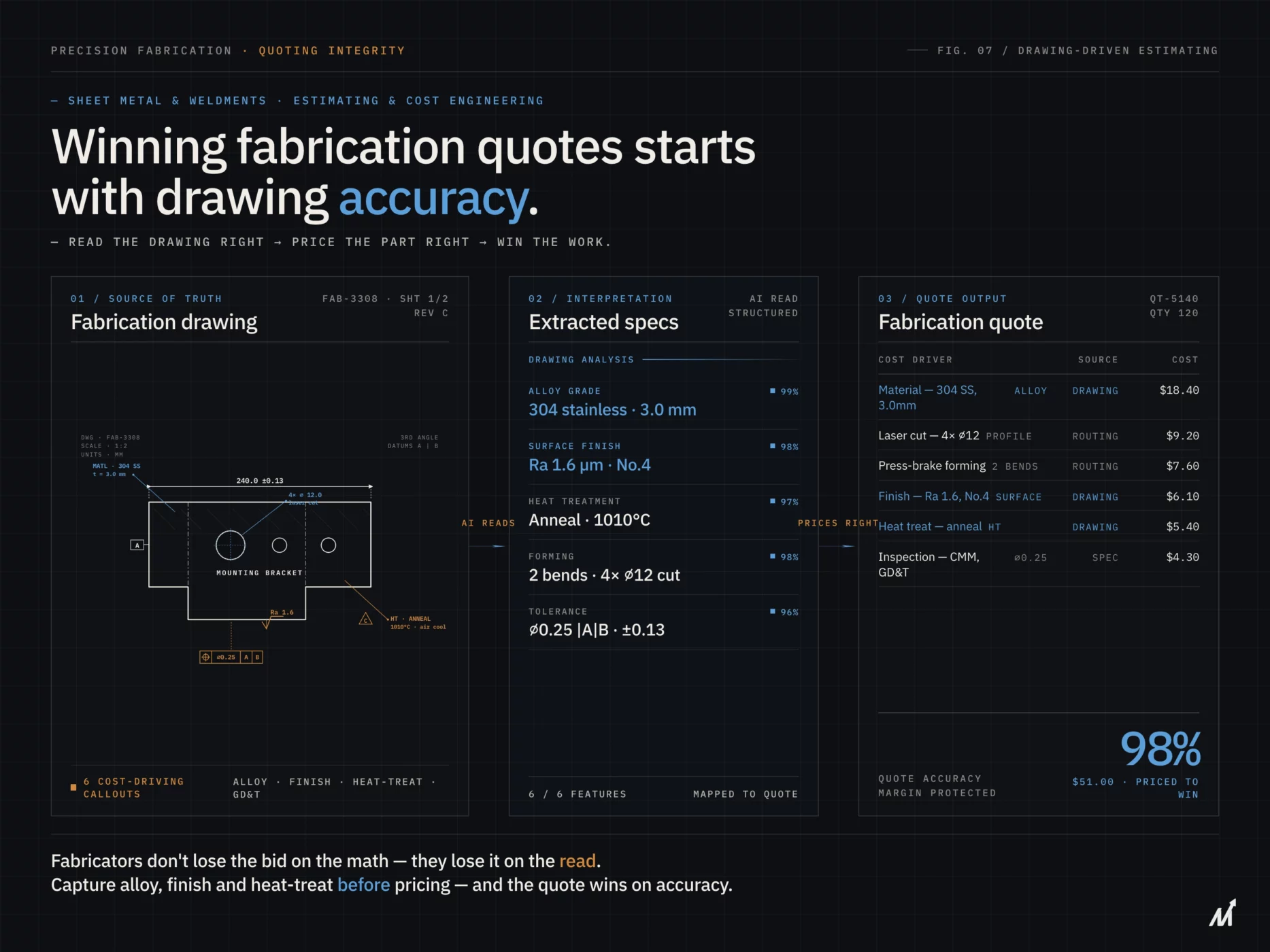
A drawing that specifies 316L stainless steel is a different cost model than one specifying 304. The difference in material cost, machinability, weld behaviour, and supplier pricing is significant. When an estimator reads “stainless steel” from a parts list table without identifying the specific grade callout in the drawing, the cost model reflects the wrong material. The supplier invoices to the specification. The quote was written for something cheaper.
2. Heat treatment
Heat treatment requirements on a metal fabrication drawing — stress relieving, annealing, hardening, case hardening — add process steps, time, and cost that don’t appear prominently in the geometry. A fabricated structural component that requires post-weld stress relief carries a different production cost than one that doesn’t. When heat treatment callouts get missed at the quoting stage, those process costs disappear from the estimate. They reappear on the production floor invoice.
3. Surface finish
Surface finish specifications — Ra values, coating requirements, plating specs — determine what post-fabrication processing the part requires. Tighter Ra specifications require additional machining or finishing operations beyond standard fabrication. Coating and plating requirements add supplier steps with their own lead time and cost. When surface finish requirements get read as aesthetic notes rather than manufacturing requirements, the quote is missing a cost category entirely.
These three aren’t edge cases. They appear on most metal fabrication drawings.
Read more about how engineering BOM errors that start at the drawing stage compound through every downstream cost component.
Alloy Grade, Heat Treatment and Surface Finish — Cost Drivers, Not Notes
Most quoting tools read what’s written in the parts list. The parts list rarely captures these three specifications completely.
Alloy grade callouts live in the drawing’s material specification block or title block — not always in the parts list table. Heat treatment requirements appear as notes on the drawing face or in a separate process specification referenced from the title block. Surface finish callouts appear as symbols on individual features — not as line items anyone types into a table.
When a quoting tool reads the table and misses the drawing, all three disappear from the cost model simultaneously.
That’s not an edge case. It’s the standard failure mode of extraction-based quoting tools in metal fabrication environments. The tool produces a BOM. The BOM looks complete. The alloy is wrong, the heat treatment step is missing, and the surface finish requirement was never priced.
AI Blueprint Classifier reads the drawing. Alloy grade specifications, heat treatment process notes, and surface finish symbols all enter the cost model as manufacturing requirements. Not as text to transcribe, but as cost drivers to price.
Where Manual Drawing Interpretation Breaks Down
Metal fabrication drawing packages are rarely simple. A fabricated assembly might combine plate steel, structural sections, machined components, and weld details across multiple drawing sheets. Each sheet carries its own specifications. Some reference standards, ASTM material grades, AWS weld symbols, and ISO surface finish callouts, that require domain knowledge to interpret correctly.
Manual estimation handles this through experience. A skilled estimator reads the drawing, recognizes the alloy callout, accounts for the heat treatment step, and factors in the surface finish requirement. That works when the estimator has the domain knowledge, the time, and the complete drawing set in front of them.
It breaks down into two specific situations.
1. At volume
A foam fabrication operation recently described a similar challenge — needing to extract part dimensional geometry from PDF, DXF, and STEP files, calculate perimeters across parts, and generate a cost summary automatically. The geometry was in the files. Getting to it manually, across every part in every package, wasn’t scalable. The same constraint applies to metal fabrication shops handling high volumes of custom RFQs. Manual drawing review works on ten jobs. It creates systematic gaps on a hundred.
2. At complexity
A manufacturing engineering team at a global process systems company, running PTC Windchill as PLM and generating STEP and DXF files for downstream processes, wanted automated cost estimation that could support Design to Cost thinking across a complex product portfolio. The challenge wasn’t reading one drawing. It was maintaining cost accuracy across drawings that reference multiple CAD environments and downstream formats. Manual interpretation at that scale introduces variability that compounds across the entire cost engineering process.
How AI Reads Metal Fabrication Drawings Differently
AI that reads drawing geometry approaches metal fabrication specifications differently from tools that transcribe parts list tables.
Alloy grade callouts
They get read as material specifications, not text labels. The system identifies the specific grade, maps it to the correct material cost and machinability profile, and carries that into the cost model. A drawing specifying 316L stainless steel produces a different cost output than one specifying 304. The distinction enters the estimate automatically.
Heat treatment requirements
They get read as process steps, not notes. A post-weld stress relief requirement or a hardness specification enters the system as a production step with associated time and cost, not as a drawing annotation that disappears before pricing begins.
Surface finish specifications
They get processed as manufacturing requirements. A tight Ra value or a coating specification triggers the correct post-fabrication process in the cost model. The quote reflects what the part actually requires.
For operations generating STEP and DXF files from CAD and PLM environments, AI engineering intelligence platforms accept those formats natively. The geometry in the file becomes the input to the cost model, removing the manual translation step between design and estimation entirely.
Learn more about how AI for quotations and cost estimation connects drawing intelligence to accurate cost outputs.
How Markovate’s Engineering Intelligence Platform Powers Metal Fabrication Quotes
Fabrication shops that handle complex drawing packages, tight material specifications, and high volumes of custom RFQs are operating in an environment where quoting accuracy is a direct commercial advantage. When a shop quotes a job correctly- on alloy, on heat treatment, on surface finish- it earns the margin it expects.
The engineering drawing intelligence platform, powered by CADIAM™, gives fabrication shops that advantage. It reads metal fabrication drawings at the geometry level — identifying alloy grade callouts as material specifications, processing heat treatment notes as production steps, and interpreting surface finish symbols as manufacturing requirements.
It accepts PDF, DXF, and STEP formats natively, allowing teams to move outputs from CAD and PLM environments directly into estimation without manual translation. The platform analyzes multi-sheet drawing packages as connected assemblies rather than individual pages and identifies cross-sheet specification conflicts before they impact the cost model.
For fabrication operations with org-specific costing logic, material pricing agreements, shop-specific process rates, and supplier relationships that affect cost, the system configures around those variables. The output reflects how the shop actually prices work. Not how a generic algorithm assumes it does.
Manufacturers who have moved to drawing-accurate estimation report fewer post-award surprises, more consistent margins across RFQ cycles, and estimating teams focused on cost strategy rather than document parsing.
Book a demo to scope a focused pilot on your actual drawing packages and material specifications.
Conclusion: The Fabrication Shops Winning on Price Are Getting the Drawing Right First
Metal fabrication is a competitive market. Every shop is trying to win the same jobs on price. The ones that do it profitably, consistently, across high volumes of custom RFQs aren’t just faster. They are more accurate at the point that matters most.
The drawing reads.
When alloy grade, heat treatment, and surface finish enter the cost model correctly — from the drawing geometry, not from a generalized parts list assumption — the quote reflects the job. The margin holds. The shop competes not by undercutting but by knowing exactly what the job costs before committing to a price.
That’s the commercial advantage that drawing accuracy delivers. And it starts before anyone opens a pricing template.
FAQs: Metal Fabrication Quotes
1. Why do metal fabrication quotes often miss actual production costs?
Most metal fabrication quoting workflows read the parts list table rather than the full drawing geometry. Alloy grade callouts, heat treatment requirements, and surface finish specifications don’t appear prominently in standard parts lists — they appear in the drawing itself. When those specifications get missed or misread, the cost model is incomplete before any pricing calculations begin.
2. How does alloy grade affect metal fabrication quote accuracy?
Alloy grade affects material cost, machinability, and weld requirements, so misidentifying it leads to inaccurate quotes. Since suppliers still manufacture and invoice to the correct specification, the shop ends up absorbing the resulting margin loss.
3. What role does heat treatment play in metal fabrication cost estimation?
Heat treatment requirements add process steps, stress relieving, hardening, and annealing, that increase fabrication time and cost. When estimators miss heat treatment callouts during quoting, they leave those costs out of the estimate. Production teams still perform the required work, forcing the business to absorb the resulting cost overrun.
4. How does AI handle STEP and DXF files in metal fabrication quoting?
AI that accepts STEP and DXF formats natively reads part geometry directly from the file output of CAD and PLM environments. Dimensional data, material specifications, and feature geometry enter the cost model from the drawing itself — removing the manual translation step between design output and estimation input.