

Most job shops that lose margin on a job don’t lose it in the spreadsheet. The shop rate was right. The setup time was there. The estimator did everything correctly — and still the job came in over cost.
The drawing was misread. Someone trusted a parts list that nobody updated after the last revision. A tolerance got treated as a label instead of a manufacturing requirement. By the time the first number went into the template, the real damage was already done.
The problem isn’t the spreadsheet — it’s what feeds it. When the input is a misread drawing, a manually built parts list that’s two revisions behind, or a tolerance callout nobody accounted for, even the most disciplined quoting process produces the wrong number.
This blog breaks down where job shop cost estimation actually breaks down, what cost components estimators consistently miss from drawings, and how AI changes the starting point by reading multi-sheet drawings, tracking revisions, and structuring critical details before estimation even begins.
What Is Job Shop Cost Estimation — And Why It’s Harder Than It Looks
Job shop cost estimation is the process of calculating what it will cost to produce a custom part or assembly before committing to a price. Unlike high-volume production runs where costs stabilize over time, every job in a job shop is different — different geometry, different materials, different tolerances, different sequence of operations.
That makes quoting genuinely hard. There’s no historical average to fall back on. Every RFQ requires a fresh read of a drawing, a fresh interpretation of what the part needs, and a fresh calculation of what that costs.
Get one of those reads wrong, and the entire quote is wrong. And in a job shop where every job is unique, there’s no production volume to average out the error. It hits the margin directly, one job at a time.
Key Cost Components Every Job Shop Must Account For
A complete job shop estimate covers more than materials and labor. Each component connects directly back to the drawing, which means a misread at the source ripples through every line item that follows.
1. Materials
These are the most visible cost components and the most frequently mispriced. When the BOM a team derives from a drawing carries missing components, wrong quantities, or an outdated material specification, the majority of the quote builds on a flawed foundation before anyone touches the pricing template.
2. Machining and labor
These costs flow directly from what the drawing actually requires. Cycle time, setup time, and number of operations all of these come from the geometry and tolerances on the drawing. A rough estimate of “similar to last time” holds until the tolerances tighten or the geometry changes, and then it doesn’t.
For job shops serving aerospace and defense customers, this complexity increases further — drawings often carry MIL-STD and AMS specifications that add strict material and process requirements that a general estimate template won’t capture.
3. Tooling and consumables
These are the costs that disappear most often from manual estimates. Cutting tools, fixtures, deburring time, surface treatments, none of these appear prominently on a drawing, but they accumulate quickly on a complex job. Teams that build estimates manually tend to undercount these consistently, and the gap shows up as unplanned cost once the job is on the floor.
4. Overhead and shop rate
These need to reflect actual costs, not industry averages or what the shop charged two years ago. When the rate in the template doesn’t match the real cost of running the floor, every hour quoted gives away margin that the estimator never sees.
5. Inspection and quality requirements
These add costs that vary significantly depending on GD&T callouts and customer specifications. A part with general block tolerances and a part requiring CMM inspection on every unit are not the same cost model, even if they look similar on the drawing at a quick glance.
For shops handling Controlled Unclassified Information (CUI) drawings from DoD or aerospace customers, inspection requirements carry additional documentation and traceability obligations that add time and cost to every job.
Where Job Shop Cost Estimation Actually Goes Wrong
The standard list of quoting mistakes, wrong shop rate, missed setup time, and underestimated scrap is real. But there’s an upstream failure that those lists consistently skip.
Every manual estimation workflow starts with someone reading a drawing and deciding what it says. That interpretation step, which revision is current, what the parts list reflects, and how tolerances affect machining, becomes the foundation on which everything else builds. When that foundation is wrong, a more intelligent spreadsheet doesn’t fix it. It just calculates the wrong answer more efficiently.
Three things go wrong at the drawing stage more than anywhere else:
The parts list and the geometry don’t match
Engineering drawings are updated in revision cycles. The geometry gets updated. The parts list table, manually maintained, gets updated inconsistently. By the time a drawing reaches an estimator, the parts list may be one or two revisions behind the actual design. An estimator who trusts that table builds a quote from an outdated starting point.
In multi-revision drawing packages, manually tracking what changed between Rev A and Rev B — and what that means for materials, tolerances, and operations — is a task that takes hours and introduces its own interpretation risk.
Multi-sheet drawings get read as individual pages
A complex machined assembly might span 15 drawing sheets. Each sheet covers a subcomponent or detail view. The BOM only makes sense when all sheets are read together, cross-referenced as a connected set. Most manual estimation reads each page in sequence.
Sheet classification — identifying which sheets cover assemblies, details, sections, or title blocks — is a step that manual review handles inconsistently, and that inconsistency is where cross-sheet discrepancies slip through.
It misses when the same part number carries different material specs on sheet 4 versus sheet 12, or when a fastener referenced on sheet 9 doesn’t appear anywhere in the parts list.
Read more on how BOM discrepancies create downstream cost problems that are expensive to fix.
GD&T gets treated as a label, not a cost driver
A tolerance callout isn’t just a number on a drawing. It determines what equipment the shop needs, what inspection process applies, and what a supplier charges. A tight true position tolerance at MMC requires CMM inspection on every part. A flatness callout of 0.005mm on a large surface requires surface grinding. These requirements add real cost — cost that doesn’t show up if GD&T gets read as an annotation rather than a manufacturing requirement.
For shops receiving both 2D PDF drawings and 3D STEP files from the same customer, discrepancies between the two are a specific and common failure point — the 2D drawing may carry updated tolerances that the 3D model doesn’t reflect, and manual review rarely catches the mismatch before quoting.
For a closer look at how tolerance decisions affect supplier pricing, see our post on AI for GD&T interpretation.
Why the Problem Starts With the Drawing, Not the Spreadsheet
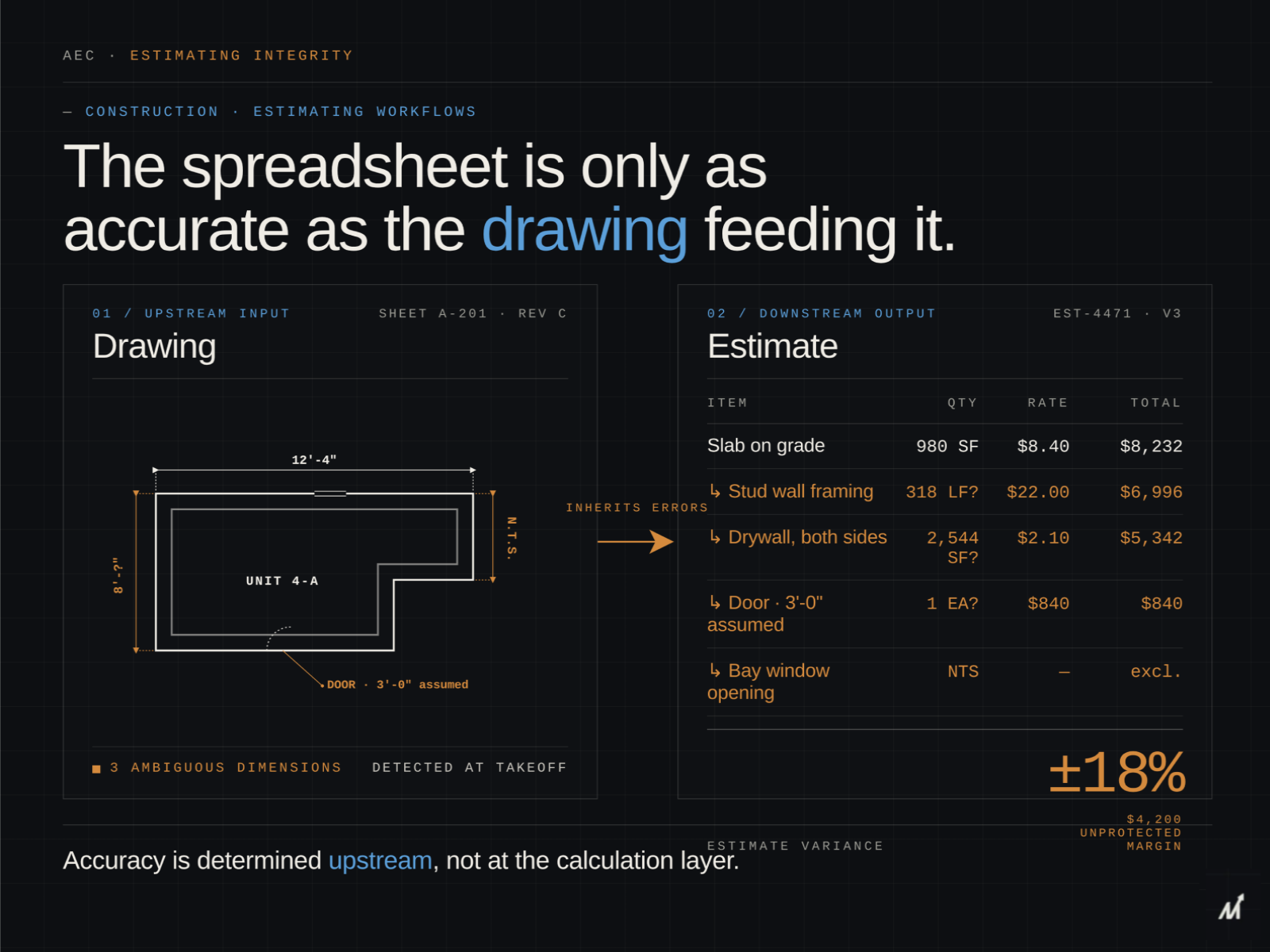
In most job shop quoting failures, the estimator did their job correctly. They applied the right shop rate, accounted for setup time, and included tooling. They quoted the part that the parts list described. The parts list just didn’t describe the actual part.
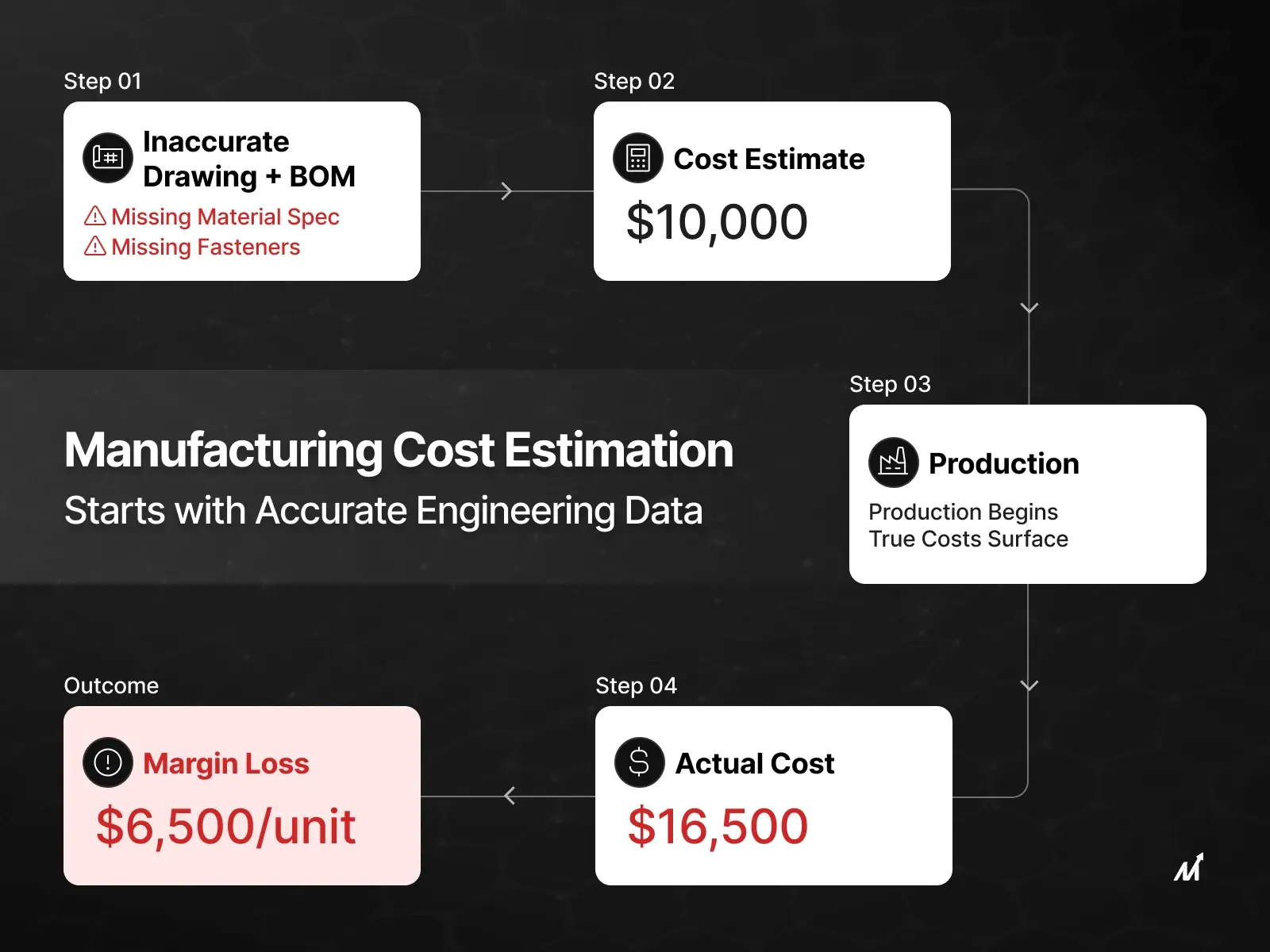
That gap, between what the drawing shows and what the parts list claims, is where margin disappears in job shop manufacturing. It’s not visible in the quote. It’s not visible when the job is won. It shows up at production, when materials don’t match, or post-delivery, when the customer’s assembly doesn’t fit.
Fixing the quoting workflow, better templates, faster software, and revised rate tables address the calculation layer. It doesn’t address the interpretation layer. And the interpretation layer is where the error is entered.
Many estimation processes still rely on engineers manually reviewing drawings and extracting information. Manual review slows down RFQ turnaround and increases variability in cost outcomes. When inputs are wrong, quotes are wrong.
Quote accuracy, for a job shop, is a drawing accuracy problem first. Everything downstream of that, the BOM, the cost model, the final price, is only as reliable as the read that produced the inputs.
Learn more about how manufacturing cost estimation depends on drawing and BOM accuracy working together.
How AI Changes Job Shop Cost Estimation From the Ground Up
When AI reads a drawing, it doesn’t read the parts list table. It reads the geometry, the shape data, feature relationships, tolerance callouts, material specifications, and assembly structure across all sheets simultaneously.
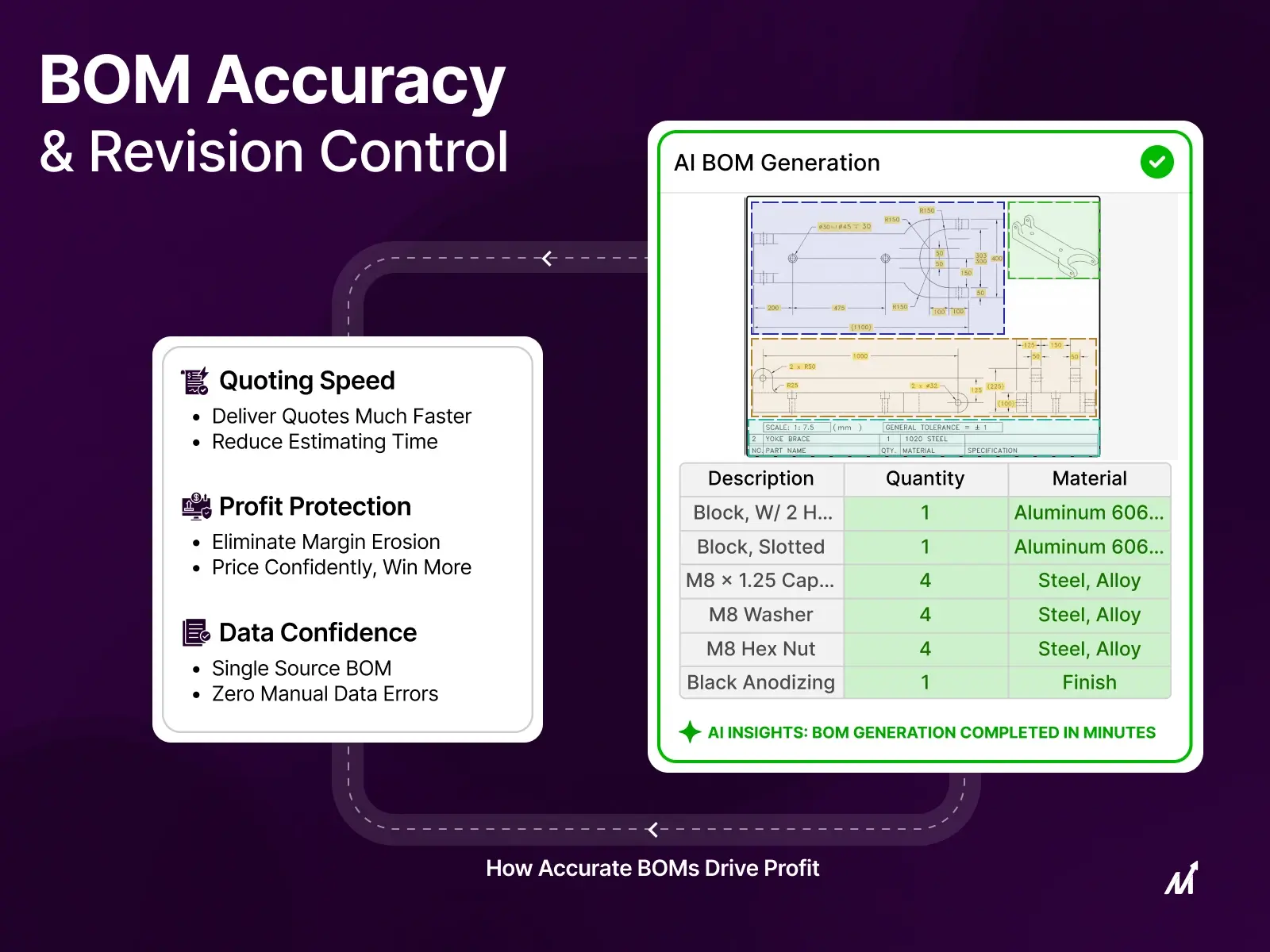
The BOM it produces isn’t a transcription of what someone typed into a table. It’s derived from what the drawing actually shows.
That changes the estimation workflow in three ways.
The BOM reflects the current drawing, not the last update
Because AI reads geometry rather than a manually maintained table, revision lag disappears. The output reflects the drawing as it is today, not as someone documented it three revisions ago.
Automated revision diff flagging goes further — it identifies exactly what changed between drawing revisions, so estimators know which line items need repricing and which remain unchanged. This turns a multi-hour manual comparison into a flagged, reviewable output.
Multi-sheet drawing sets are read as connected assemblies
Part numbers, material specs, and component relationships are cross-referenced across every sheet in the package simultaneously. Automated sheet classification identifies each sheet’s role in the package — assembly, detail, section, schematic — before extraction begins, so the system processes each sheet in the right context rather than treating every page as equivalent.
Discrepancies, conflicting specs across sheets, and referenced components that aren’t detailed anywhere in the set get flagged before they reach the estimator.
GD&T callouts become cost inputs, not annotations
Tight-tolerance features generate distinct line items with the machining and inspection requirements they actually carry. The cost model that follows reflects the part the drawing specifies, not a generalized version of it.
When a customer submits both a 2D PDF and a 3D STEP file, AI can run a 2D vs 3D comparison automatically — surfacing any discrepancy between the two before it enters the BOM or the quote.
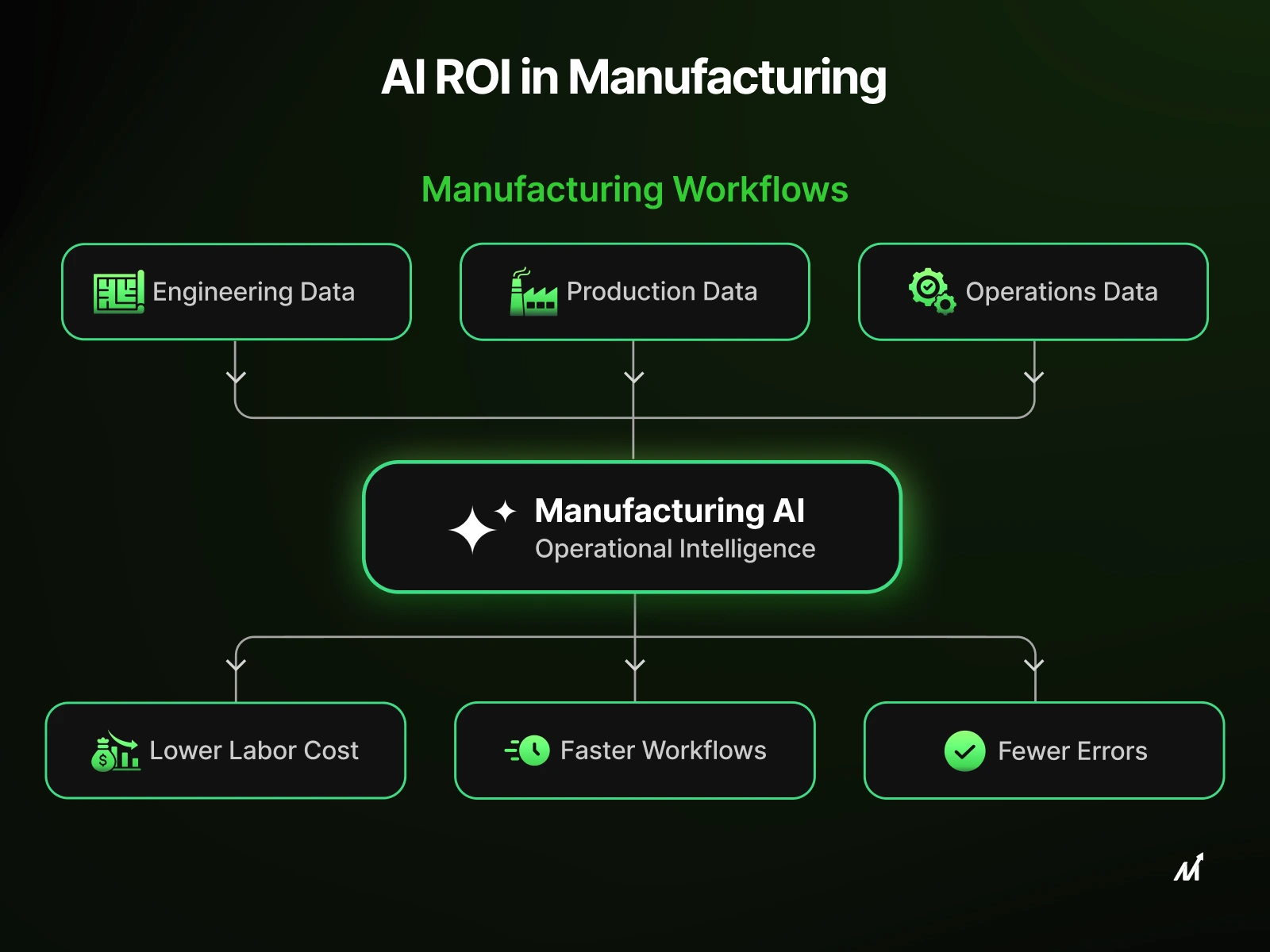
The result is a starting point for estimation that’s complete, current, and aligned with actual manufacturing requirements. The estimator spends their time on cost strategy, shop rate optimization, supplier selection, and margin decisions, rather than on parsing drawing packages and hoping the parts list is up to date.
For a detailed look at how engineering BOM errors start before quoting and how to stop them upstream, see our recent post.
How Markovate’s AI Blueprint Classifier Powers Accurate Job Shop Quoting
Job shops face a quoting challenge that gets harder as volume grows — more RFQs, more complex drawings, tighter turnaround expectations, and less margin for interpretation error on any individual job.
Markovate’s AI Blueprint Classifier bridges this gap. The platform reads engineering drawings, PDFs, DWGs, and STEP files at the geometry level rather than transcribing what a manually maintained parts list claims.
It validates GD&T callouts against ASME Y14.5 standards, cross-references part numbers and material specifications across complete multi-sheet drawing packages, and generates structured MBOMs, BBOMs, and Bills of Quantities with confidence scores on every line item — so estimating teams know exactly where to trust the output and where a quick review adds value. Outputs export directly into ERP, PLM, and inventory systems, so the structured data flows into quoting workflows without additional manual processing.
For job shops serving DoD, aerospace, and defense customers, the platform is deployed with security controls aligned to federal requirements, with data residency configured based on customer and regulatory needs, including region-specific deployments where required. This ensures compliance across government contractors and their supply chains before any AI system touches controlled engineering data.
For job shops, this means the estimation process starts from a foundation that reflects what the drawing actually shows today, not what a designer documented three revisions ago.
As Jason Porter, VP of Engineering & Program Management at MPP Innovation, put it:
“Markovate’s AI Blueprint Classifier helped us significantly accelerate our cost and timeline estimations. The automation and accuracy it brought to blueprint analysis have become a major value-add to our pre-production process.”
Connect with us to see how it applies to your RFQ workflow.
Conclusion: Win More Jobs Without Underpricing Them
Job shops don’t lose margin because their estimators aren’t skilled. They lose it because the inputs those estimators work from are wrong before the first number gets entered.
Fixing that starts one step earlier than most quoting improvements focus, at the drawing itself. When the BOM comes from the drawing’s geometry rather than a manually maintained table, when GD&T callouts enter the cost model as requirements rather than labels, and when multi-sheet packages are read as complete assemblies rather than individual pages, the quote that comes out the other end actually reflects the job.
That’s not a faster version of the same process. It’s a more accurate one. And in job shop manufacturing, accuracy is the margin.
FAQs
1. What is job shop cost estimation?
Job shop cost estimation is the process of calculating the full cost to produce a custom part or assembly before pricing a job. It covers materials, machining, labor, tooling, inspection, and overhead. It has to be done fresh for every RFQ because every job in a job shop is unique.
2. Why do job shop quotes often lose margin?
Most margin loss in job shop quoting traces back to the drawing read, not the calculation. Outdated parts lists, multi-sheet drawing inconsistencies, and GD&T callouts that don’t make it into the cost model all create a gap between the quote price and actual production cost.
3. How does AI improve job shop cost estimation?
AI reads drawing geometry directly rather than transcribing manually maintained parts lists. It cross-references multi-sheet drawing packages, parses GD&T as cost-driving manufacturing requirements, and produces BOMs that reflect the current drawing state. This gives estimators a reliable, complete starting point before any calculations begin.
4. What’s the difference between job shop estimating and standard manufacturing cost estimation?
In standard high-volume manufacturing, cost models stabilize over production runs, and historical data drives pricing. In job shop estimating, every job is unique — custom geometry, custom tolerances, custom material specs. There’s no volume to average out an error, so drawing accuracy at the individual job level matters more directly to the margin.