

Quote turnaround time gets blamed on pricing. In most shops, that’s not where the delay actually comes from.
The RFQ usually waits on the experienced estimators who can read the print correctly. Tolerances need checking. A casting might only have a 2D drawing to work from, with no 3D model available. By the time the quote is ready, the buyer has often already committed to whoever answered first.
Quote turnaround time measures that whole gap, not just the pricing math at the end of it. It’s the distance between an RFQ landing in an inbox and a number the buyer can actually act on.
This blog looks at what’s really driving slow turnaround, what it costs beyond the obvious for heavy industries like manufacturing, and where AI actually closes the gap.
What Counts as Slow Quote Turnaround Time
Quote turnaround time is the gap between an RFQ arriving and a quote going out the door. For most shops, that gap runs one to three days. For complex, multi-process, or aerospace-grade parts, it can stretch past a week.
Buyers don’t wait around for the best quote. They act on the first credible one. A shop that responds in a day competes on capability. A shop that takes a week competes with whoever else was too slow to answer first.
Why does turnaround vary so much by part type
A simple bracket with a clean 3D model and one process might get quoted in an hour. A casting that moves into machining and assembly, with only a 2D print to work from, can take days before an estimator even reaches the pricing step. The variation isn’t random. It tracks directly with how much manual reading the drawing demands.
Turnaround as the first filter, before price
Buyers use turnaround as their first filter, often before price is even part of the conversation. A buyer with five bids on the table has already ruled out the slowest responders by the time the fastest quote is under real evaluation.
The Real Cost — Lost Deals, Not Just Lost Hours
Slow turnaround doesn’t just delay revenue. It erases it, quietly, in ways that rarely show up in a monthly report.
Deals that never get a quote at all
Every shop tracks the RFQs it quoted and lost. Almost none track the RFQs that never got a quote at all, because the backlog was too deep and the deadline passed first. That number is often larger than the lost-quote number, and it stays invisible until someone goes looking for it.
Margin given away to win back speed
Some shops compensate for slow turnaround by cutting prices once they finally respond, trying to win back the ground lost to a faster competitor. That’s a margin sacrificed to make up for a scheduling problem, not a pricing one.
Estimator hours spent on jobs that were already lost
Every hour spent building a quote for a job the buyer already awarded elsewhere is an hour not spent on the next RFQ. Slow turnaround compounds itself: the backlog grows faster than the team can clear it, and the next RFQ waits even longer.
Reputation with repeat buyers
Buyers who send RFQs regularly notice patterns. A shop that consistently responds late gets deprioritized on future bid lists, even when its pricing and quality are competitive. Turnaround becomes a reputation, not just a metric on one job.
Why the Drawing Determines How Fast a Quote Goes Out
Most shops assume the bottleneck is pricing. It usually isn’t.
Where the hours actually go
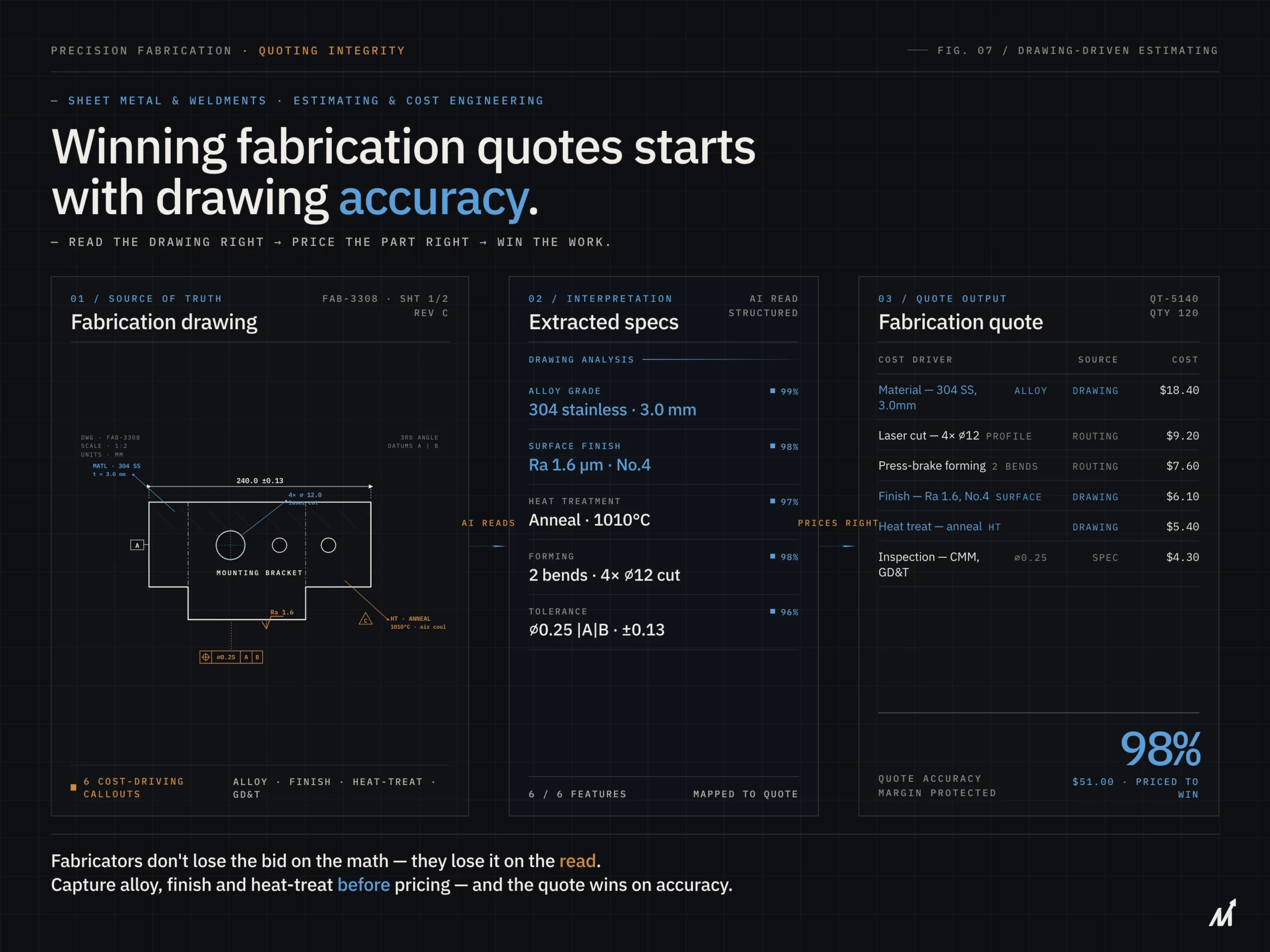
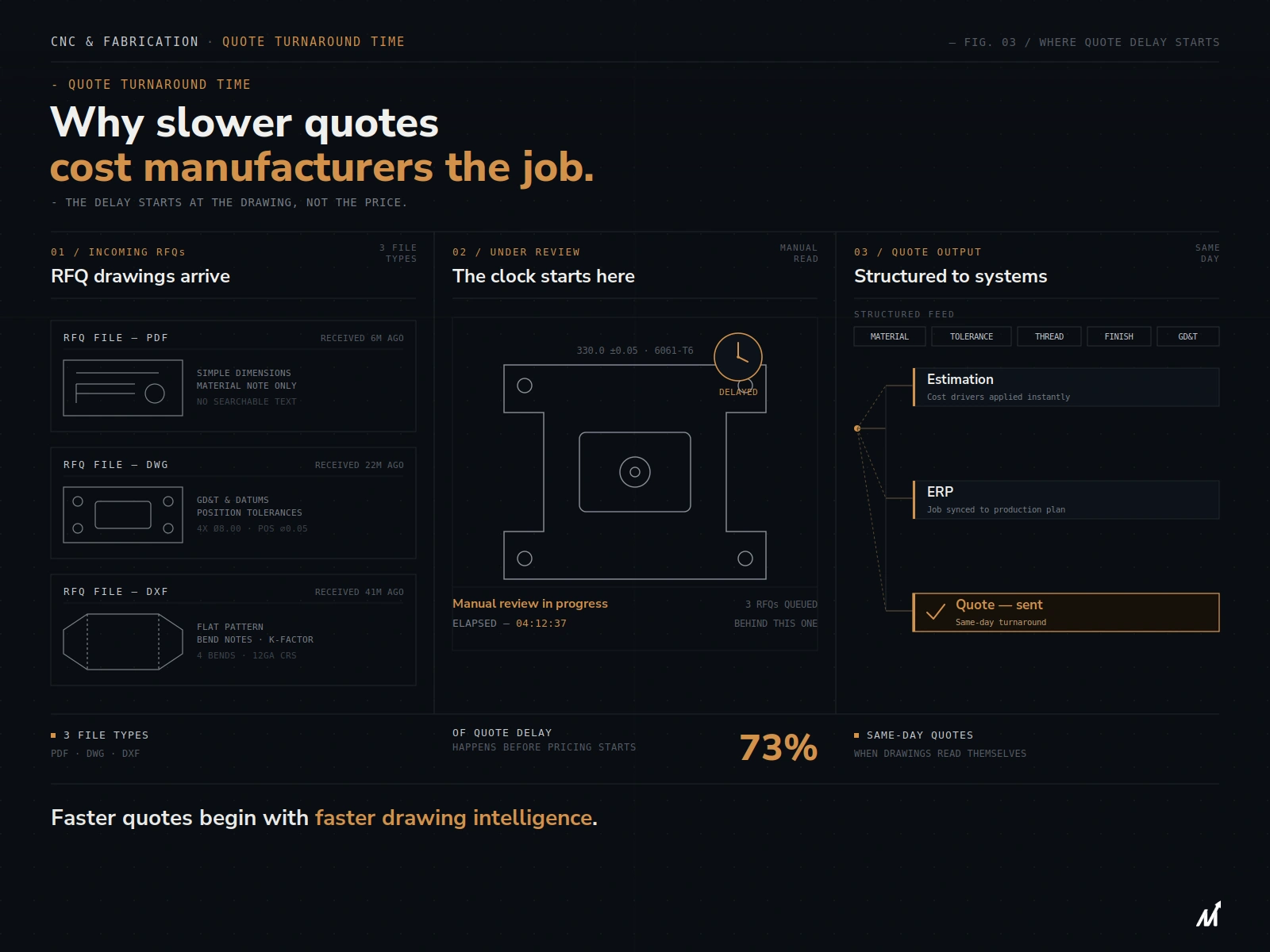
The actual pricing math — machine rates, material costs, markups — takes an estimator minutes once the inputs are known. What eats the hours is getting to that point: reading the print, pulling dimensions and tolerances by hand, checking GD&T callouts, cross-referencing material specs, and re-keying all of it into a quoting tool or spreadsheet.
See how AI blueprint interpretation pulls this data directly from the drawing instead of by hand.
When there’s no 3D model to fall back on
For a part with only a 2D print and no 3D model, that step takes even longer. Job shops working with castings often face exactly this. A drawing shows the geometry, but there’s no CAD file to upload into most quoting software, so the estimator falls back to a manual takeoff before pricing can even start. Material thickness that varies across a casting adds another layer of manual checking that most quoting tools were never built to handle.
When a part spans more than one process
For parts that move through more than one process — a permanent mold casting, machined, then assembled — the problem compounds. Each stage needs its own cost inputs pulled from the same drawing: tooling and draft angles for the casting, machining time and setup for the CNC step, labor and purchased components for assembly. Reconciling all three into a single number, done by hand, is where hours disappear.
Read more on how manufacturing cost estimation breaks down across stages like these.
The pricing engine was never the constraint. Getting clean, structured data out of the drawing was.
Why Every Complex Quote Waits on Your Most Experienced Estimator
Most shops can name the one or two people who handle the hardest quotes. Everyone else routes complex RFQs to them by default, because they are the only ones who can read a print fast and correctly.
The bottleneck is judgment, not headcount
That concentration is the real turnaround bottleneck. It’s not that quoting software is missing. It’s that the judgment required to read a drawing accurately sits in one or two heads, and every complex RFQ has to wait its turn behind whatever they’re already working on.
The same pattern across different shops
This shows up across very different operations. A job shop with a casting and only a 2D print needs someone who can read tolerances and material call-outs without a 3D model to lean on. A manufacturer evaluating new quoting platforms for its estimating department is often doing so precisely because the current process depends too heavily on one person’s availability.
A precision manufacturer running its design and cost engineering through an established PLM system still hits the same wall, because the PLM stores the drawing, it doesn’t read it. The details differ. The bottleneck is the same.
How AI Closes the Turnaround Gap Without Sacrificing Accuracy
Closing the gap doesn’t mean pricing faster. It means getting an estimator to the pricing stage faster, with the reading and re-keying work already done.
Reading the drawing directly, in any format
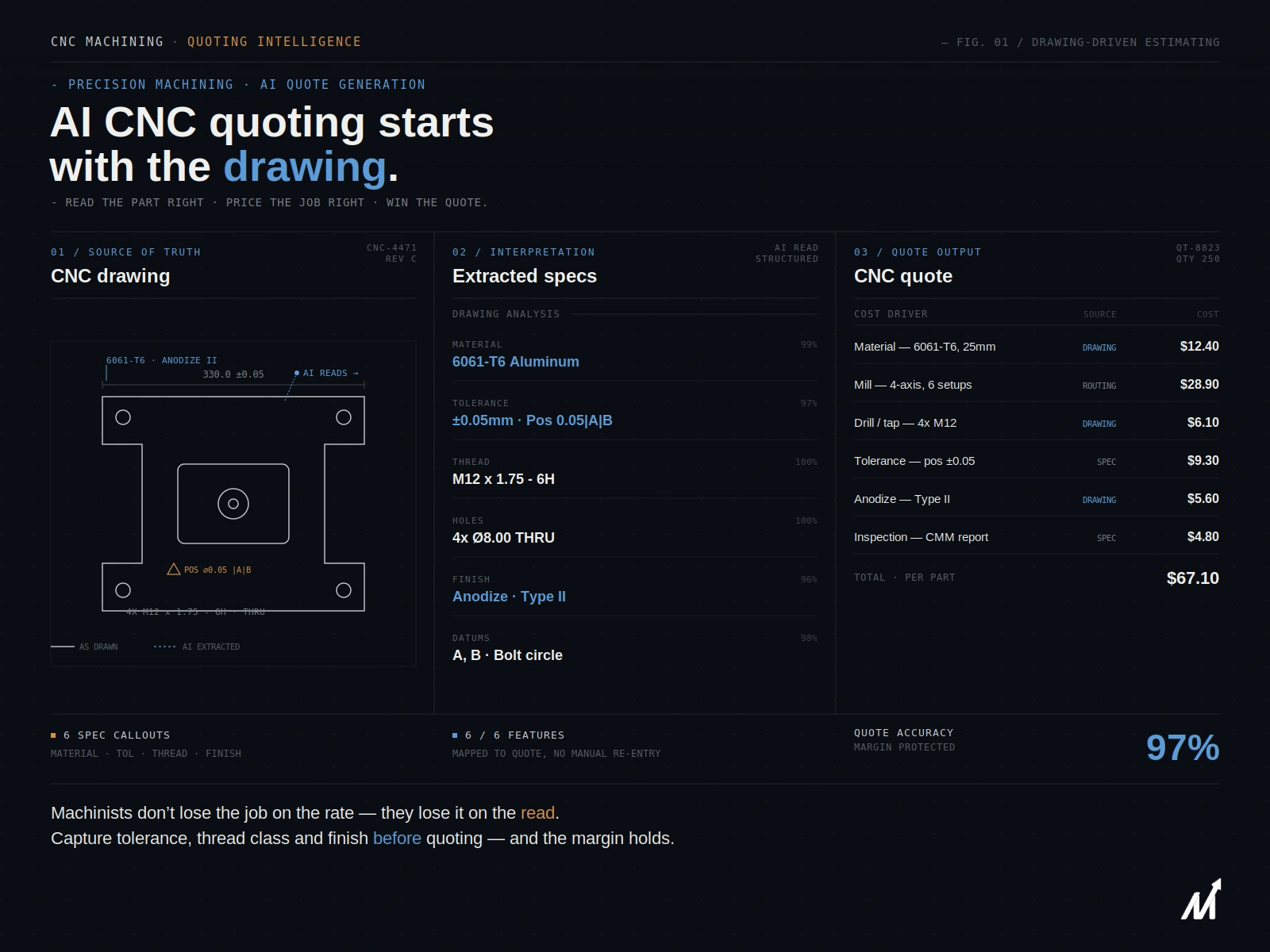
AI drawing extraction reads a print directly — DWG, DXF, STEP, PDF, or a scanned copy — and pulls out dimensions, tolerances, GD&T callouts, and material specs as structured data. It works without a 3D model and without manual re-keying.
Flagging multi-process jobs automatically
For multi-process parts, this matters even more. The system can flag which features push a part into a different process route, so a casting-and-machining job gets priced as one structured job instead of three separate manual estimates stitched together afterward.
Keeping the estimator’s judgment in the loop
The estimator still makes the calls that need judgment: unusual tolerances, edge-case materials, pricing exceptions. What disappears is the hour spent transcribing a print before any of that judgment can even begin. Turnaround drops because the manual step disappears, not because anyone is rushing the review.
How Markovate Gets You From Drawing to Quote Faster
Manufacturers losing bids to slower turnaround usually don’t have a pricing problem. They have a reading problem, and it repeats on every RFQ that lands.
Markovate’s engineering drawing intelligence platform, AI Blueprint Classifier, powered by CADIAM™, reads a drawing and stages the quote before an estimator ever opens it. The reading step that used to eat most of the turnaround happens automatically, on every job, regardless of format or volume.
Our Product: AI Blueprint Classifier
From drawing geometry to a staged cost build-up
The platform’s Quote Agent pulls cost inputs straight from drawing geometry and builds the cost line by line: material cost per part, machining runtime for the specified process, setup time amortized across the run quantity, and tooling or fixturing cost amortized the same way.
For a machined aluminum part, that might mean a line for 6061-T6 material, a line for three-axis milling runtime, and separate amortized lines for setup and fixturing — each one tied directly to the geometry feature that produced it.
Every line traces back to the drawing
That traceability matters as much as the speed. Each cost line cites the exact feature or cost-catalogue entry the engine read it from, so an estimator can check the logic in seconds instead of re-deriving it from scratch.
If a number looks wrong, the estimator can see exactly why the engine quoted what it did and override it, with the audit trail carrying through into the ERP.
Run-quantity and margin priced live, not estimated
Run-quantity breaks reprice live as the estimator adjusts quantity, showing the price-break logic behind every tier instead of one aggregated number. Margin adjusts on a slider, with win probability re-scored in real time against the customer’s own quote history — not an industry average — so the estimator can see what a price move actually buys in win odds before committing to it.
One extraction pipeline, several connected agents
The same extraction pipeline that powers the Quote Agent also runs the platform’s GD&T and BOM agents, so tolerance data and bill-of-materials rows feed straight into the cost build-up instead of getting keyed in twice. For P&ID-heavy environments like oil and gas or EPC, a separate agent handles digitization and tag extraction on the same underlying engine, structuring extracted data into the asset hierarchy the operation requires.
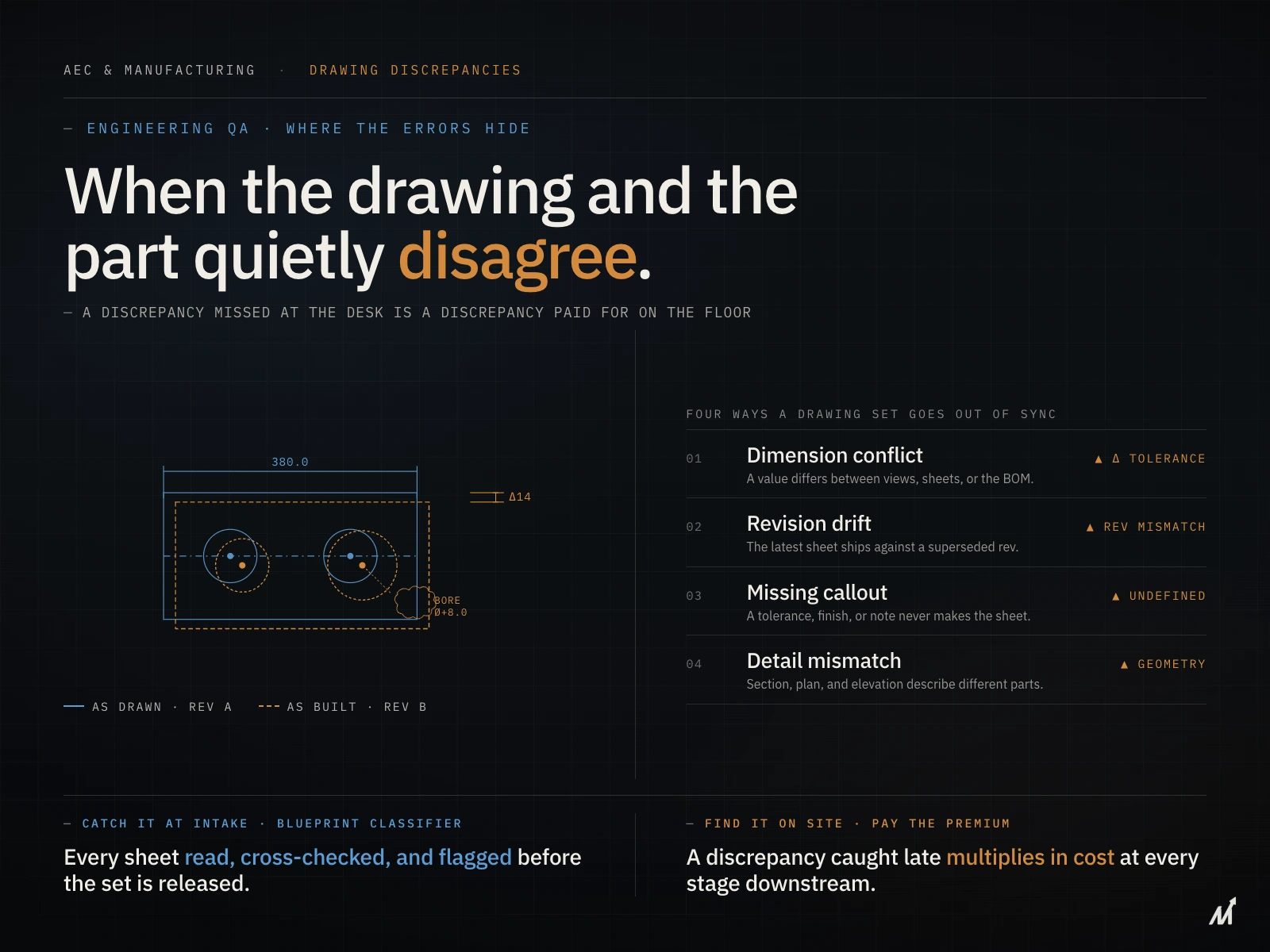
A comparison agent flags what changed between drawing revisions, and a takeoff agent applies the same extraction logic to construction and materials takeoff. All of it runs on one platform, so data captured once by one agent doesn’t need re-entry by another.
Built for enterprise data and compliance requirements
Each deployment runs in its own tenant, on Azure US or Azure EU depending on the customer’s data-residency requirement, with data encrypted in transit and at rest. There’s no cross-customer training and no shared pricing data between tenants.
The platform is built on Markovate’s ISO 27001-certified and ISO 9001-certified delivery infrastructure, which matters for manufacturers handling defense, aerospace, or other controlled drawings. Quotes export directly into the customer’s existing ERP as the system of record, rather than living in a separate tool the team has to reconcile by hand.
Conclusion: Quote Turnaround Is a Drawing Problem, Not a Pricing Problem
Most shops try to fix quote turnaround by tightening the pricing process. That’s rarely where the time goes.
The hours disappear earlier — reading the print, chasing tolerances, reconciling a multi-process job by hand, waiting for the one estimator who can do it correctly. Fixing that step does more for turnaround than any pricing shortcut ever will.
Faster reading gets you to a faster quote. Not the other way around.
FAQs: Quote Turnaround Time for Manufacturers
1. What is a good quote turnaround time for manufacturers?
Most competitive shops respond within one to two days for standard parts. Complex or multi-process jobs often take longer unless the drawing-reading step is automated.
2. Why does quote turnaround time matter more than price?
Buyers often commit to the first credible quote they receive. A shop with strong pricing but slow turnaround still loses the job to whoever answered first.
3. What actually slows down quote turnaround the most?
Reading and interpreting the drawing, not calculating the price. Manual takeoff, tolerance checks, and re-keying data into a quoting tool consume most of the time.
4. Can AI improve quote turnaround without impacting accuracy?
Yes. AI extraction handles the repetitive reading and data structuring, while estimators still review flagged exceptions and make the final judgment calls.
5. Does AI quoting software work without a 3D CAD model?
Yes. AI drawing extraction can read a 3D file like STEP when one exists, but it doesn’t require one. It reads 2D prints, DXFs, and scanned PDFs directly, so a missing 3D model doesn’t stall the quote.