


Due diligence is becoming increasingly complex as businesses navigate larger data volumes, tighter timelines, and higher expectations for accuracy. Traditional manual review methods, once central to financial, legal, operational, and compliance assessments, often struggle to keep pace.
Generative AI is emerging as a practical solution. According to Accenture research, 70% of professionals believe generative AI will help generate higher-than-expected returns on M&A transactions, while 84% see its potential to enhance the reliability, efficiency, and speed of planning and executing these deals.
By automating repetitive tasks, analyzing unstructured data, and identifying critical patterns, Gen AI allows teams to make faster, more informed decisions. Its applications extend across industries such as M&A, legal, real estate, insurance, technology, manufacturing, private equity, and finance, helping organizations streamline compliance checks, reduce manual effort, and uncover key insights.
This blog explores how generative AI is reshaping modern due diligence, highlighting its practical applications, business benefits, and opportunities for organizations.
Table of Contents
- What Is Gen AI in Due Diligence?
- Key Use Cases of Gen AI in Due Diligence Across Industries
- Business Benefits & ROI of Using Gen AI for Due Diligence
- How Markovate Helps Businesses Deploy Gen AI for Due Diligence
- Conclusion
- FAQs
What Is Generative AI in Due Diligence?
Generative AI in due diligence uses advanced AI models, including large language models and transformers, to automate and enhance the evaluation of financial, legal, operational, and compliance data. Instead of manually reviewing thousands of documents, Gen AI processes large datasets, extracts insights, and generates context-aware summaries and reports quickly.
It goes beyond basic automation by understanding unstructured data, identifying patterns, and producing actionable outputs, such as risk snapshots, contract summaries, or tailored due diligence reports. This is especially valuable for industries handling high volumes of data under tight timelines, including M&A, legal, real estate, insurance, technology, manufacturing, private equity, and finance.
Why Gen AI Matters in Modern Due Diligence
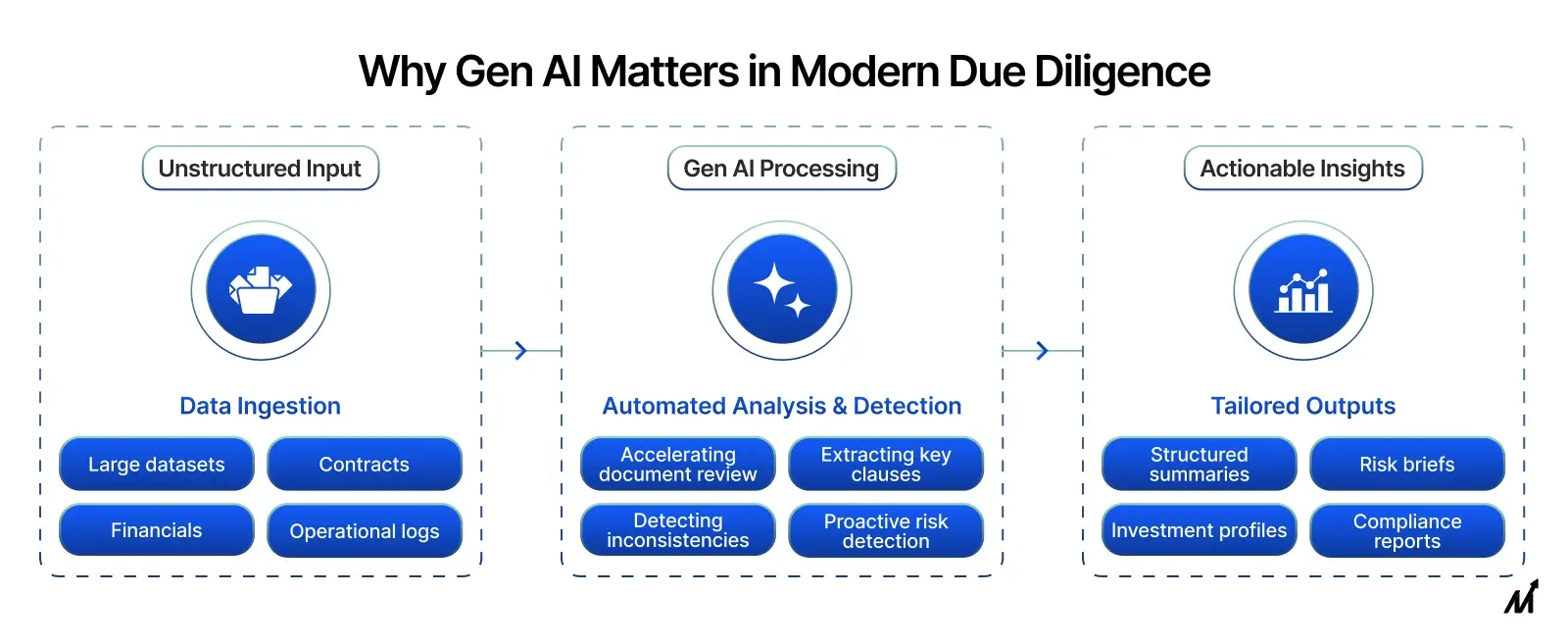
Due diligence requires a thorough review of documents, cross-checking data, and assessing risks. Traditional methods are time-intensive and prone to oversight. Generative AI enhances the process by:
- Automating repetitive analysis: It quickly reviews large datasets, allowing teams to focus on complex judgment calls instead of manual data sorting.
- Improving accuracy and depth of insight: AI detects inconsistencies, risks, and patterns that may go unnoticed in manual review.
- Accelerating document and contract review: Using NLP, Gen AI extracts key clauses, obligations, risks, and anomalies from legal and financial documents.
- Supporting proactive risk detection: By scanning historical and real-time data, it highlights potential red flags early in the evaluation process.
- Producing tailored due diligence outputs: It generates structured summaries, risk briefs, or investment profiles aligned with the team’s requirements.
The Value It Brings
Generative AI combines speed, analytical precision, and contextual reasoning to reduce operational workload and strengthen decision-making. It enables organizations to turn complex data into actionable insights, improving efficiency, ensuring compliance, and enhancing competitive advantage across industries.
Key Use Cases of Gen AI in Due Diligence

Generative AI is reshaping the due diligence landscape by accelerating analysis, improving accuracy, and reducing manual effort. Below are the most relevant and in-demand use cases organizations are adopting today.
1. Automated Document Intelligence
Due diligence requires reviewing thousands of pages across contracts, financials, compliance documents, and communication records. Gen AI dramatically speeds up this stage by:
- Classifying documents based on relevance or risk
- Extracting key metrics, clauses, and obligations
- Highlighting inconsistencies or missing information
- Summarizing long documents into clear, decision-ready insights
This enables teams to reduce manual reading workloads and focus on deep analysis.
2. Contract Review & Legal Risk Analysis
Gen AI’s natural language processing capabilities allow it to navigate complex legal language with impressive accuracy. It can:
- Flag non-standard clauses
- Identify liability-heavy terms
- Compare contract versions
- Detect regulatory compliance gaps
This shortens legal review cycles and reduces the risk of unnoticed issues
Read this blog to know how AI helps in legal document analysis.
3. Financial and Operational Risk Detection
By analyzing structured financial reports and unstructured sources like emails or operational logs, Gen AI helps identify patterns such as:
- Revenue inconsistencies
- Fraud indicators
- Litigation exposure
- Vendor or supply-chain vulnerabilities
The system can score risks and prioritize areas requiring deeper investigation.
4. Regulatory & Compliance Monitoring
Compliance issues can significantly impact deal value. Gen AI supports teams by:
- Tracking regulatory updates across jurisdictions
- Mapping compliance requirements to internal documents
- Identifying gaps in controls, policies, or disclosures
This reduces the chance of post-transaction surprises.
5. Data Extraction, Clean-Up & Normalization
Due diligence involves merging data from multiple formats and systems. Gen AI can:
- Extract key data from PDFs, spreadsheets, and scanned files
- Normalize metrics into consistent formats
- Tag documents for governance and audit trails
This improves accuracy and saves analysts hours of manual prep work.
Secondary Use Cases
These use cases are important but typically supplement the core diligence workflow.
6. Deal Screening & Early Red-Flag Detection
Performs initial scans for financial, reputational, or regulatory concerns before allocating resources.
7. Customer & Counterparty Due Diligence
Automates identity verification, risk scoring, and transaction pattern analysis, particularly valuable in banking, fintech, and insurance.
8. ESG & Sustainability Assessment
Consolidates ESG reports, news sentiment, and compliance data to evaluate environmental and governance risks.
9. Intellectual Property & Technology Due Diligence
Analyzes patents, licensing terms, code quality, and IP risks, especially relevant in tech and biotech deals.
10. Supply Chain Risk Evaluation
Maps supplier relationships and identifies operational, ethical, or geopolitical risks that affect continuity.
11. Financial Anomaly & Fraud Detection
Highlights suspicious patterns in expenses, transactions, or reporting that indicate fraud or misstatement.
12. Automated Reporting & Stakeholder Summaries
Generates dashboards, red-flag summaries, and executive-ready reports, streamlining communication with stakeholders.
How Different Industries Are Using GenAI in Due Diligence
a) Financial Services
In banking and fintech, GenAI accelerates credit checks, flags anomalies in financial statements, and strengthens AML/KYC processes. Teams rely on AI to detect fraud patterns early and to evaluate counterparties more accurately, making financial risk assessments far more data-driven than before.
b) Private Equity & M&A
Deal teams use GenAI for faster target screening, operational assessments, and contract analytics. It helps surface red flags, model scenarios, and benchmark performance, enabling investors to move quickly without compromising depth during competitive deal cycles.
c) Real Estate
Property due diligence becomes more efficient with AI-driven lease abstraction, title review, valuation analysis, and zoning verification. GenAI reduces the manual burden of reviewing hundreds of pages of legal and financial documents associated with each asset.
d) Manufacturing & Supply Chain
AI maps supply chains, evaluates supplier compliance, and identifies geopolitical or operational risks. It helps companies assess ESG exposure, product quality issues, and potential disruptions, which are critical during acquisitions or vendor onboarding.
e) Technology & IP-Heavy Industries
Here, GenAI examines patent databases, analyzes code repositories, and reviews cybersecurity posture. This allows acquirers to validate IP ownership, detect vulnerabilities, and assess the scalability or technical debt of a target company’s products.
f) Insurance
Insurers leverage GenAI to analyze claims history, identify fraud patterns, and evaluate underwriting risks. It supports more accurate customer profiling and ensures compliance with evolving regulations during transactions or partnerships.
With these practical applications in mind, it becomes clear that generative AI is not just streamlining processes, it is also delivering measurable value. The next section explores the tangible business benefits and return on investment that Gen AI brings to the due diligence process.
Business Benefits & ROI of Using Gen AI for Due Diligence
Generative AI is reshaping due diligence as it offers measurable benefits for businesses while enhancing decision-making.
1. Enhanced Efficiency
AI automates time-intensive tasks such as document review, data extraction, and contract analysis. By handling repetitive processes, it significantly reduces turnaround times and frees up teams to focus on strategic and high-value activities, improving overall productivity.
2. Improved Accuracy and Risk Management
Through advanced algorithms and natural language processing, generative AI identifies patterns, anomalies, and potential risks that may go unnoticed in manual reviews. This leads to more reliable insights, minimizes human errors, and strengthens the overall risk assessment process.
3. Cost Optimization and ROI
By reducing manual effort and accelerating workflows, generative AI lowers operational costs while enhancing the depth and quality of analysis. Businesses can achieve clear returns on investment through faster decision-making, more thorough evaluations, and optimized resource allocation.
4. Informed Decision-Making
Generative AI provides actionable insights that support better decision-making in mergers, acquisitions, investments, and partnership evaluations. By consolidating and analyzing large volumes of structured and unstructured data, AI empowers teams to make well-informed strategic choices.
5. Strategic Advantage
Organizations leveraging generative AI gain a competitive edge by streamlining due diligence, improving regulatory compliance, and enhancing transparency for stakeholders. This enables businesses to navigate complex transactions efficiently and confidently.
In summary: Generative AI transforms due diligence by combining automation with advanced analytics, enhancing efficiency, accuracy, and decision-making, and delivering measurable business value.
Building on these benefits, Markovate leverages its deep AI expertise to deliver customized generative AI solutions that transform due diligence into a faster, more accurate, and strategically actionable process for businesses across industries.
AI-Enhanced Due Diligence, Designed for Accuracy and Impact with Markovate
In today’s fast-paced business environment, due diligence is no longer just about completing checks quickly; it’s about doing it smarter, safer, and more strategically. Markovate leverages generative AI to transform complex diligence workflows into precise, data-driven decision engines.
Partnering with Markovate means tapping into an ecosystem designed to maximize impact:
- Intelligent AI pipelines: Deploy tailored AI and machine learning models that seamlessly integrate into your workflows, tackling your unique diligence challenges.
- Scalable, future-ready solutions: Built on a flexible architecture, our systems grow with your business, managing increasing data volumes without compromising speed or accuracy.
- Cross-domain expertise: Combining AI, data science, and industry insights, our teams provide end-to-end support, from strategic design to full deployment.
- Rapid time to value: Implement custom AI solutions efficiently, accelerating actionable insights and decision-making in weeks, not months.
- Proven outcomes across sectors: Deliver measurable ROI in finance, healthcare, manufacturing, legal, and beyond, transforming diligence from a process into a strategic advantage.
- Trustworthy and compliant AI: Embed transparency and governance into every model, ensuring regulatory readiness and ethical AI use.
- Continuous optimization: Post-deployment monitoring, model retraining, and proactive updates ensure long-term efficiency and accuracy.
Proven Impact Across Industries
A strong example comes from a U.S.-based investment management firm that implemented an AI-powered system to automate the consolidation of operational and financial data for quarterly investor reports.
Tasks that previously took weeks were reduced to hours, while AI-generated insights improved accuracy and highlighted key trends for better decision-making. This demonstrates the potential of AI to accelerate data analysis, enhance reporting, and provide actionable intelligence – capabilities that Markovate brings to due diligence workflows across industries.
With Markovate, AI doesn’t just speed up due diligence; it amplifies your team’s strategic capabilities, allowing professionals to focus on interpreting insights, managing risks, and making informed business decisions.
Conclusion: The Future of Smarter Due Diligence
Generative AI is reshaping due diligence, helping organizations analyze complex information more efficiently and make informed decisions with confidence. By combining advanced data processing with human expertise, businesses can identify risks, uncover insights, and streamline workflows across mergers, acquisitions, investments, and other strategic transactions.
As due diligence evolves, adopting smarter, technology-driven approaches is key to staying competitive and minimizing risk.
Discover how Markovate’s AI-powered solutions can simplify your due diligence process, enhance accuracy, and support faster, more reliable decision-making. Contact for more information!
FAQs: Generative AI in Due Diligence
1. How is generative AI used in due diligence?
Generative AI helps review documents, analyze financial and legal data, detect risks, and create clear summaries or reports much faster than manual methods.
2. What are the benefits of generative AI for due diligence?
It reduces review time, improves accuracy, lowers costs, and helps teams make more confident decisions by analyzing large amounts of data quickly.
3. Can generative AI replace human due diligence teams?
No. It supports teams by automating repetitive tasks and highlighting insights, but human expertise is still needed for judgment, strategy, and final decisions.
4. Which industries use generative AI for due diligence?
Industries like finance, real estate, insurance, manufacturing, technology, private equity, and legal services use it to speed up reviews and reduce risk.