

You invested in CPQ software to speed up quoting. Your sales team has a cleaner workflow. Configurations are more consistent. And yet — quotes are still going out late. Bids are still being lost. Your estimators are still buried.
If this sounds familiar, the problem isn’t your CPQ software. The problem is what happens before CPQ even starts.
Configure, Price, Quote (CPQ) software has become one of the most adopted tools in manufacturing sales — and for good reason. According to a 2025 survey of 500 manufacturing decision-makers, 69% of organizations plan to increase their CPQ investment this year. The promise is real: faster quote turnaround, fewer pricing errors, better margin control.
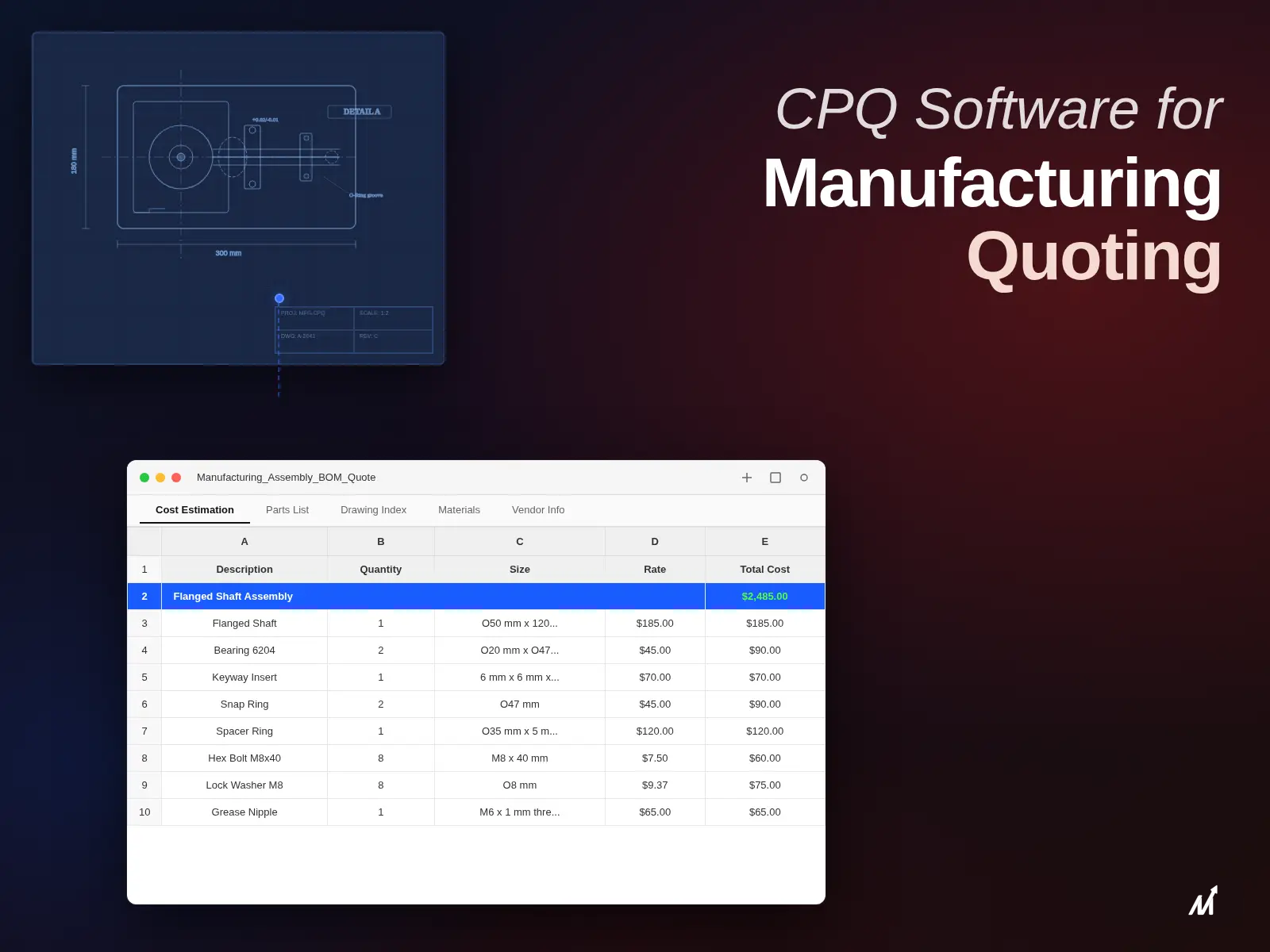
But for manufacturers dealing with custom orders, engineer-to-order products, or complex drawing packages, CPQ only solves half the problem. The other half, the step where your team has to manually extract part counts, dimensions, materials, and tolerances from a 40-sheet PDF before CPQ can do anything — that bottleneck remains completely untouched.
This blog breaks down what CPQ software for manufacturing actually does well, where it falls short, and what a complete quoting setup looks like for manufacturers who are serious about winning more bids, faster.
Why Manufacturers Are Still Losing Quotes Despite Having CPQ
CPQ adoption in manufacturing is at an all-time high. The tools are more capable than ever, and implementations have become faster and more accessible. Yet many manufacturers are still missing bid deadlines, sending inaccurate quotes, and losing contracts to faster competitors.
So what is going wrong?
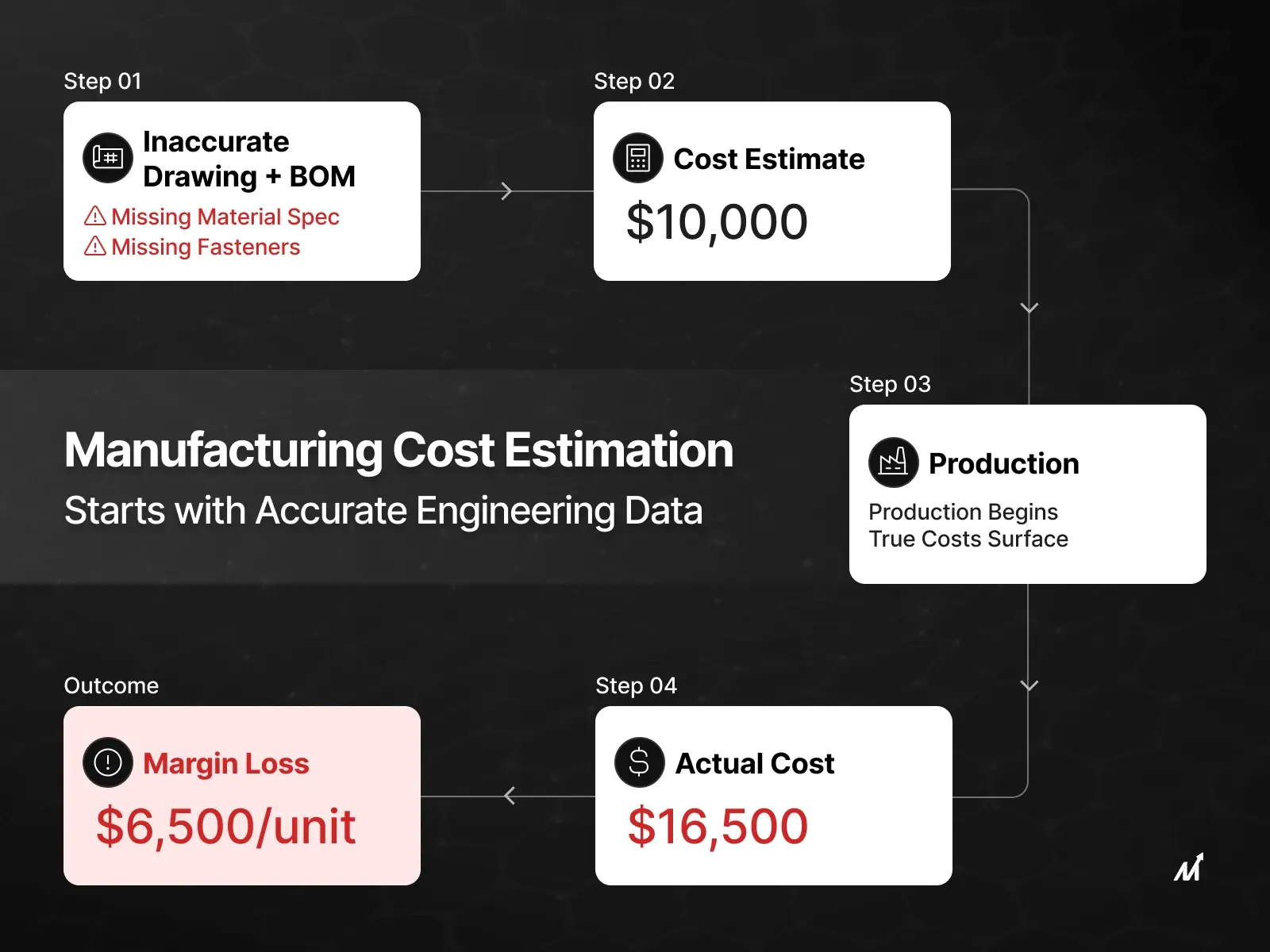
The answer, in most cases, is not the CPQ software itself. It is the assumption behind it — that quoting starts when a sales rep opens the system. For standard, catalog-based manufacturers, that assumption holds. But for engineer-to-order, make-to-order, or custom parts manufacturers, quoting starts much earlier: the moment a customer sends a drawing package.
Before CPQ can configure anything, someone has to manually open that 30 or 40-sheet PDF, extract part numbers, dimensions, tolerances, materials, and surface finishes, and translate all of it into structured inputs the system can work with. That process alone can take anywhere from several hours to multiple days, depending on drawing complexity — and it happens completely outside of CPQ.
This is why manufacturers investing in CPQ still struggle. The bottleneck was never in the configure-price-quote step. It was in the step before it.
What CPQ Software Actually Does (And Where It Stops)
To be clear — CPQ software delivers real, measurable value. According to the same Smart Manufacturing 2025 report (given above), CPQ cuts quoting errors and delays by 36% and improves customer experience by 35%. Manufacturers using CPQ have also reported up to 35% revenue growth within the first 12 months of implementation. Those numbers are not marketing claims; they reflect genuine operational improvement for teams that were previously managing quotes through spreadsheets and email threads.
Here is what CPQ genuinely does well:
1. Product configuration
CPQ enforces engineering rules automatically, ensuring every configuration a sales rep builds is technically valid and manufacturable — without needing an engineer to sign off on every quote.
2. Pricing accuracy
It calculates pricing in real time using live material costs, labor rates, margin thresholds, and customer-specific discount rules. This eliminates the guesswork and pricing inconsistency that erodes margins on manual quotes.
3. Quote generation
CPQ produces professional, customer-ready proposals that can flow directly into your CRM and ERP, thus removing the document preparation time that ties up estimators on low-value tasks.
4. Approval workflows
It flags quotes that fall below profitability thresholds before they go out, giving operations leaders control over margins without micromanaging every deal.
Where CPQ stops is equally important to understand. CPQ works from a product catalog and a set of predefined rules. It assumes the inputs, part specifications, materials, and quantities are already known and structured before the process begins.
For manufacturers selling from a fixed catalog, this works perfectly. For manufacturers responding to custom RFQs with technical drawing packages, CPQ has no ability to read a drawing, extract a BOM, or validate design specifications. That entire upstream layer is outside its scope entirely.
The Real Quoting Bottleneck: It’s Upstream of CPQ
Ask any estimator at a custom or precision manufacturer where their time actually goes, and the answer is almost never “building the quote.” It is reading the drawings.
A typical RFQ for a custom assembly comes in as a package of PDF blueprints, CAD files, and spec sheets. Before a single number goes into a quoting system, someone on your team has to:
- Identify and count every unique component across the drawing set
- Extract dimensions, tolerances, and GD&T specifications for each part
- Determine material types and surface finish requirements
- Cross-reference against any applicable standards, such as ASME or ISO
- Translate all of this into a structured bill of materials
For complex packages, this process takes days. It is also where most quoting errors originate, a missed tolerance, a misread material spec, or a miscounted component quantity that turns a winning bid into a loss-making job.
This is the bottleneck that CPQ cannot touch. And it is why manufacturers who have invested in CPQ often find that their quote turnaround times have not improved as dramatically as they expected. The sales-side workflow got faster. The engineering-side input process did not change at all.
Solving the full quoting problem means solving this upstream step first.
What Happens When You Pair CPQ with AI Drawing Intelligence
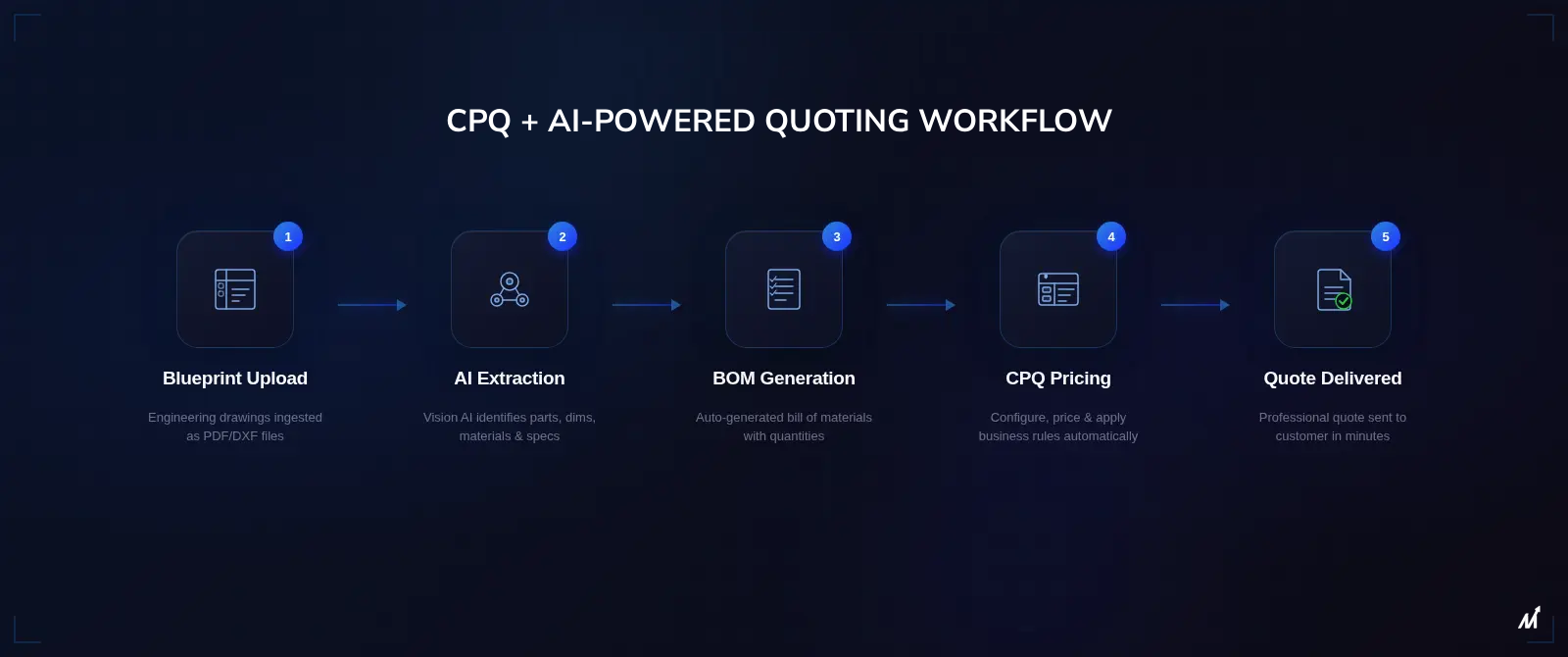
When AI drawing intelligence is added upstream of CPQ, the entire quoting workflow changes.
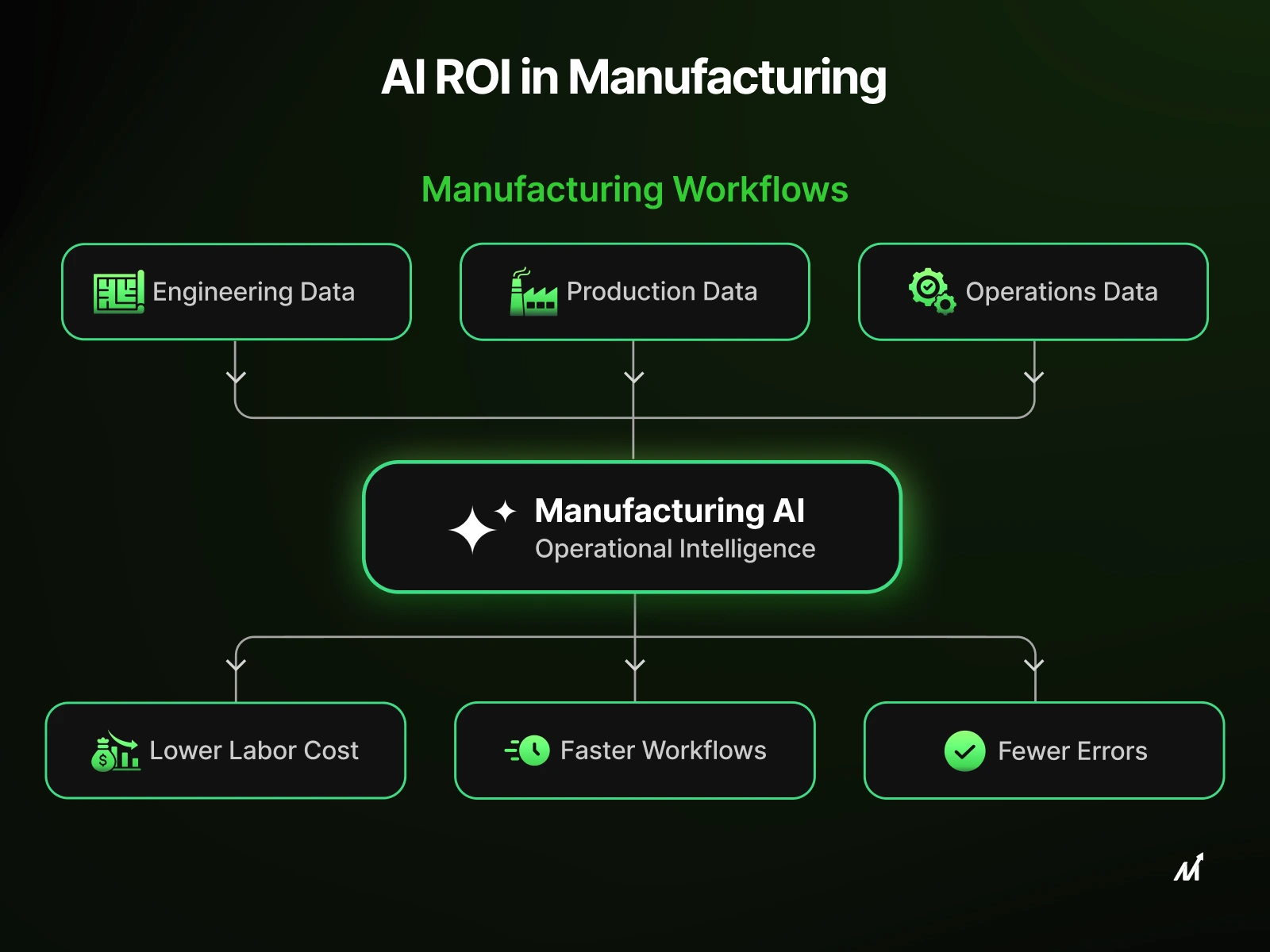
Instead of an estimator manually reading a drawing package and building a BOM from scratch, an AI system ingests the PDF, DWG, or STEP files directly — identifies components, extracts dimensions and tolerances, validates GD&T compliance against ASME and ISO standards, and generates a structured MBOM, BBOM, or BoQ automatically. That output then feeds directly into CPQ or ERP as clean, validated data, ready for pricing and quote generation.
The practical impact is significant. What previously took an estimator two to three days now takes minutes. More importantly, the BOM that enters CPQ is based on verified drawing data, not manual interpretation, which means downstream pricing and proposals are built on a far more accurate foundation.
For manufacturer sales teams, this means responding to RFQs the same day they arrive, even for complex custom assemblies. For operations leaders, it means fewer production holds caused by specification errors that slipped through during manual extraction. For the business as a whole, it means CPQ finally delivers on its full promise, because the data going into it is as fast and accurate as the output coming out of it.
This is not a replacement for CPQ. It is the layer that makes CPQ work properly for manufacturers dealing with custom, engineered products.
Key Features to Look For
Not all CPQ platforms are built for manufacturing complexity. If you are evaluating options, these are the capabilities that separate platforms genuinely suited to manufacturing from generic sales quoting tools:
1. Engineer-to-order support
The platform must handle custom configurations, not just catalog selections. If your products involve variable specs, materials, or design constraints driven by customer requirements, your CPQ needs to accommodate that flexibility without breaking pricing rules.
2. ERP and PLM integration
A CPQ that does not connect to your ERP creates a data re-entry problem that erases much of the efficiency it was meant to deliver. Native integration with SAP, Oracle, or your PLM system ensures that accepted quotes flow directly into production planning without manual handoff.
3. BOM and drawing input compatibility
This is the critical question most buyers skip. Can the system accept structured BOM data from upstream engineering tools, or does everything have to be entered manually from a product catalog? For custom manufacturers, this determines whether CPQ actually reduces quoting time or just reorganizes it.
4. Margin controls and approval workflows
CPQ should automatically enforce your profitability floor and route quotes that need review without relying on a manager to catch every exception manually.
5. Confidence scoring and auditability
For complex configurations, the system should surface where outputs are validated versus where human review is recommended. This is particularly important for aerospace, defense, and precision manufacturing, where drawing accuracy has compliance implications.
How Markovate’s AI Blueprint Classifier Fills the Gap
Markovate’s AI Blueprint Classifier is built specifically to solve the upstream problem described in this blog — the step before CPQ.
It accepts drawing packages in PDF, DWG, and STEP formats and automatically extracts structured BOMs, validates GD&T compliance against ASME Y14.5 and ISO standards, and generates production-ready MBOMs, BBOMs, and Bills of Quantities — in minutes rather than days. Every output comes with a confidence score, so your engineering team knows exactly where to trust the result and where to apply a quick review.
The outputs integrate directly with ERP, PLM, and CAD environments, including SolidWorks, SAP, and PTC Windchill. Further, the structured BOM data flows seamlessly into whatever quoting or production planning system sits downstream, including your CPQ platform.
For VP of Engineering and manufacturing operations leaders dealing with high volumes of custom RFQs, the result is a quoting workflow that is both faster and more accurate — without expanding your estimating headcount. Trusted by engineering teams in aerospace, defense, and precision manufacturing, and deployable on-premise or in air-gapped environments for ITAR-sensitive drawing packages.
You can explore Markovate’s AI Quoting & Estimation solution or read more on AI for quotations and cost estimation in manufacturing to understand how this fits into your broader quoting strategy.
In the End: Is Your Quoting Stack Actually Complete?
CPQ software is a sound investment for manufacturers, but it is only one part of the quoting equation. If your team is still spending days manually extracting data from drawing packages before CPQ can start, the bottleneck has not moved. It has just been relocated.
A complete quoting stack for custom and engineer-to-order manufacturers looks like this:
Drawing intelligence → Structured BOM → CPQ → ERP
Each step feeds the next with clean, validated data. Remove any one of them and the chain breaks — usually at the point where a human has to step in and fill the gap manually.
If you want to see what this looks like in practice on your own drawing packages, Markovate offers a demo under NDA. Your team gets to evaluate real extraction results on your actual files — not a controlled benchmark.
Schedule a demo with our AI expert team to see how AI Blueprint Classifier works in action!