


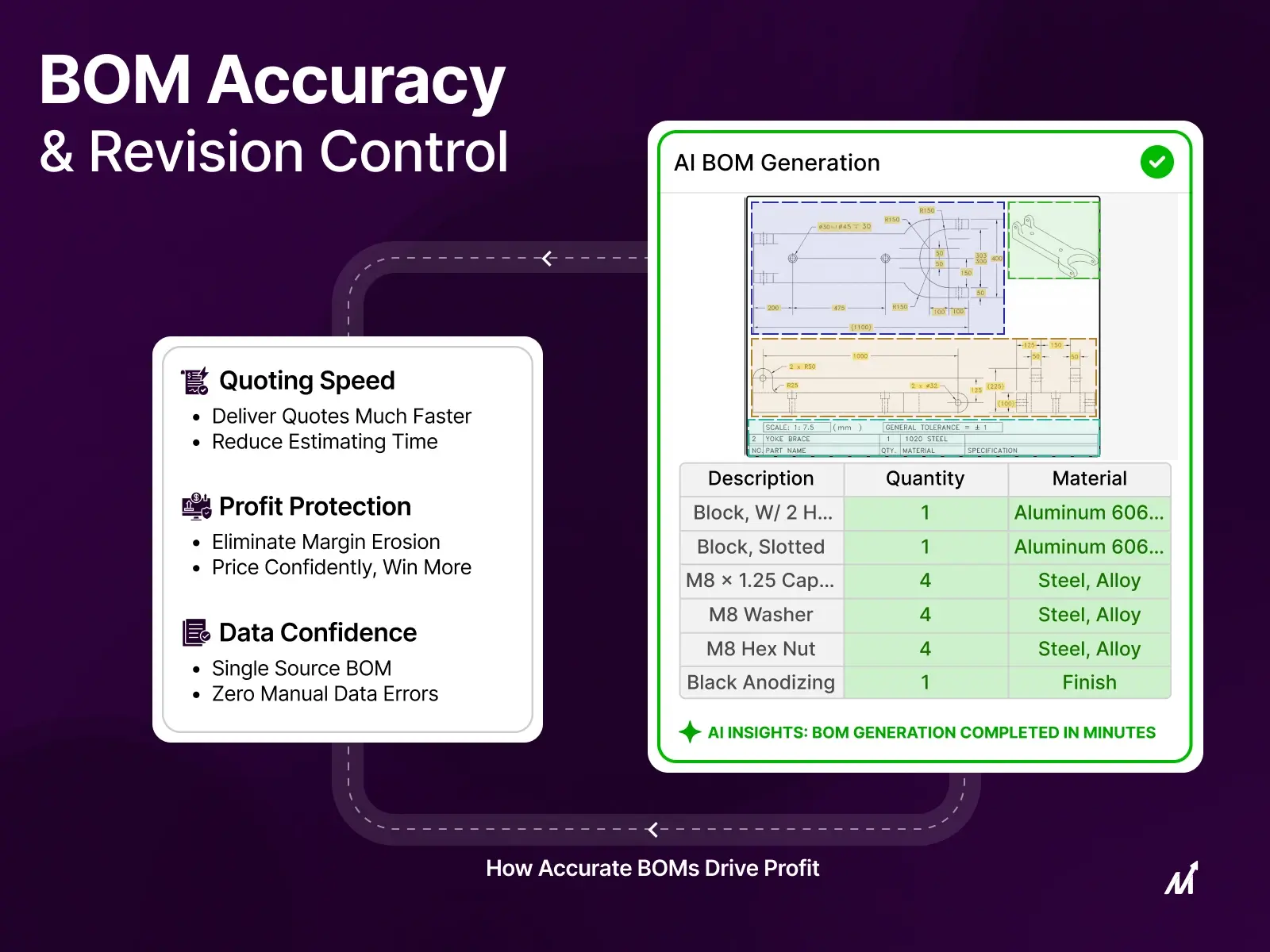
In manufacturing, quote profitability is determined long before production begins. It starts with the Bill of Materials. When BOMs are inaccurate or out of sync with engineering changes, quotes become unreliable, leading to margin erosion, lost RFQs, and costly surprises during production.
Industry research and manufacturing audits consistently show that poor BOM quality and weak change control drive rework, procurement errors, and cost overruns across discrete manufacturing operations. As RFQ cycles shorten and competition intensifies, manufacturers relying on manual BOM creation and informal revision tracking struggle to respond quickly and confidently.
This is why BOM accuracy has emerged as one of the strongest indicators of profitable manufacturing quotes, and why leading manufacturers are rethinking how BOMs are created, validated, and maintained at scale.
Table of Contents
- BOM Accuracy Is a Profit and Quoting Metric
- How BOM Inaccuracy Impacts Manufacturing Quotes & Margins
- Why BOM Revision Control Breaks Down Between Engineering & Estimating
- How Leading Manufacturers Improve BOM Accuracy at Scale
- How Markovate’s AI Blueprint Intelligence Improves BOM Accuracy & Quote Reliability
- Conclusion: Accuracy Is the New Speed
- FAQs
BOM Accuracy Is a Profit and Quoting Metric
In manufacturing, quote accuracy is only as reliable as the data behind it. At the center of that data is the Bill of Materials. When BOMs are inaccurate, incomplete, or misaligned with engineering intent, quoting teams are forced to make assumptions – assumptions that directly impact margins.
In practice, BOM accuracy determines whether a quote reflects actual production requirements or a version of reality shaped by gaps and uncertainty. This is why manufacturers increasingly recognize that quoting challenges are rarely pricing problems; they are data and interpretation problems. As we discussed earlier in our AI for manufacturing quotations, unreliable inputs inevitably lead to unreliable outcomes.
When BOM accuracy breaks down, manufacturers typically see:
1. Material quantity mismatches
Incorrect quantities inflate costs or, worse, understate material requirements, thus leading to margin loss once production begins.
2. Missed or underestimated components
Fasteners, secondary parts, and process-specific items are often omitted during manual BOM creation, especially in complex or high-mix assemblies.
3. Incorrect specifications due to blueprint misinterpretation
Manual review of drawings increases the risk of using the wrong material grade, tolerance, or finish; errors that rarely surface until procurement or production.
4. Late discovery of errors during production
BOM issues identified after a job is released to the floor result in rework, expedited sourcing, and unplanned cost increases.
For enterprise manufacturers responding to high volumes of RFQs, these issues don’t appear as isolated mistakes. They accumulate across quotes, plants, and teams, thus quietly eroding profitability even when win rates look healthy. This is why leading manufacturers treat BOM accuracy not as an engineering task, but as a core input to reliable, repeatable quoting.
How BOM Inaccuracy Impacts Manufacturing Quotes and Margins

Despite its central role, the Bill of Materials is often treated as a reference document rather than a core business asset. When the BOM does not reflect the true scope of a build or the latest engineering intent, it directly undermines the reliability of manufacturing quotes and the profitability of delivered work.
The business consequences of BOM inaccuracy
1. Underquoted jobs → margin erosion
When a BOM misses parts, quantities, or assemblies, the resulting quote underestimates the true cost. The job may be won, but profitability evaporates as material shortages, expedited purchases, and unplanned labor inflate costs later in the process. Companies experiencing this pattern often see unexpected production cost overruns and reactive rush purchases that were never priced into the original quote.
2. Overestimated BOMs → uncompetitive pricing
Conversely, when a BOM overstates quantities or includes unnecessary components, quotes become artificially high. In competitive RFQ environments, this can immediately eliminate a bid, not because of quality or capability, but simply because pricing could not compete. Overestimation often stems from conservative assumptions to avoid risk, but that risk avoidance becomes a strategic liability.
3. Slow, error-prone quoting → lost RFQs
Manual reconciliation of BOMs, especially when they originate from PDFs, emails, or spreadsheets, slows the quoting process and increases the chances of human error. In markets where quoting cycles are compressing and response speed influences win rate, slow, error-prone quotes translate into lost opportunities and eroded market share.
Across all these issues, the real problem isn’t just bad data; it’s uncertainty. When teams can’t trust the BOM, estimators are forced to guess. Those guesses then affect procurement, scheduling, and production planning, often leading to delays, rework, and unexpected costs.
This is why many manufacturers are rethinking how BOMs are created in the first place. Instead of relying on manual interpretation, leading organizations are adopting automated BOM generation from engineering drawings to ensure that BOMs are accurate, complete, and aligned with design intent from the start.
You can explore this approach in more detail in our blog on AI-Automated BOM Generation.
Why does this matter in modern manufacturing?
BOM inaccuracy doesn’t just distort cost models; it signals gaps in process governance, revision control, and interdepartmental alignment. Modern manufacturing systems increasingly acknowledge that:
- A robust BOM supports accurate material cost structures and accounting
- An inaccurate BOM results in misaligned production plans
- Errors detected late (in production or QA) are far more costly than those caught at the quoting stage
As BOMs connect quoting, sourcing, and production, even small errors can have a ripple effect. When supply conditions shift or engineering changes occur, minor BOM discrepancies can quickly turn into margin pressure, delays, and operational disruption.
In the next section, we will examine why these issues often stem from breakdowns between engineering and estimating, particularly around revision control, and how leading manufacturers close that gap.
Why BOM Revision Control Breaks Down Between Engineering and Estimating
If BOM inaccuracy drives unreliable quotes, weak revision control is often the root cause. In many manufacturing enterprises, engineering and estimating operate on different timelines, tools, and assumptions, making it difficult to ensure that quotes reflect the latest design intent.
Where revision control fails in practice
- Engineering updates don’t consistently reach estimators
Design changes are frequently communicated through various channels – email threads, updated PDFs, or informal conversations. While engineering teams may be working with the latest revision, estimating teams often continue quoting from earlier versions, unaware that specifications, materials, or tolerances have changed.
- Outdated revisions are reused during quoting
Under RFQ pressure, estimators tend to reuse prior BOMs or reference older drawings to accelerate response time. Without clear visibility into revision history, this reuse introduces risk, especially for high-mix or custom manufacturing, where even small design changes can materially impact cost.
- Manual revision tracking creates hidden errors
Tracking revisions across spreadsheets, shared folders, and loosely named documents (for example, “v3,” “final-final,” “revB”) increases the chances of human error. These errors rarely surface during quoting; they emerge later during procurement or production, when correction costs are highest.
Why PLM alone doesn’t solve the problem
Product Lifecycle Management (PLM) systems play an important role in managing engineering data and formal change processes. However, in quoting workflows, PLM often falls short for one critical reason: it manages data, not drawing interpretation.
PLM systems can indicate that a revision exists, but they don’t help estimators understand:
- What actually changed in the blueprint
- Whether the change affects materials, quantities, or processes
- How those changes should be reflected in the BOM used for pricing
As a result, revision control becomes a compliance exercise rather than a practical safeguard for quote accuracy.
The downstream impact on quoting reliability
When revision control breaks down:
- Estimators lose confidence in BOM validity
- Quotes require manual cross-checks and assumptions
- Speed and accuracy become mutually exclusive
This disconnect reinforces the challenges outlined in the previous section and sets the stage for a larger question: how do manufacturers ensure that BOMs used for quoting always reflect the true, current design intent, without slowing down the process?
That question leads directly to how high-performing manufacturers approach BOM accuracy at scale.
How Leading Manufacturers Improve BOM Accuracy at Scale

To maintain quote reliability and protect margins, top-performing manufacturers treat BOM accuracy as a strategic operational process, not just a documentation task. They combine process standardization, technology, and cross-functional alignment to prevent errors before they impact quotes.
Best practices adopted by leading manufacturers
1. Blueprint-driven BOM creation
Automating the extraction of BOMs directly from engineering drawings ensures that quantities, components, and specifications reflect the latest design. This approach minimizes manual interpretation errors and accelerates quote preparation.
Read our blog to learn more about AI BOM management with blueprint classification!
2. Single source of truth across teams
Consolidating BOM data into a centralized repository prevents outdated revisions from being used. Estimators, engineers, and procurement teams access the same information, thus reducing miscommunication and errors.
3. Automated revision detection and alerts
Advanced systems can flag changes in drawings or specifications automatically, so estimators are immediately aware of updates. This reduces the risk of quoting from obsolete versions and shortens response times for RFQs.
4. Reduced dependency on tribal knowledge
By documenting processes, standardizing templates, and integrating intelligent BOM management, organizations minimize reliance on individual memory or experience. This ensures scalability and consistency across multiple sites or teams.
5. Integration with PLM and ERP systems
High-performing manufacturers connect BOM management with broader enterprise systems to maintain alignment between engineering, costing, and production planning. This ensures that any change propagates automatically across the organization, supporting both quoting and operational efficiency.
What is the outcome of such practices?
By implementing these practices, manufacturers achieve faster, more accurate quotes, reduce costly rework, and protect margins at scale. Standardization and automation transform BOM management from a bottleneck into a competitive advantage, further setting the stage for leveraging AI-driven solutions for blueprint intelligence.
Even with best practices, maintaining BOM accuracy at scale remains challenging. That’s why leading manufacturers turn to AI solutions like Markovate’s AI Blueprint Classifier, which interprets blueprints directly to generate reliable BOMs, bridging engineering intent and quoting precision.
How Markovate’s AI Blueprint Classifier Improves BOM Accuracy and Quote Reliability
To address persistent challenges in BOM accuracy and quoting, Markovate developed the AI Blueprint Classifier, a proprietary solution designed for enterprise-scale manufacturing operations. Built with real-world complexity in mind, it bridges the gap between engineering drawings and reliable, cost-ready BOMs.
Key capabilities
- Enterprise-grade accuracy: Successfully implemented for a leading US-based enterprise, the solution ensures consistency across high-mix, low-volume production lines, supporting multiple plants and suppliers.
- Compliance-ready workflows: Designed to meet strict manufacturing standards, the AI Blueprint Classifier maintains regulatory compliance and audit readiness across engineering and quoting processes.
- GD&T and blueprint interpretation: Automatically reads geometric dimensioning and tolerancing (GD&T) and interprets complex blueprint specifications, thus reducing manual errors and misinterpretation in BOM creation.
- Automated revision detection: Identifies engineering changes in new drawings, flags revisions, and ensures that estimating teams always work from the latest, accurate information.
- Seamless integration with existing systems: Works alongside PLM and ERP platforms, further enabling a unified, end-to-end workflow from engineering to quoting and procurement.
By automating blueprint interpretation and BOM generation, this solution helps manufacturers respond faster to RFQs, protect margins, and scale quoting operations without increasing headcount. It transforms BOM accuracy from a risk factor into a strategic advantage, allowing enterprises to compete confidently in complex manufacturing environments.
Learn more about our AI development expertise for manufacturing solutions!
The Takeaway: Accuracy Is the New Speed
Reliable BOMs are the foundation of profitable quotes and efficient operations. Manufacturers that ensure revision control, standardized processes, and accurate blueprint interpretation gain confidence in their quoting, reduce costly errors, and protect margins across the enterprise.
For manufacturing leaders seeking to improve operational efficiency, reduce errors, and scale quoting with confidence, Markovate provides proven expertise and solutions tailored to enterprise needs. Contact our team for guidance.
FAQs: BOM Accuracy
1. Why is BOM accuracy critical for manufacturing quotes?
BOM accuracy directly determines whether a manufacturing quote reflects the true cost of materials, processes, and labor. Inaccurate or incomplete BOMs lead to underquoted jobs, margin erosion, or uncompetitive pricing, hence making BOM accuracy a foundational requirement for reliable and profitable quoting.
2. How do BOM errors affect manufacturing margins?
BOM errors often surface late, during procurement or production, resulting in rework, expedited material purchases, and unplanned labor. These downstream corrections increase actual costs beyond the quoted amount, quietly eroding margins even when RFQs are won.
3. How can manufacturers improve BOM accuracy at scale?
Leading manufacturers improve BOM accuracy by automating blueprint interpretation, standardizing BOM generation, and ensuring revision changes are detected early. AI-driven blueprint analysis reduces manual errors, removes dependency on tribal knowledge, and ensures BOMs used for quoting reflect the latest engineering intent.
Solutions like Markovate’s AI BOM software help accurately interpret drawings, reduce manual errors, and ensure BOMs used for quoting reflect the latest engineering intent.