

In the artificial intelligence sphere, Google has introduced Gemini AI, its latest generative AI platform. Google Gemini platform, emerging from Google’s AI research divisions, DeepMind and Google Research, manifests in three distinct versions:
- Gemini Ultra: The premier model of the Gemini series.
- Gemini Pro: A streamlined version of Gemini.
- Gemini Nano: A compact model optimized for mobile devices like the Pixel 8 Pro.
Unlike previous models focused solely on text, Gemini’s design philosophy embraces a multimodal approach. It can process and generate diverse data types, including audio, images, videos, extensive codebases, and multilingual text. This capability is a significant stride beyond Google’s text-centric LaMDA model, expanding the potential applications of Gemini in various domains.
How is Google Gemini different from Google Bard?
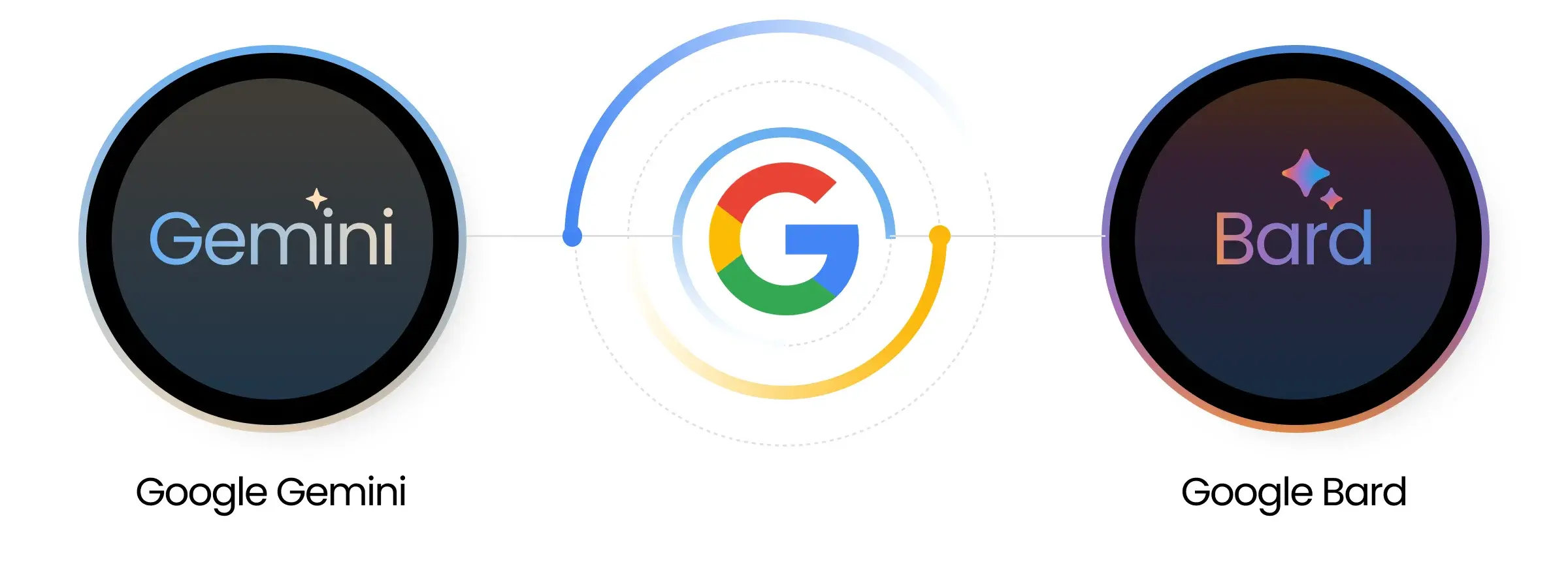
The distinction between Gemini and other Google offerings, such as Bard, is crucial for understanding its place in the AI landscape. Bard is an interface for accessing Gemini AI and other generative AI models analogous to an application or client. In contrast, Gemini is not an application but a suite of models, each with distinct capabilities and scopes. This separation highlights Gemini’s role as a foundational technology rather than a standalone product.
Moreover, Gemini operates independently of other Google AI projects, such as the Imagen-2 text-to-image model, showcasing Google’s diverse yet interconnected AI development strategy.
As Gemini evolves and introduces new features, it will enable businesses and enterprises to handle a broader range of data types. This advancement suggests a future where AI’s applicability extends beyond traditional text-based tasks, offering innovative solutions across various industries.
Google Gemini Models
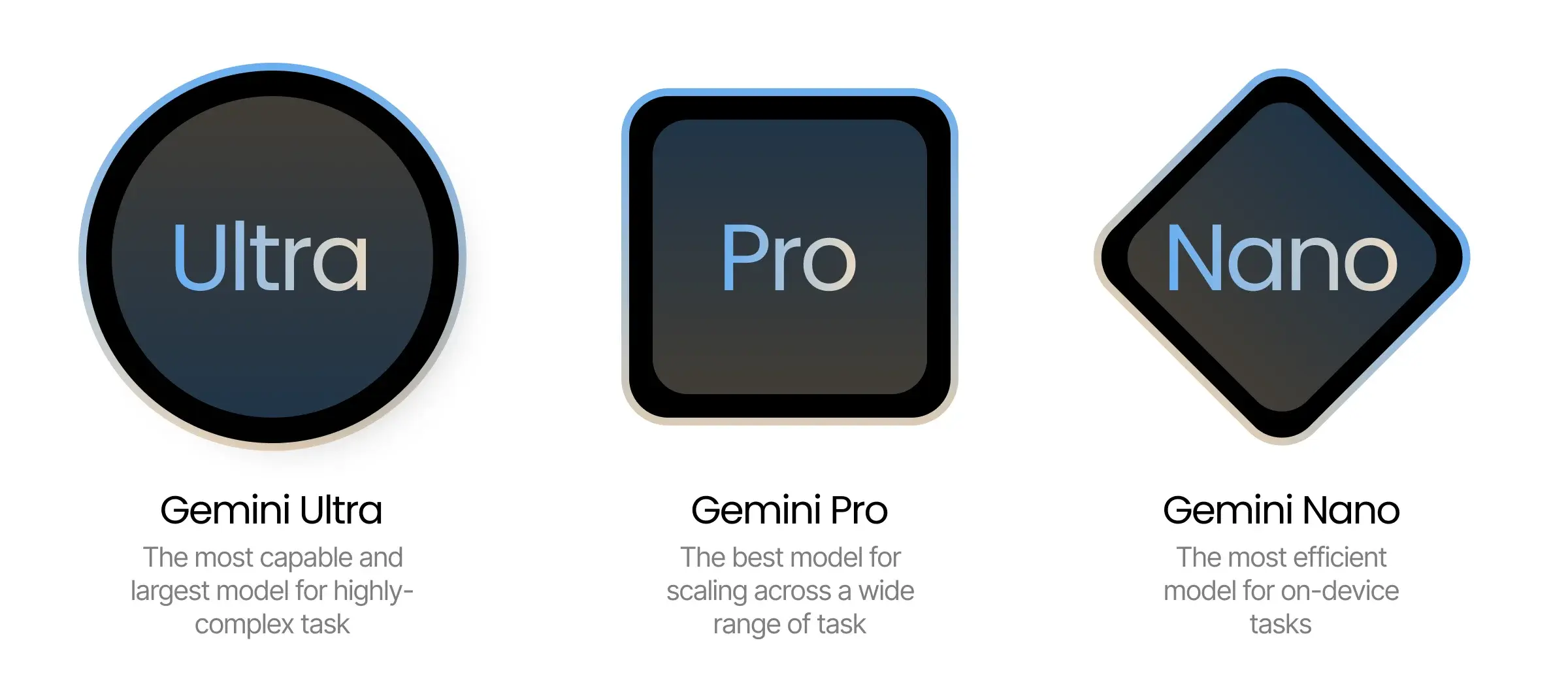
The Gemini suite, developed by Google, represents a significant stride in AI technology. This suite encompasses a range of multimodal models, each designed to undertake a vast spectrum of tasks. These include transcribing spoken words, captioning visuals and videos, and creating artistic works. However, it’s important to note that most of these capabilities are still in the pipeline, with their eventual rollout to the market expected in the foreseeable future.
There’s a certain degree of skepticism regarding Google’s promises, largely fueled by past experiences. The company’s initial release of Google Bard was disappointment. A recent promotional video showcasing Gemini’s capabilities was criticized for being overly embellished. Currently, Gemini is available, but its functionality is somewhat restricted.
Assuming Google’s claims are accurate, the different Gemini models are poised to offer a range of functionalities upon their release:
1. Gemini Ultra:
- Current State: As the foundational model of the Gemini suite, Gemini Ultra has only been available to a select group of users, primarily within a few Google apps and services. A broader launch is scheduled for later this year. Still, for now, most information about Gemini Ultra comes from Google’s product demonstrations.
- Capabilities: Google claims Gemini Ultra can assist with academic tasks, such as providing step-by-step solutions to physics problems or identifying errors in pre-solved problems. Additionally, it could help extract and synthesize information from scientific papers, particularly in updating datasets and charts with the latest information. Although Gemini Ultra can generate images, the initial product launch will not include this feature. This decision might be due to the complexity of the process, which differs from how applications like ChatGPT generate images.
2. Gemini Pro
- Availability and Usage: Gemini Pro is already publicly accessible, but its capabilities vary depending on its deployment environment. In Google’s Bard, which first launched in a text-only format, Gemini Pro enhances reasoning, planning, and understanding capabilities, surpassing LaMDA.
- Comparative Analysis: Research by Carnegie Mellon and BerriAI found that Gemini Pro outperforms OpenAI’s GPT-3.5 in managing longer and more complex reasoning sequences. However, Gemini Pro faces challenges with intricate mathematical problems and has been noted for some inaccuracies in basic fact-checking. Google has pledged enhancements, but the timeline remains unclear.
- Integration in Vertex AI: Gemini Pro is also integrated into Vertex AI, Google’s AI development platform. It operates in a text-to-text format, with an additional endpoint, Gemini Pro Vision, handling text and imagery. Developers can customize Gemini Pro for specific applications, including connecting to external APIs for specialized tasks.
- Future Developments: Plans for early 2024 include incorporating Gemini Pro into custom conversational agents within Vertex AI. It will also support search summarization, recommendation systems, and answer generation features using a wide range of sources, including images and PDFs.
3. Gemini Nano
- Design and Application: Gemini Nano is a more compact version of the Pro and Ultra models, optimized for direct operation on devices like smartphones. It currently powers two features on the Pixel 8 Pro: Summarize in Recorder and Smart Reply in Gboard.
- Functionality: In the Recorder app, Gemini Nano provides summaries of recorded content like conversations, interviews, and presentations, even offline. Gboard’s Smart Reply suggests potential responses during text conversations. It is initially compatible with WhatsApp and is expected to expand to other messaging apps.
Read More about Gemini Nano
Comparing Google Gemini with OpenAI’s GPT-4
When comparing Google’s Gemini to OpenAI’s GPT-4, it’s essential to look at specific technical aspects. Gemini Ultra is expected to be a step ahead of GPT-4, particularly in academic benchmarks. While Google claims Gemini Ultra excels in 30 out of 32 key benchmarks, these metrics don’t fully capture a model’s practical effectiveness.
In comparing Gemini to OpenAI’s GPT-4, Google claims that Gemini Ultra surpasses the latter in several academic benchmarks, potentially indicating a new standard in AI performance. Gemini Pro, on the other hand, is said to excel in summarizing content, brainstorming, and creative writing compared to GPT-3.5. However, these claims need to be seen in the context of Gemini’s performance in real-world applications, especially considering the noted challenges in accuracy and translation abilities.
The implications of Gemini’s development and its comparison with OpenAI’s GPT-4 extend beyond technical prowess. They highlight the evolving landscape of AI technology, where new benchmarks continually set and surpass themselves. The Gemini suite, with its multimodal capabilities, significantly advances this journey and promises to transform how we approach and execute tasks across various domains.
As the technology evolves at lighting speed, it will be crucial to monitor the accuracy, reliability, and ethical use of these AI models. Google’s ambitious roadmap for Gemini suggests a future where AI is not just a tool for completing tasks but a partner in enhancing human capabilities. The real test will come when we integrate these models into everyday applications, where we can measure their effectiveness and impact.
Also read – Why Tech Insiders are excited about GPT
Pricing Model of Google Gemini Pro
Gemini Pro’s pricing model is designed for business scalability. Currently free in its preview phase, it will transition to a usage-based pricing AI model. The cost will be $0.0025 per character for input and $0.00005 per character for output. For example, summarizing a 500-word article (about 2,000 characters) would cost $5, while generating an article of the same length would be around $0.1. This model offers businesses a predictable cost structure for budgeting.
Where to Access Google Gemini Pro?
Gemini Pro is currently accessible through Google Bard in English in the U.S., with plans to expand its language and regional support. It’s also available in preview through Vertex AI’s API, supporting 38 languages and various functionalities. AI Studio allows developers to build and test Gemini-based applications, providing prompt creation and chatbot development tools. Google plans to integrate Gemini into its Duet AI for Developers and development tools for Chrome and Firebase, enhancing coding capabilities.
Pricing Model of Google Gemini Nano
Gemini Nano’s pricing strategy focuses on addressing the unique needs of mobile application development. Although Gemini Nano has not yet disclosed specific details, it is expected to adopt a flexible and competitive pricing model. This approach is likely to cater to the diverse budgetary requirements of mobile app developers, ranging from small startups to larger enterprises. The model may include options like pay-per-use or subscription-based plans designed to offer scalability and affordability. Such a pricing structure will enable developers to integrate advanced AI capabilities into their apps without incurring prohibitive costs, making it an attractive option for a wide range of mobile applications.
Accessing Gemini Nano
Gemini Nano’s accessibility is a key aspect of its design, meant to provide ease of integration for developers. Presently, Gemini Nano is available in the Pixel 8 Pro. It demonstrates its capabilities in a mobile environment. Google is expected to provide Gemini Nano through developer-focused platforms, such as APIs and SDKs for Android, to ensure broader access. These tools will enable developers to seamlessly incorporate Gemini Nano into their applications, enhancing functionality and user experience.
Future plans for Gemini Nano involve expanding its availability beyond the Pixel series to other Android devices, increasing its reach in the mobile market. This expansion will allow a greater number of developers to leverage the model’s capabilities, fostering innovation in the app development sector.
Leverage Google Gemini with Markovate
The Markovate team boasts exceptional proficiency in utilizing Google AI Studio. We are adept at empowering businesses and enterprises to harness the full potential of Google Gemini, seamlessly integrating its advanced AI capabilities into their operations for enhanced efficiency and innovation.
1. Navigating Gemini AI Integration
Markovate possesses the expertise to seamlessly integrate the latest Gemini AI models into your business framework, ensuring you are at the forefront of AI advancements.
2. Leveraging Gemini Nano for Mobile Innovation
With Gemini Nano’s mobile optimization, Markovate can enhance your mobile applications, incorporating advanced AI features like real-time content summarization and intelligent response generation.
3. Exploiting Gemini Ultra for Data Insights
Utilizing Gemini Ultra’s superior data processing abilities, Markovate can unlock deeper insights and analytics for your business, aiding in more informed decision-making and strategy development.
4. Custom AI Solution Development
Markovate’s team can craft tailored AI solutions using Gemini AI technology, such as specialized chatbots or predictive models, ensuring your business stays ahead in innovation.
5. Adaptive AI Strategy and Support
Markovate provides continuous adaptation and support for your Gemini AI implementations, ensuring they remain cutting-edge and aligned with your evolving business goals.
Conclusion
The Gemini suite stands as a testament to the rapid advancements in AI, symbolizing a future where AI’s role is not only pervasive but also transformative. Its potential to augment human intelligence across various fields presents exciting possibilities. However, the journey from theory to practice, from controlled demonstrations to real-world applications, will be the ultimate measure of its success and contribution to the field of AI.
FAQs
1. What distinguishes Gemini Ultra from other models in the Gemini suite?
Gemini Ultra is the premier model in the Gemini suite. It is primarily available to a select group of users and focuses on academic and complex tasks. Unlike the other models, it boasts advanced capabilities in processing and synthesizing information, particularly from scientific papers. However, the initial launch will exclude the image generation feature, which has highlighted demonstrations.
2. How does Gemini Pro compare to OpenAI’s GPT-3.5 and GPT-4?
Gemini Pro, already publicly accessible, demonstrates enhanced reasoning and understanding capabilities, particularly in Google’s Bard interface. Comparative analysis shows that it outperforms GPT-3.5 in managing complex reasoning sequences. While Google claims Gemini Ultra surpasses GPT-4 in academic benchmarks, Gemini Pro’s real-world application effectiveness, especially in accuracy and translation, remains a crucial factor for comparison.
3. What are the practical applications of Gemini Nano, and how is it unique?
Gemini Nano, optimized for mobile devices like the Pixel 8 Pro, brings AI capabilities directly to users’ fingertips. For instance, its current applications include summarizing recorded content and suggesting responses in text conversations, showcasing its practicality in everyday mobile use. Unlike its counterparts, Gemini Nano operates directly on mobile devices and offers a compact and efficient AI solution.
4. What is the pricing model for Gemini Pro, and how does it benefit businesses?
Gemini Pro’s pricing model is usage-based. Currently free in its preview phase but transitioning to a cost of $0.0025 per character for input and $0.00005 per character for output. This model provides businesses with a predictable cost structure. Thus allowing for scalable budgeting and efficient allocation of resources for AI-driven tasks.
5. How can developers access and utilize Gemini Nano in their mobile applications?
Gemini Nano is currently featured in Google’s Pixel 8 Pro. With plans for broader access through developer-focused platforms. Future integration into Android APIs and SDKs will enable developers to seamlessly incorporate Gemini Nano into their apps. Consequently, it will enhance the functionality and user experience. Advanced AI capabilities will foster innovation in mobile app development by enhancing accessibility.