

In today’s media and entertainment industry, technology is a game-changer. Companies are using new tech to create better content and improve how people experience their products while boosting their brand. A vital part of AI in media is using data to get insights about customers’ wants and needs. This means changing how they operate to make things better for their audience.
Artificial Intelligence (AI) is at the heart of these changes. Additionally, it brings tools like predictive analytics (guessing future trends), recommendation systems (suggesting what you might like), and understanding customer behaviors. Consequently, these tools help media companies make their services more engaging and enjoyable.
AI isn’t just about short-term gains but also long-term growth. Nearly all media companies (98%) use data to understand and improve customer experiences. By 2023, AI in media and entertainment will be worth $8.4 billion.
So, what does AI do in media and entertainment? Well, it’s about using smart tech to keep the industry evolving and staying relevant to what people want.
Businesses Making Big Strides
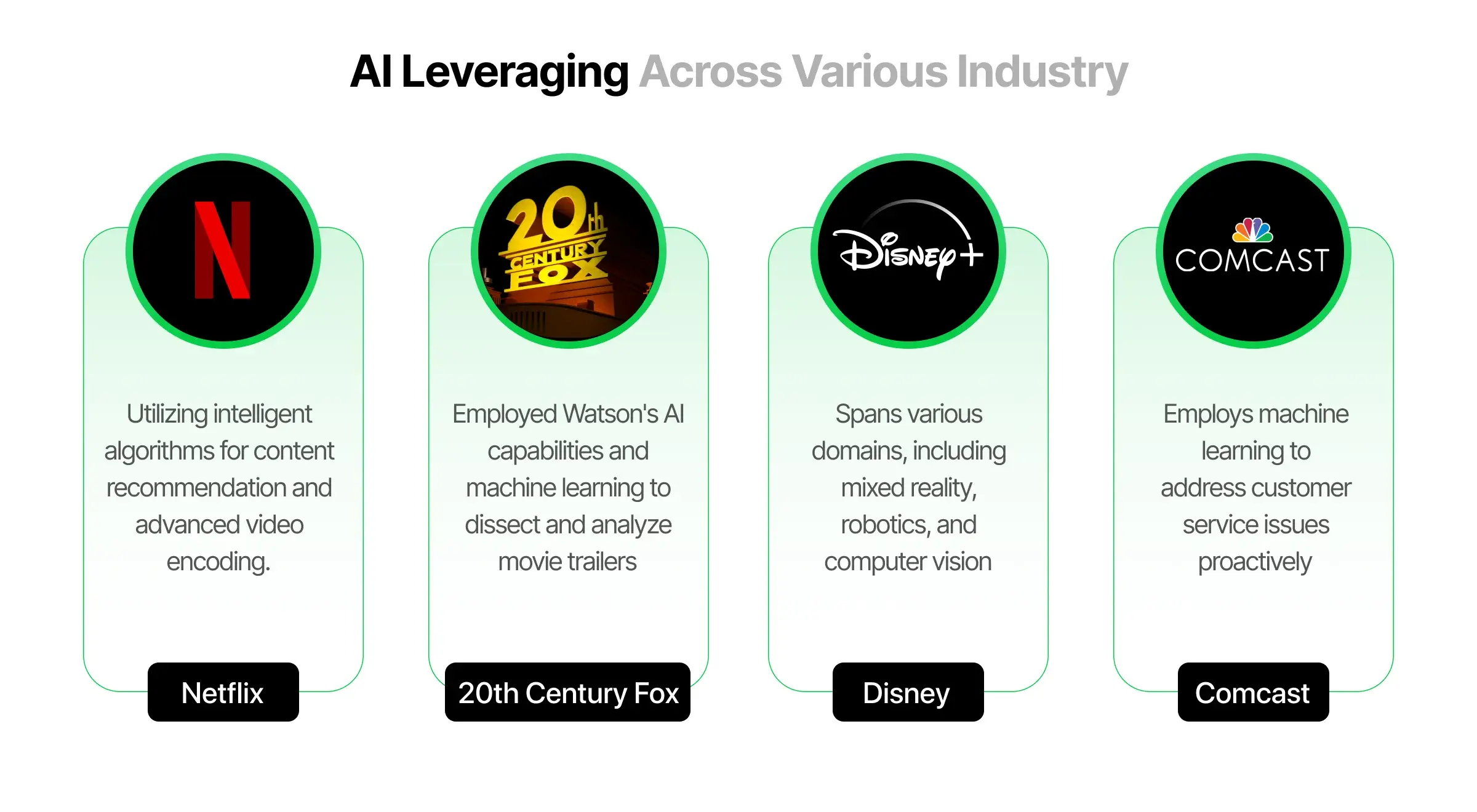
In the evolving media and entertainment landscape, Artificial Intelligence (AI) is making significant strides, transforming business operations and content engagement strategies. Here’s an overview of how AI is being leveraged across various industry players:
- Netflix: Netflix stands at the forefront of AI applications in media, utilizing intelligent algorithms for content recommendation and advanced video encoding. This approach ensures a personalized viewing experience while maintaining high-quality streaming with optimized data usage. Their continuous innovation sets a high benchmark in the industry.
- 20th Century Fox and IBM: In a collaborative effort, 20th Century Fox and IBM employed Watson’s AI capabilities and machine learning to dissect and analyze movie trailers. Consequently, this led to creating a trailer for the film “Morgan,” showcasing AI’s proficiency in understanding audience preferences and assisting in content creation.
- Disney: Disney’s application of AI spans various domains, including mixed reality, robotics, and computer vision. Additionally, they’ve notably used deep learning to enhance image quality in film production, as seen in “Finding Dory.” Their StoryPrint project further exemplifies AI’s role in creating innovative storytelling methods.
- Comcast: Comcast employs machine learning to address customer service issues proactively. Their system can accurately predict when a technician’s visit is necessary, demonstrating a 90% success rate. Moreover, this proactive approach signifies AI’s role in improving customer experience and operational efficiency.
These examples underline AI’s transformative role in the media industry, offering businesses and enterprises insights into harnessing technology for innovation and efficiency.
Key Application of AI in Media
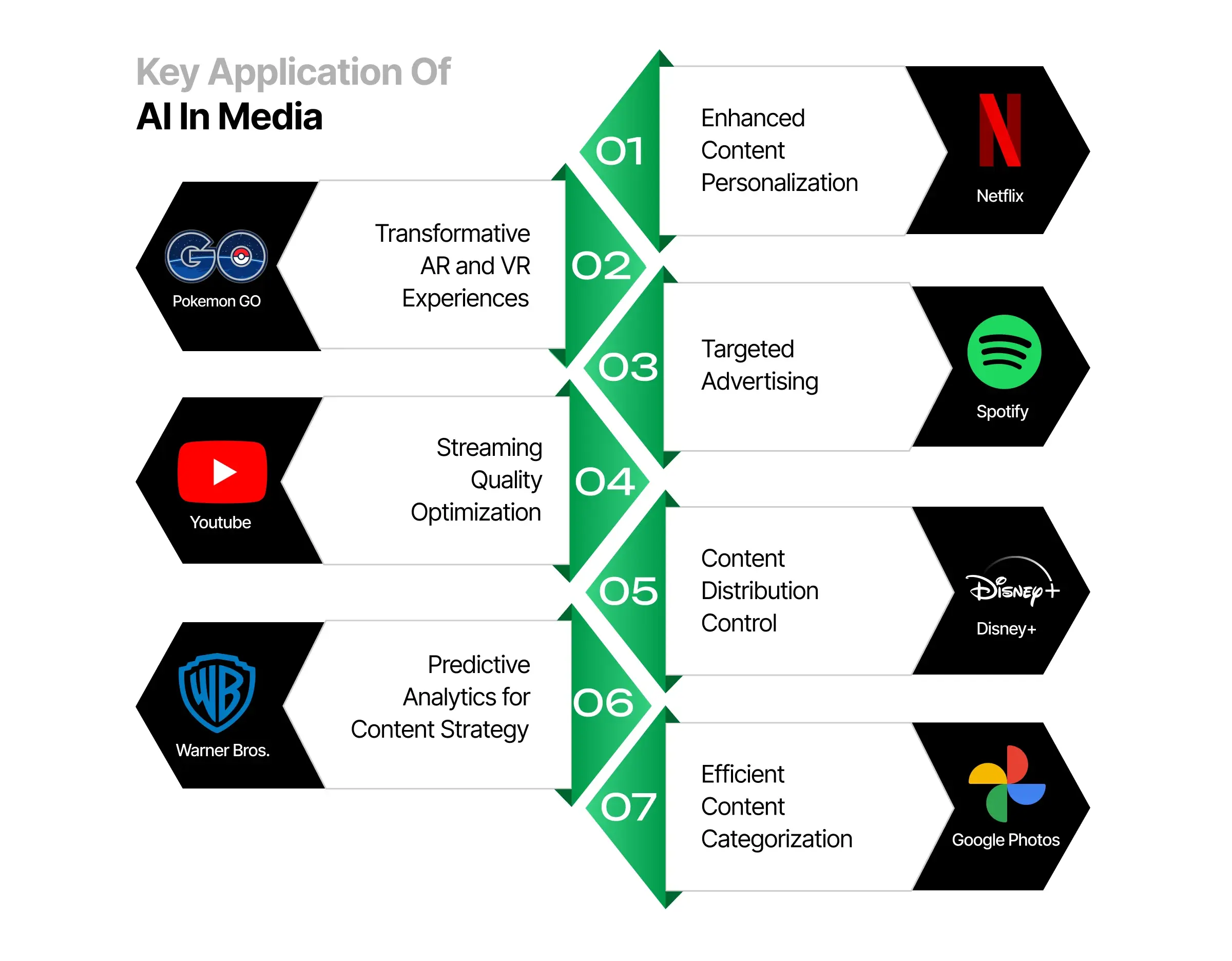
In the dynamic field of media and entertainment, Artificial Intelligence (AI) is not just an innovative addition; moreover, it is a fundamental driver of change, reshaping content delivery and consumption. Here’s a detailed exploration of its multifaceted impact:
1. Enhanced Content Personalization
At its core, AI empowers platforms to understand individual user preferences through data analysis. Additionally, by examining viewing histories and engagement patterns, AI algorithms can accurately predict and suggest content that resonates with each user. This improves the user experience by simplifying content discovery and increases the time spent on the platform, elevating engagement and loyalty. Additionally, the sophistication of these algorithms means they continually evolve, becoming more precise as they learn from ongoing user interactions.
Example: Netflix is a prime example. Their recommendation system uses AI to analyze user data, such as viewing history and search queries, to suggest films and TV shows. This system accounts for a significant percentage of their viewership, guiding users to content they are likely to enjoy, increasing engagement, and subscription retention.
2. Transformative AR and VR Experiences
AI significantly enhances augmented and virtual reality experiences, making them more interactive and engaging. By integrating AI with AR/VR, media companies can create content that responds in real-time to user actions and environmental changes. Additionally, this technology enables more natural and intuitive interactions within virtual environments, making the experience closer to real-world interactions. For instance, AI can program characters in a virtual reality game to adapt their responses based on the player’s actions, creating a unique and personalized experience each time.
Example: Pokémon GO, developed by Niantic, leverages AR and AI to create an immersive experience. Furthermore, the game uses the player’s real-world location and environment, overlaying digital creatures in real-time. AI helps spawn Pokémon based on location, time, and player behavior, enhancing the user’s interactive experience.
3. Targeted Advertising
AI’s ability to analyze vast amounts of data in real time allows for highly targeted advertising. Additionally, it identifies patterns in user behavior, enabling advertisers to present ads that are more likely to be relevant to each viewer. Consequently, this increases the likelihood of ad engagement and conversion and enhances the viewer’s experience by reducing the frequency of irrelevant ads. This precision targeting is a win-win, benefiting both advertisers in terms of ROI and consumers in relevance.
Example: Spotify’s use of AI for targeted advertising is noteworthy. Nonetheless, by analyzing user listening habits, preferences, and even the time of day they listen, Spotify can deliver personalized ads that resonate with the listener’s current mood or activity, making the advertising experience more relevant and less intrusive.
4. Streaming Quality Optimization
AI plays a crucial role in optimizing streaming quality. Meanwhile, AI algorithms can dynamically adjust the streaming quality by analyzing the user’s internet speed and device capabilities, balancing high-quality visuals with smooth playback. This ensures a buffer-free experience, especially crucial during high-traffic periods. For users with limited bandwidth, AI can suggest optimal viewing times or alternative content that requires less bandwidth, thus maintaining a consistent quality of service. In addition to AI tools, HEVC compression can further enhance video quality while reducing bandwidth usage, ensuring a consistent viewing experience.
Example: YouTube uses AI to optimize video streaming quality. However, their algorithms assess the viewer’s internet speed and device type to adjust the video resolution and bitrate on the fly. This ensures a smooth streaming experience with minimal buffering, even under fluctuating network conditions.
5. Content Distribution Control
AI tools are instrumental in managing content distribution across diverse geographical regions. Furthermore, they automatically detect and filter content that may not comply with local regulations, ensuring that media companies adhere to various international content standards. This helps not only maintain legal compliance but also preserve cultural sensitivities. Moreover, AI-driven systems are adept at identifying and flagging copyright infringements and fake news, safeguarding intellectual property, and maintaining content integrity.
Example: Disney+ uses AI to comply with regional content regulations. Their platform automatically adjusts available content based on the viewer’s location, adhering to local laws and cultural norms. For example, certain movies or scenes unsuitable for specific regions due to cultural sensitivities are automatically filtered out.
6. Predictive Analytics for Content Strategy
AI’s predictive analytics tools analyze social media trends and viewer responses to forecast content popularity. Therefore, this insight enables content creators to understand what themes, genres, or formats resonate with audiences. By anticipating viewer preferences, media companies can tailor their content creation and marketing strategies more effectively. Thus, ensuring they are always ahead of the curve in a rapidly changing media landscape.
Example: Warner Bros. partnered with Cinelytic to use AI for predictive analytics in film distribution decisions. Thus, by analyzing historical and current data trends, this AI system helps predict a film’s revenue potential, guiding investment, marketing strategies, and release schedules.
7. Efficient Content Categorization
With an overwhelming amount of content available, AI aids in efficient categorization and classification. Meanwhile, through automated tagging and metadata annotation, AI systems can quickly organize content into relevant categories, making it easier for users to find what they want. This improves user experience and enhances content discoverability, which is crucial for content providers in an increasingly competitive market.
Example: Google Photos employs AI to categorize and sort images. Furthermore, it uses image recognition to automatically tag and organize photos based on people, places, and objects. This makes searching for specific images easier for users, as they can simply search for a term like “beach” or “birthday” to find relevant photos.
Other Popular Applications of AI in Media
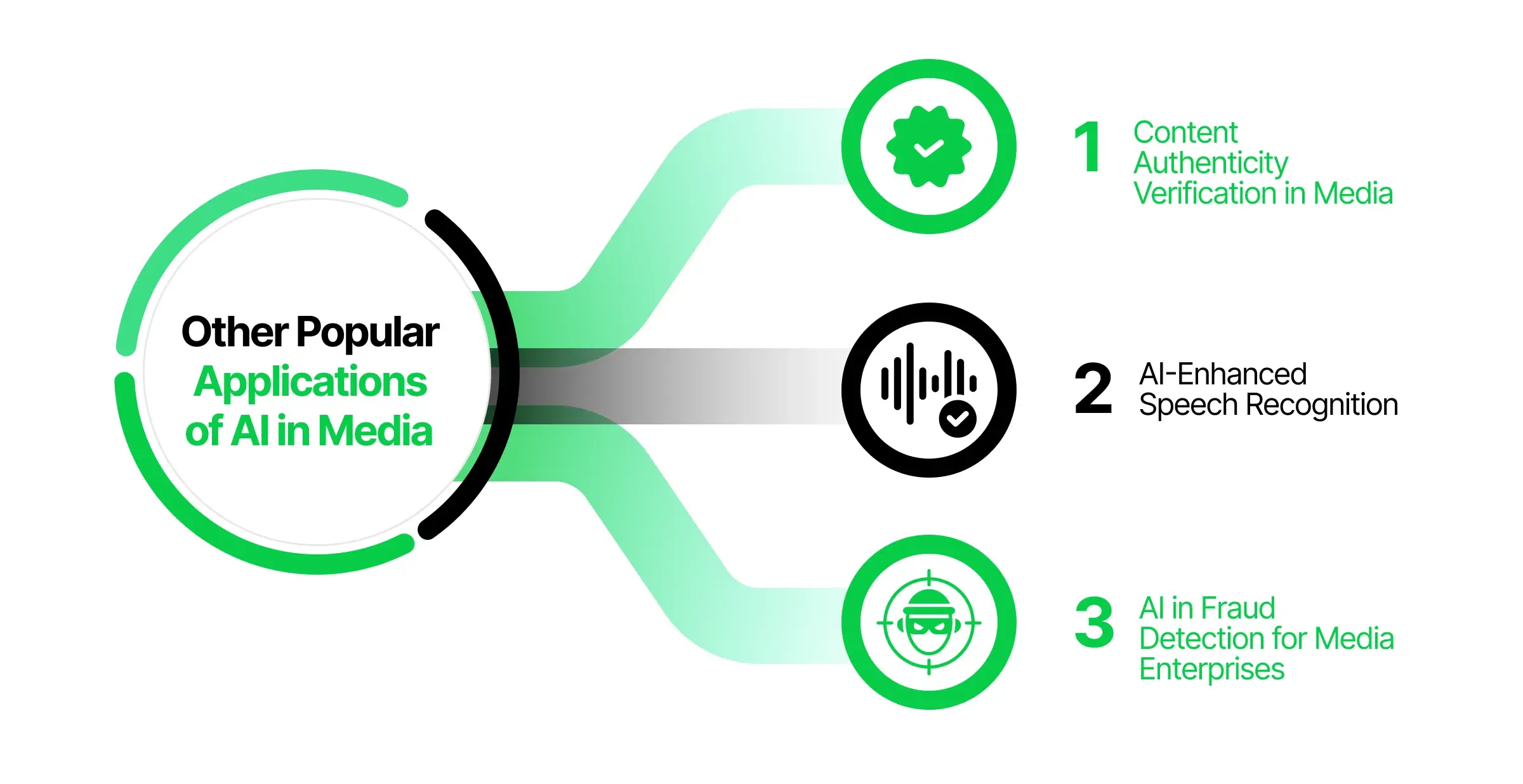
1. Content Authenticity Verification in Media
In the current digital age, discerning the veracity of data is a challenge for businesses. Nonetheless, enterprises encounter a vast array of information daily, making manual verification of each piece impractical. To address this, advanced AI-driven technologies are employed for media authenticity verification. These systems leverage deep learning algorithms to assess whether content has been tampered with or altered. For instance, a news organization can integrate such AI solutions to scrutinize incoming reports, ensuring that the information being disseminated is accurate and hasn’t been digitally manipulated. This approach not only safeguards the integrity of the data but also reinforces the credibility of the enterprise.
Innovations like Deepfakes AI are even being adapted for ethical use, such as creating realistic training simulations and enhancing digital storytelling with lifelike visual effects.
2. AI-Enhanced Speech Recognition
In the realm of media, converting copious amounts of audio data into structured, actionable information is a Herculean task. Nonetheless, AI-powered speech recognition technologies step in to bridge this gap. These tools, utilizing Natural Language Processing (NLP) and deep learning, can transcribe and summarize key points from lengthy business meetings, enabling employees to concentrate on the discussion rather than note-taking. For example, a multinational corporation might use this technology to automatically generate meeting summaries, thus enhancing efficiency and focus. Additionally, AI-driven subtitle generation has democratized access to foreign language digital content, making it more inclusive and accessible.
3. AI in Fraud Detection for Media Enterprises
Differentiating between malicious criticism and constructive feedback is a nuanced challenge for businesses. Nonetheless, AI’s role in the media sector extends to identifying and mitigating fraudulent activities. Utilizing pattern recognition, AI systems can identify spammy profiles based on their repetitive and predictable activities. For instance, a media company might employ AI algorithms to scan user comments, separating spam from genuine feedback. Furthermore, AI aids in the verification of unusual financial transactions and employee backgrounds, ensuring smooth business operations. This proactive approach is essential in maintaining a positive brand image and preemptively addressing potential disruptions.
Overall, AI’s role in the media and entertainment industry is multifaceted and far-reaching. It’s not merely about introducing new features but about fundamentally enhancing how content is created, delivered, and experienced. AI drives efficiency, personalization, and innovation, ensuring that businesses stay competitive while delivering exceptional value to consumers. As this technology continues to evolve, its influence on the industry is set to deepen, promising even more groundbreaking changes in the years to come.
Innovative Approaches to Integrating AI in the Media and Entertainment Industry
The Media and Entertainment (M&E) industry, historically at the forefront of technological integration, has evolved from utilizing algorithms for visual effects in early cinematic milestones like ‘Westworld’ (1973) and ‘Tron’ (1982) to creating expansive digital universes in modern games such as ‘No Man’s Sky.’ This industry’s progression now prominently features AI in curating social media content and shaping the distribution strategies of media firms.
With AI’s burgeoning role, M&E professionals are poised to adopt AI in four strategic domains:
1. Exploring AI’s Role in Enhancing Creativity
Generative AI garners significant attention for its ability to learn and recreate patterns from vast content types, ranging from artwork to music and speech. Examples include:
- Writing: AI tools like GPT-3.5 and GPT-4 generate scripts and articles.
- Visual Art: Platforms like Dall-E and Adobe Firefly produce high-quality illustrations.
- Music Creation: Tools like OpenAI’s Jukebox synthesize music snippets.
- Speech Synthesis: Google’s DeepMind WaveNet generates realistic human speech.
- Video Production: Solutions like Runway ML facilitate short video creation based on textual inputs.
These technologies, rather than being viewed as a threat, should be considered as amplifiers of human creativity, much like Steve Jobs viewed computers as tools to augment human capabilities.
AI’s contribution to the creative process includes:
- Automating routine reporting, freeing journalists for investigative tasks.
- Generating preliminary creative concepts for human refinement.
- Empowering smaller teams to produce professional content.
- Enabling interactive and user-generated content.
- Facilitating research and providing starting points for in-depth exploration.
- Enhancing video streaming quality and gaming experiences through AI-driven image generation.
2. Streamlining Media Workflows with AI
AI excels in accelerating time-intensive and mundane aspects of content creation. Applications include:
- Color correction and masking in video editing software like DaVinci Resolve and Adobe Premiere Pro.
- Audio syncing in Adobe Premiere Pro and Final Cut Pro X.
- Automated metadata tagging by Adobe Sensei and Clarifai.
- Subtitle generation, custom avatar and localization tools like Descript, Synthesia, and HeyGen.
- AI-powered video editing enhancements in Adobe Premiere Pro and After Effects.
These tools expedite traditional creative processes, allowing for greater focus on innovative endeavors.
3. Personalizing Content through AI
While the concept of completely individualized AI-generated content is intriguing, a more practical application lies in AI’s ability to personalize existing content. Advanced recommendation algorithms in platforms like TikTok, Spotify, and Netflix alleviate decision fatigue, offering tailored content suggestions. However, business-to-business (B2B) solutions like Tavus, Maverick, and bHUman customize video content for various corporate applications.
However, in exploring these personalization avenues, maintaining ethical standards and respecting privacy concerns remains paramount.
Explore about AI as a Service
Key Advantages of AI in Media and Entertainment
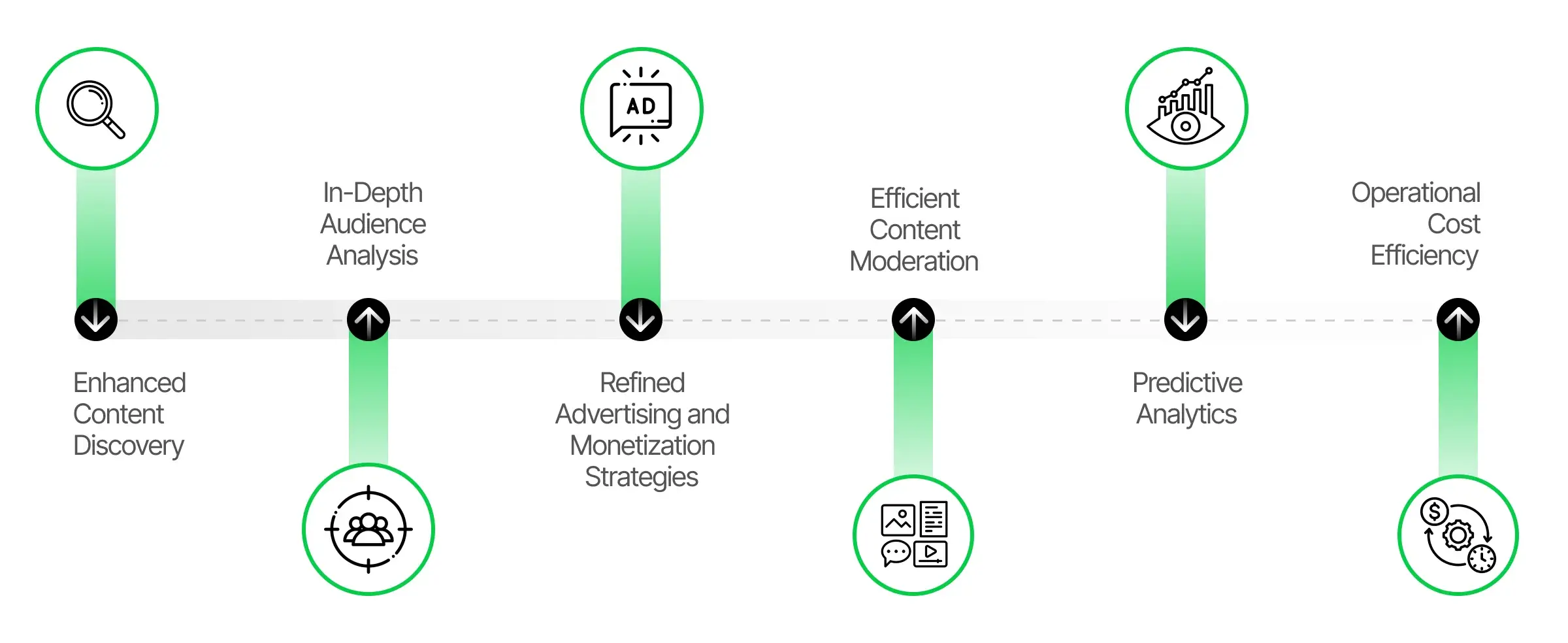
AI’s transformative potential is universally acknowledged, especially in its capacity to refine the M&E sector through:
1. Enhanced Content Discovery
What: Sophisticated AI recommendation systems use complex algorithms to analyze user preferences and behaviors, suggesting media content that aligns with these insights.
Why: The aim is to connect audiences with media that they are likely to enjoy but might not discover on their own. This is particularly beneficial for niche content, which might otherwise be overshadowed by mainstream media.
How: These systems analyze past viewing habits, search queries, and even user interactions on digital platforms to build a profile of user preferences. They then use this profile to recommend content that matches or is similar to these preferences.
Impact: Indeed, this leads to a more personalized media experience for users and provides visibility to a wider range of content creators, ensuring that diverse and niche content finds its intended audience.
2. In-Depth Audience Analysis
What: AI tools scrutinize viewer data to offer detailed insights about audience preferences and behaviors.
Why: Understanding the audience at a granular level aids content creators in crafting media that resonates more deeply with viewers, leading to higher engagement rates.
How: AI analyzes data points such as viewing duration, platform interactions, and content preferences, compiling these into actionable insights for content creators.
Impact: Indeed, creators can use these insights for strategic brainstorming, leading to content that is more aligned with audience interests and potentially increasing viewer loyalty and engagement.
3. Refined Advertising and Monetization Strategies
What: AI-driven targeted advertising uses data analytics to present viewers with ads that are relevant to their interests, making advertising less intrusive.
Why: The goal is to create a more pleasant viewing experience for the audience while also providing higher value to advertisers.
How: By analyzing user data, AI systems identify patterns and preferences, allowing advertisers to target their ads more effectively to the relevant audience.
Impact: Indeed, this approach enhances the effectiveness of advertising campaigns, improves viewer experience, and opens up new revenue streams for media platforms and creative agencies.
4. Efficient Content Moderation
What: AI’s proactive approach in content moderation involves the automatic screening and filtering of user-generated content.
Why: This is done to ensure compliance with platform guidelines, protect users from harmful content, and maintain a positive user experience.
How: AI algorithms are trained to detect and flag content that violates specific guidelines, such as hate speech, misinformation, or explicit material.
Impact: Indeed, streamlined moderation processes lead to safer online environments, enhancing user experience and trust in digital platforms.
5. Predictive Analytics
What: Large-scale analysis of audience behavior is used to predict future trends and viewer preferences.
Why: Predictive analytics aids in making informed decisions about content strategy, helping media firms stay ahead of market trends.
How: AI tools analyze data like viewer engagement metrics, social media trends, and demographic information to forecast future behaviors and preferences.
Impact: Indeed, this foresight enables content creators and distributors to develop strategies that are more likely to succeed, ensuring relevance and competitiveness in the market.
6. Operational Cost Efficiency
What: AI accelerates content production processes, enhancing efficiency and reducing operational costs.
Why: The objective is to streamline production without compromising on quality, prioritizing ethical considerations and audience engagement.
How: AI is employed in various stages of production, from scriptwriting and editing to post-production, automating time-consuming tasks and aiding in decision-making.
Impact: Indeed, this not only reduces the time and cost involved in content creation but also allows for the allocation of resources towards more creative and strategic endeavors, enhancing overall content quality.
Best Practices for Adopting AI in Media
As AI’s capabilities expand, conscientiously adhering to ethical standards is essential for businesses and enterprises. Here’s a structured approach to maintaining ethical integrity in AI applications:
1. Commitment to Transparency
In the current landscape, it is crucial to clearly identify AI-generated content, particularly in client-oriented services. This approach fosters trust and mitigates potential misinterpretations regarding the origin of the content.
2. Embracing Diverse Data Sources
A significant challenge in AI development is the inadvertent perpetuation of existing societal biases. Nonetheless, to counteract this, it is essential to train AI models on a broad spectrum of data sources. This strategy not only enhances the representativeness of the AI’s outputs but also actively works towards diminishing ingrained biases.
3. Upholding Intellectual Property Rights
Utilization of large language models necessitates the utmost respect for intellectual property. Thus, this involves ensuring that all content and data used for training these models are appropriately licensed. Moreover, a model case is Getty’s bespoke AI tool, developed on a foundation of legally permissible images, setting a precedent for responsible AI development.
4. Fostering Human-AI Synergy
The focus should be on leveraging AI to augment and complement human creativity rather than replacing it. Meanwhile, this hybrid approach optimizes workflows and catalyzes the creation of novel art forms, resonating more profoundly with audiences who value the human element in creative outputs.
5. Ensuring Privacy and Data Security
In employing AI for analyzing consumption patterns, it is imperative to anonymize user data and employ robust encryption methods. This practice not only safeguards user privacy but also reinforces the ethical stature of the enterprise in handling sensitive information.
6. Continuous Ethical Vigilance
The field of AI ethics is dynamic, mirroring the rapid evolution of the technology itself. Staying informed about these developments is critical. What may be a priority today, like transparency, might evolve tomorrow, shifting focus to other ethical aspects, such as the choice of AI models or data sources.(Also read about AI in Compliance: Best Practices)
Revolutionizing Media with Markovate’s AI Expertise
At Markovate, our focus is on harnessing the power of AI to tackle the specific challenges faced by the media industry. Thus, understanding the dynamic nature of media, we offer tailored AI solutions that address key problems and unlock new opportunities. Our expertise enables media companies to:
- Enhance Content Personalization: We develop sophisticated AI algorithms that analyze audience preferences, enabling media firms to deliver highly personalized and engaging content. Thus, this increases viewer satisfaction and loyalty.
- Streamline Content Production: Our custom-built AI apps/system can automate routine production tasks, from editing to content moderation, significantly reducing turnaround times and operational costs while maintaining high-quality standards.
- Optimize Audience Insights: Leveraging AI, we provide deep analytics capabilities, giving media companies actionable insights into viewer behaviors and trends. Therefore, this assists in strategic decision-making and content strategy refinement.
- Improve Content Discovery: We create advanced recommendation engines, making it easier for audiences to discover relevant content, thus enhancing user experience and expanding content reach.
By partnering with Markovate, media companies can effectively navigate the challenges of the digital age. Moreover, they can utilize AI to create more impactful, efficient, and viewer-centric media experiences.
FAQs
1. What are the primary benefits of integrating AI in media production and distribution?
AI in media enhances efficiency, creativity, and personalization. It streamlines production processes, offers advanced content recommendation algorithms, and aids in generating innovative content ideas. Additionally, AI tools can analyze audience data for targeted content creation, leading to more engaged viewership.
2. How is AI transforming content creation in the media industry?
AI in media is revolutionizing content creation by automating routine tasks and offering tools for generating unique content. However, this includes AI-driven scriptwriting, automated video editing, and the creation of realistic digital graphics. It allows media professionals to focus on more complex, creative aspects of production, enhancing overall content quality.
3. Can AI improve audience engagement and content personalization in media?
Yes, AI in media plays a crucial role in content personalization and audience engagement. Furthermore, by analyzing viewer preferences and behaviors, AI algorithms can tailor content recommendations, creating a more personalized viewer experience. This leads to higher engagement rates and audience satisfaction.
4. What role does AI play in enhancing the accuracy and efficiency of media analytics?
AI in media significantly improves the accuracy and efficiency of analytics by processing vast amounts of data quickly. It can track viewer trends, predict content popularity, and provide insights into audience demographics. Therefore, enabling media companies to make data-driven decisions for content strategy and marketing.
5. How does AI contribute to ethical and responsible content moderation in media?
AI in media aids in responsible content moderation by automatically detecting and filtering inappropriate or harmful content. It ensures compliance with regulatory standards and maintains a safe viewing environment, all while reducing the manual labor required for content review and moderation. This contributes to a more ethical and viewer-friendly media landscape.