

Revenue cycle management has never been a simple problem. Across coding, billing, claims, and denials, RCM teams are managing hundreds of interdependent workflows, and the margin for error keeps shrinking.
The pressure is real. According to McKinsey, health systems collectively spend over $140 billion annually on revenue cycle operations, with manual processes and fragmented vendor landscapes eating into that figure every year. At the same time, providers reporting that more than 10% of their claims are denied have climbed from 30% in 2022 to 41% in 2025, per EY.
Autonomous medical coding addresses part of this — removing the human approval dependency from routine coding workflows. But coding is one step. The revenue cycle is dozens. And as RCM organizations push toward higher efficiency, the bottlenecks are shifting: payer rule changes, denial loops, AR follow-up, underpayment recovery — none of these are solved by coding automation alone.
This is where agentic AI enters. Unlike autonomous coding, which operates on a single task, agentic AI coordinates across the full revenue cycle as one connected workflow — without waiting for a human to move work from one stage to the next.
This blog explores what that shift looks like in practice, why RCM companies specifically are moving in this direction, and what it takes to build the case internally.
What Is Agentic AI in Revenue Cycle Management?
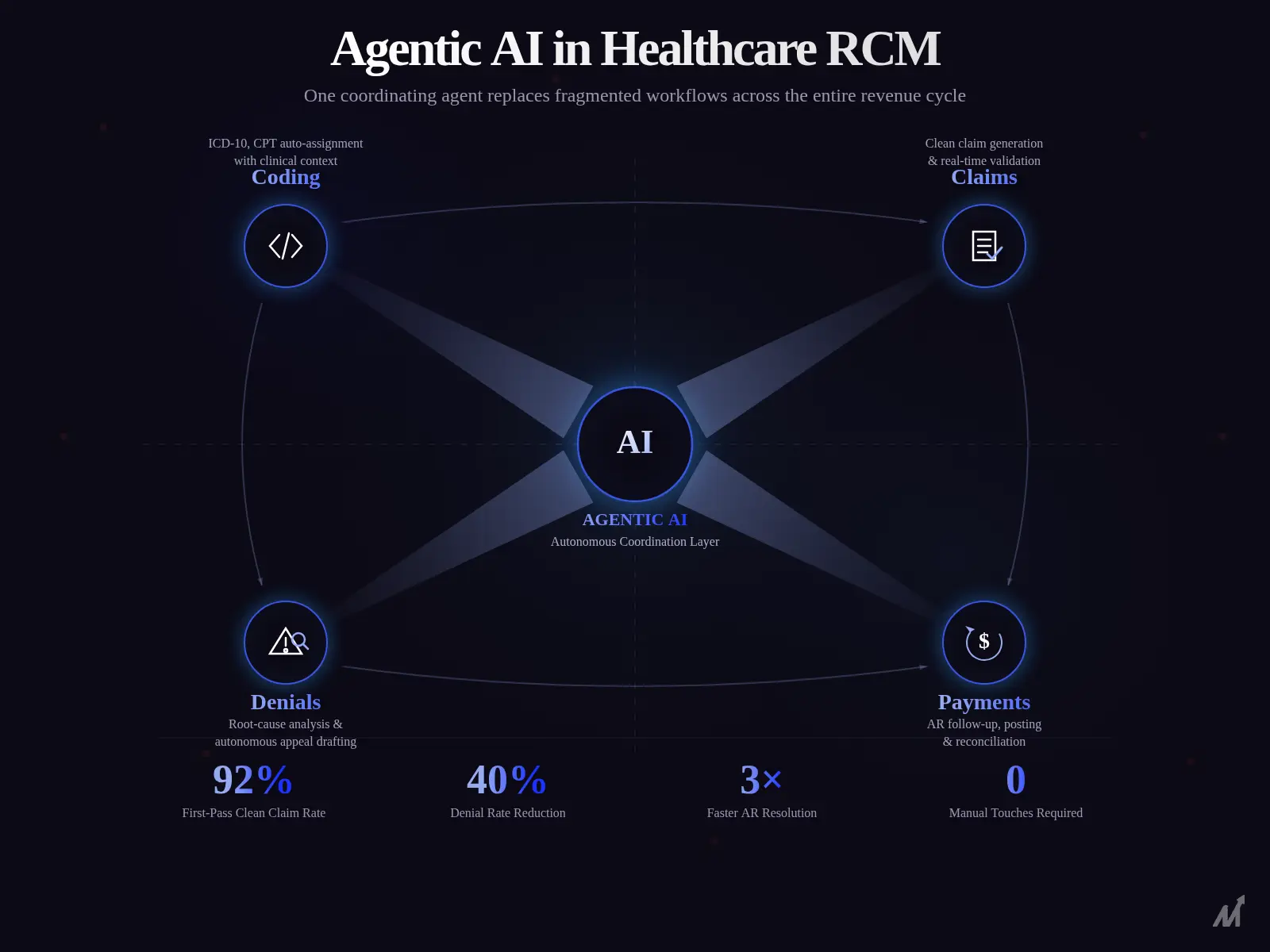
Agentic AI in revenue cycle management refers to autonomous AI systems that can independently reason, make decisions, and execute multi-step RCM workflows — without requiring human intervention at each stage. Unlike rule-based automation or even autonomous coding, agentic AI doesn’t operate on a single task in isolation. It coordinates across the entire revenue cycle — from coding and claim submission to denial management and payment reconciliation — as one continuous, self-directing workflow.
The distinction matters because RCM is not a single problem. It is a chain of interdependent processes where a gap at any stage creates downstream revenue loss. Agentic AI is designed to manage that chain end-to-end, not just accelerate one part of it.
From Autonomous Coding to Agentic AI: What’s the Next Step?
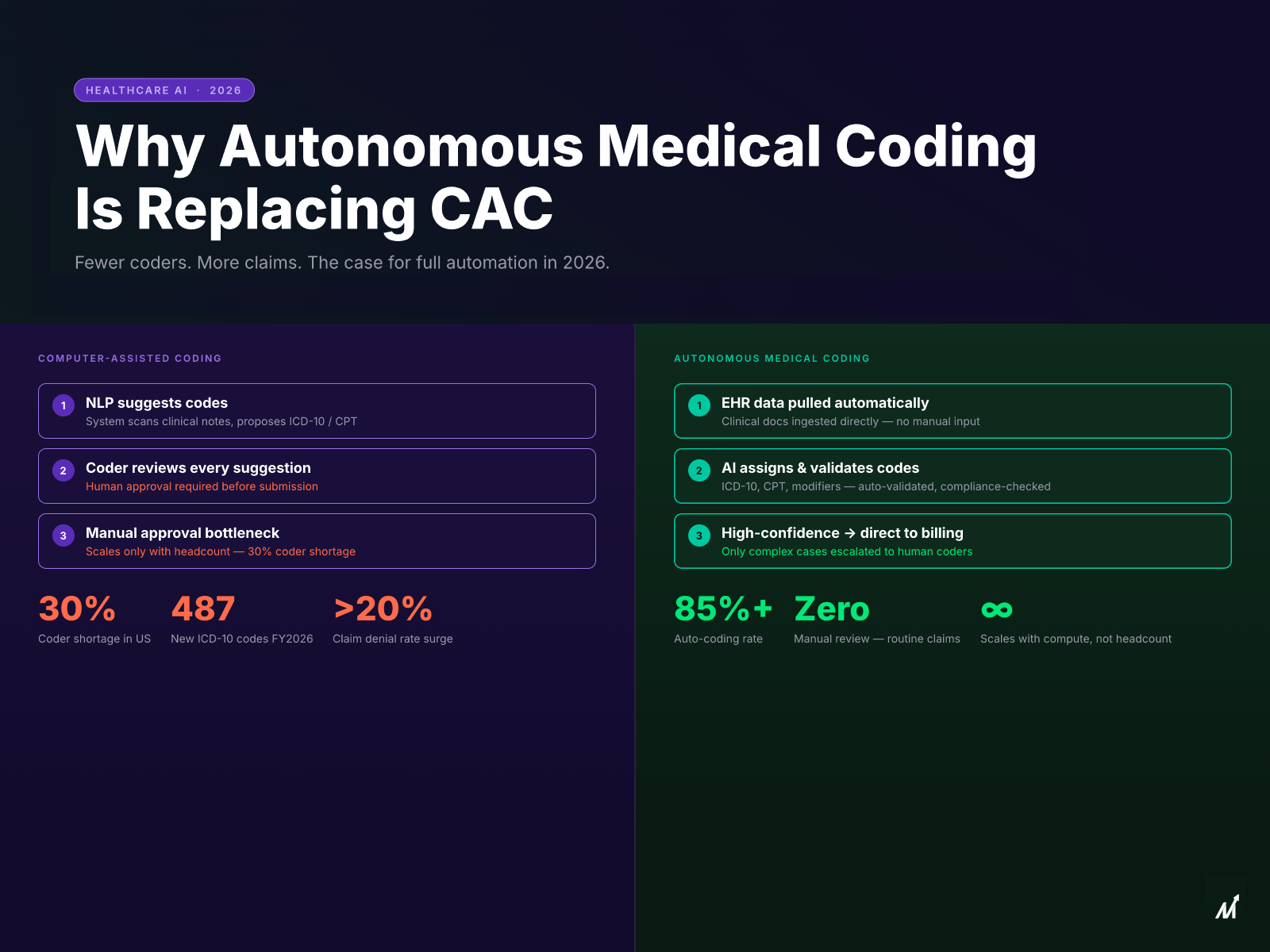
Autonomous medical coding was a meaningful leap. Instead of a coder reviewing every chart, AI reads the clinical documentation, assigns ICD-10 and CPT codes, and sends high-confidence encounters straight to billing — no human touchpoint required. For high-volume, routine encounters, this works well.
But autonomous coding was designed to solve a specific problem: the coding queue. It was never designed to manage what happens before or after that queue.
Now consider a payer updating its coverage policy mid-month, causing previously clean claims to start denying. Or an appeal that needs to be drafted, submitted, and tracked across 30 different payer portals. Or underpayments are quietly building up because no one has the bandwidth to cross-check remittance data against contracted rates
These aren’t edge cases. They are daily realities for every RCM team, and they sit entirely outside the scope of autonomous coding.
Agentic AI extends the logic of automation beyond coding into these adjacent workflows. Where autonomous coding handles one task end-to-end, agentic AI handles a chain of tasks, reasoning through each step, acting on the outcome, and moving to the next without waiting for a human handoff.
It doesn’t just assign codes. It monitors payer behavior, flags documentation gaps before submission, triggers denial workflows, drafts appeals, and reconciles payments, all within the same automated pipeline.
Think of autonomous coding as a specialist. Agentic AI is the operating system that specialists run inside.
For RCM organizations already using or evaluating autonomous coding, agentic AI is not a replacement; it is the logical next layer. One that turns a point solution into a connected, self-governing revenue cycle.
How Agentic AI Operates Inside RCM Workflows
Most automation tools in RCM are built to handle discrete tasks — verify eligibility here, suggest a code there, flag a denial over here. Each tool does its job, but the handoffs between them still depend on human coordination. That coordination gap is where revenue leaks.
Agentic AI closes that gap by operating as an interconnected layer across the revenue cycle. Here is what that looks like in practice:
1. Documentation Ingestion and Code Assignment
The system pulls clinical documentation directly from the EHR — physician notes, discharge summaries, operative reports, lab results — and reads the full clinical picture, not just isolated terms. It assigns ICD-10 and CPT codes based on complete context, runs compliance checks against payer-specific rules, and routes high-confidence encounters straight to billing without a human touchpoint.
2. Pre-Submission Claim Validation
Before a claim goes out, the agentic system cross-references it against current payer contracts, standard guidelines, and historical denial patterns for that specific payer. Claims flagged as high-risk are corrected or escalated before submission, not after rejection.
3. Payer Monitoring and Rule Adaptation
Payer policies change constantly. Rather than waiting for a rule library update, agentic AI monitors actual adjudication outcomes in real time, detects shifts in payer behavior, and adjusts coding and submission logic accordingly. This is what separates it from static CAC or RPA systems that require manual reprogramming with every policy change.
4. Autonomous Denial Resolution
When a claim is denied, the system identifies the denial reason, traces it back to the root cause, whether that is a documentation gap, a coding error, or a payer-specific policy conflict, and initiates the appropriate resolution. For straightforward denials, it corrects and resubmits autonomously. For complex cases, it prepares a structured appeal with supporting documentation and escalates to a human reviewer with full context already assembled.
5. AR Follow-Up and Payment Reconciliation
On the back end, agentic AI tracks outstanding AR, prioritizes accounts by recovery likelihood and dollar value, and initiates follow-up actions without waiting for a staff member to work through a queue. Payment posting is matched against contracted rates automatically, with underpayments flagged for recovery before they age out.
What makes this agentic, rather than simply automated, is that each of these functions feeds into the next. The system doesn’t stop at the boundary of one task and wait. It reasons through the outcome, decides the next action, and executes — continuously, across the full revenue cycle.
For a closer look at how this applies specifically to the coding layer, see Markovate’s AI medical coding software.
Why RCM Companies Specifically Are Making the Switch
Health systems and hospitals get most of the attention in AI adoption conversations. But the organizations feeling the most acute pressure to shift toward agentic AI are RCM companies — the outsourced firms managing revenue cycle operations for multiple provider clients simultaneously.
The economics are different here. An RCM company isn’t managing one health system’s claims. It is managing dozens across different specialties, payer mixes, EHR environments, and compliance requirements, all under contracted turnaround times and accuracy SLAs. Every inefficiency is multiplied across clients. Every denial that isn’t resolved autonomously requires a staff member to work it manually, across multiple client accounts.
Here is what is driving that pressure:
1. Workforce constraints don’t scale with client growth
RCM firms can’t simply hire their way to higher throughput. The U.S. currently faces a significant shortage of certified medical coders, and turnover in billing and AR roles remains persistently high. Agentic AI allows RCM companies to absorb higher coding and denial volumes without proportional headcount growth, directly protecting margins as client rosters expand.
2. Denial rates are rising across every client portfolio
According to Experian Health’s 2025 State of Claims report, 41% of providers now report that more than one in ten of their claims are denied, up from 30% just three years ago. For RCM companies managing denial workflows across multiple clients, that trajectory is a direct hit to operational capacity. Agentic AI’s ability to resolve denials autonomously, without a staff member working each case, is a structural advantage that manual or CAC-based approaches cannot replicate.
3. Payer complexity is accelerating
Payers are increasingly deploying their own AI to review and deny claims faster and with greater precision. RCM companies relying on static rule libraries or periodic policy updates are operating with a systematic lag. Instead of waiting for insurance companies to deny claims, Agentic AI watches results in real-time and automatically fixes its own coding rules to stay one step ahead.
For RCM companies specifically, the shift to agentic AI is not just an efficiency play. It is a competitive differentiation. Firms that can demonstrate autonomous denial resolution rates, faster turnaround times, and lower cost-to-collect will increasingly win and retain provider clients over those that cannot.
Key Capabilities to Look for in an Agentic AI RCM Platform
Not every platform that uses the word “agentic” delivers on it. As RCM organizations evaluate options, these are the capabilities that separate genuine agentic AI systems from rebranded automation tools.
1. End-to-end workflow coverage
A true agentic platform doesn’t handle coding in isolation. It connects coding, claim submission, payer monitoring, denial management, and payment reconciliation as one continuous workflow. If the system stops at code suggestion or hands off to a separate tool at each stage, it is not agentic; it is sequential automation with extra steps.
2. Real-time payer rule adaptation
The system should monitor actual real-time outcomes and update its coding and submission logic based on what payers are actually doing, not just what policy documents say. Static rule libraries that require manual updates create denial exposure windows that agentic systems should eliminate entirely.
3. Autonomous denial resolution with escalation controls
The platform should handle straightforward denials from root-cause identification through to resubmission without human involvement. For complex cases, it should escalate with full context already assembled, not just a denial code, so reviewers can act immediately rather than reinvestigating from scratch.
4. Transparent audit trails per decision
Every code assignment, claim action, and denial response should be logged with complete documentation linkage. This is non-negotiable for HIPAA compliance, CMS alignment, and internal audit readiness. If the system cannot explain why it assigned a specific code or triggered a specific action, it creates compliance risk rather than reducing it.
5. EHR integration depth
Agentic AI is only as effective as the clinical data it can access. The platform should support bidirectional integration with major EHR systems, pulling the full clinical picture, not just isolated fields, and writing structured outputs back into the record.
6. Performance visibility
First-pass claim rate, denial rate by payer and encounter type, autonomous resolution rate, and average days-to-payment should all be accessible in real time. Without this visibility, RCM organizations cannot measure the actual impact of agentic AI or identify where human oversight still adds the most value.
How Markovate Approaches Agentic AI in Medical Coding
Markovate’s AI medical coding software is built for healthcare organizations managing high coding volumes, complex clinical documentation, and continuously evolving compliance requirements — the exact conditions where agentic AI delivers the most measurable impact.
The platform analyzes patient notes, procedures, and diagnoses in real time, automatically predicting and extracting ICD-10 and CPT codes using proprietary AI trained on extensive medical datasets. It goes beyond code suggestion, further understanding the full clinical context, validating documentation, and flagging missing or incomplete codes before a claim moves forward.
Key capabilities
Intelligent Code Prediction and Mapping — Real-time ICD-10 and CPT code prediction with clinical context validation and gap flagging, reducing the documentation errors that drive denials downstream.
High-Volume Batch Processing — Simultaneous processing of large sets of medical records with consistent accuracy and real-time validation across thousands of encounters — without additional headcount.
AI Medical Scribe Integration — Secure voice transcription captured in real time, structured into clinical notes, and fed directly into the coding engine, eliminating manual documentation as a bottleneck.
Real-Time EHR Integration — Direct, bidirectional connection with existing electronic health record systems, ensuring coding workflows run on complete and current clinical data.
Audit-Ready Output — Every coded encounter generates a full, explainable audit trail compliant with CMS, Medicaid, and HIPAA standards — ready for billing or compliance review without additional formatting.
Real-Time Dashboard Analytics — Coding performance, claim status, and key operational metrics surfaced in an intuitive dashboard, giving RCM teams the visibility to act on trends before they affect revenue.
The solution is designed for health systems, hospitals, physician groups, RCM outsourcing firms, and medical billing companies — supporting clinical, billing, and health IT teams without disrupting existing workflows. Organizations using Markovate’s platform have seen measurable reductions in coding costs, faster claim processing cycles, and consistent improvement in coding accuracy over time.
To see how the platform works in practice, schedule a demo.
Conclusion
Agentic AI in revenue cycle management is not a distant capability. It is already being deployed by RCM companies and health systems that recognize the limits of point-solution automation. Instead of treating the revenue cycle as a set of disconnected tools, they are approaching it as a connected, end-to-end system.
The pressures driving this shift are not temporary. Denial rates are rising, workforce constraints persist, and payer complexity continues to increase. At the same time, RCM costs are not declining on their own. Agentic AI addresses these challenges directly, not just by speeding up individual tasks, but by removing the coordination gaps between them.
For RCM organizations evaluating their next step, the question is no longer whether agentic AI works. The focus is now on building the right foundation to deploy it effectively, starting with the coding layer that everything else depends on.
Markovate’s AI medical coding software is built precisely for that starting point. Talk to our team to discuss what an agentic coding implementation looks like for your organization.
Frequently Asked Questions
1. What is the difference between autonomous medical coding and agentic AI in RCM?
Autonomous medical coding handles a single task — reading clinical documentation and assigning codes without human review. Agentic AI operates across the entire revenue cycle. It coordinates coding, claim submission, payer monitoring, denial resolution, and payment reconciliation into a single, connected, self-directing workflow. Autonomous coding is a component. Agentic AI is the system it runs inside.
2. How does agentic AI handle payer rule changes without manual reprogramming?
Unlike CAC or RPA systems that rely on static rule libraries requiring manual updates, agentic AI monitors actual outcomes in real time. When payer behavior shifts, a coverage policy narrows, and a denial pattern emerges. The system detects it through live claims data and adjusts its coding. Further, submission logic accordingly, without waiting for a scheduled library update.
3. Does agentic AI in RCM require replacing existing EHR or billing systems?
No. Agentic AI platforms are designed to integrate with existing EHR and billing infrastructure rather than replace it. They connect via secure APIs, pull clinical data from the systems already in use, and write structured outputs back into those same systems. The transition is additive — organizations gain autonomous workflow capabilities without overhauling the technology stack they already depend on.