

Every major era of enterprise computing has been defined by one thing: the operating layer that made everything else work.
Mainframes had job schedulers. Client-server computing had Windows. The internet era standardized on Linux. Cloud scaled on Kubernetes. Each of these layers became invisible infrastructure — not because they were the most exciting technology, but because they were the most necessary one.
We are at another such inflection point.
Enterprises today have deployed LLMs, AI copilots, and automation platforms at scale. The investment is real. But most of it is trapped at the surface — systems that suggest, summarize, and assist, but do not actually complete work. Your copilot can draft a purchase order. It cannot submit it to your ERP, route it through approval, and track the delivery. That gap — between AI understanding and AI execution — is the problem that an agentic operating system is built to close.
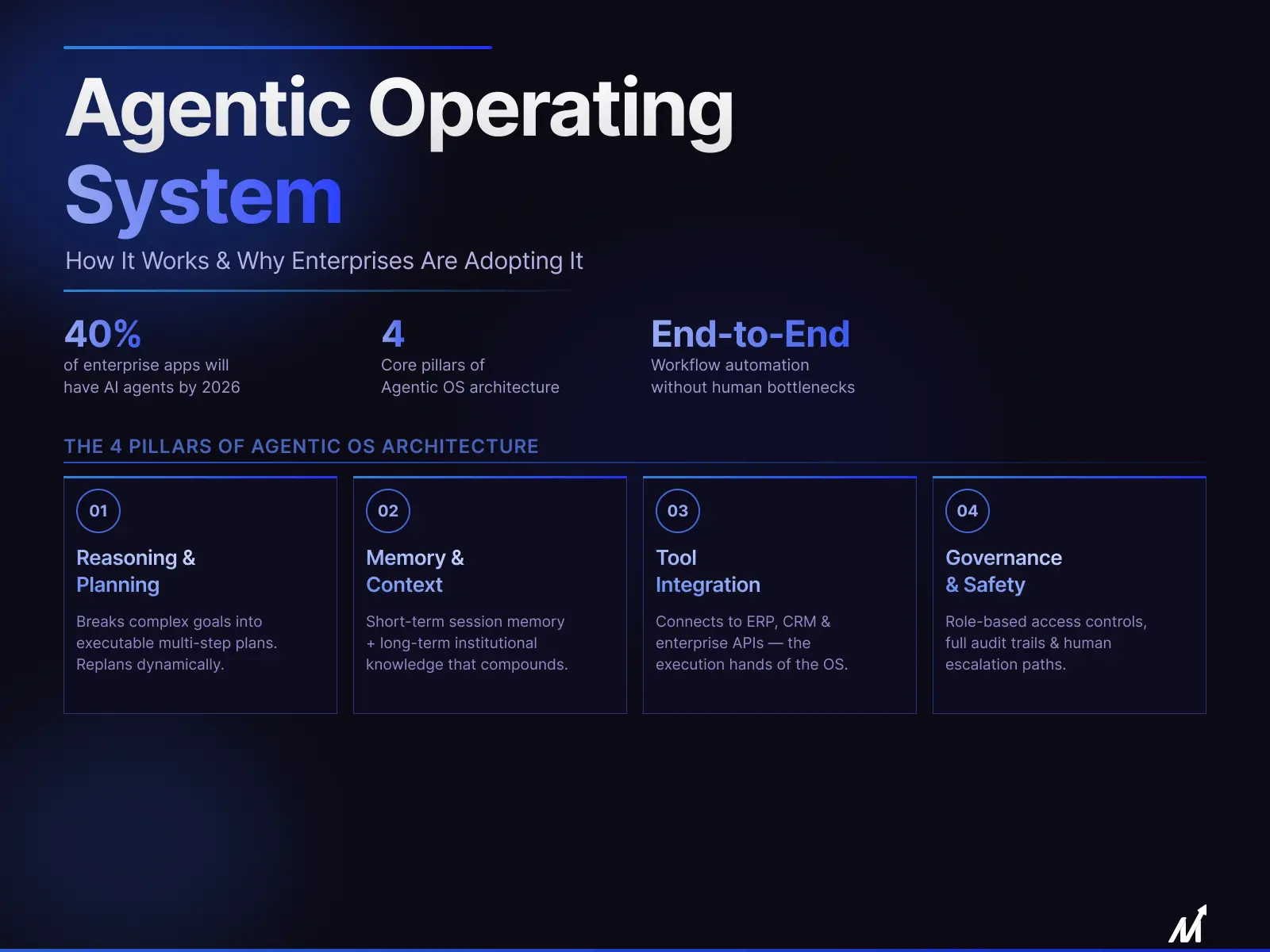
Gartner predicts that by 2026, 40% of enterprise applications will feature task-specific AI agents, up from less than 5% in 2025. The infrastructure to coordinate those agents at scale needs a name — and an architecture. That is what an agentic OS provides.
This guide covers what an agentic operating system actually is, how it works under the hood, how it differs from single AI agents and traditional automation, and where enterprises are putting it to use today.
What Is an Agentic Operating System (AOS)?
An agentic operating system is a software layer that manages, coordinates, and governs multiple AI agents working together to complete multi-step tasks — without requiring human intervention at every step.
To understand what that means in practice, it helps to think about what an operating system actually does. Your laptop’s OS doesn’t ask you to manually allocate memory when you open a new tab or decide which processor core should handle your email. It manages all of that invisibly, so the applications running on top can simply do their job. An agentic OS works on the same principle — but instead of managing applications, it manages AI agents operating inside your enterprise. It decides which agent handles which task, what data each agent can access, how work gets passed between them, and what happens when a step fails or a decision needs escalation.
The word “agentic” signals something important here. Unlike systems that wait for a command before responding, an agentic OS is built to act with intent. It perceives the state of your workflows, determines what needs to happen next, and executes — within whatever guardrails your organization has set. That distinction — between a system that responds and one that drives — is what separates an agentic OS from every AI tool that came before it.
A chatbot handles one conversation. A single AI agent handles one task. An agentic operating system handles an entire workflow end to end — routing work across specialized agents, preserving context across every handoff, connecting into your existing systems, and delivering a completed outcome rather than a recommendation that still requires a human to act on it.
That is the gap it closes. Not intelligence — enterprises already have that in their AI tools. Execution.
The 4 Pillars of an Agentic OS Architecture
An agentic operating system is not a single model or a monolithic piece of software. It is a coordinated system built on four interdependent layers. Understanding each one helps explain why an agentic OS can do what no standalone AI tool, however capable, can do on its own.
Pillar 1: Reasoning and Planning
When a goal lands in the system — say, “process all flagged invoices from this week and escalate anything over $50,000” — the first thing the agentic OS has to do is break that goal apart. It cannot simply hand the instruction to a single model and hope for the best. It needs to decompose the objective into a sequence of steps, determine what information is needed at each stage, decide which agent or tool should handle each step, and anticipate what could go wrong.
This is the reasoning and planning layer. Think of it as the project manager inside the OS — the part that turns a broad objective into an executable plan before a single action is taken. What separates a good agentic OS from a fragile one is how well this layer handles unexpected conditions: when a data source returns nothing, when an approval gets rejected, or when, halfway through a workflow, the circumstances change. A robust planning layer does not freeze; it replans.
If you want to understand how this fits into the broader design of enterprise agent systems, Markovate’s deep dive on agentic AI architecture covers the structural patterns in detail.
Pillar 2: Memory and Context
Humans working on complex tasks do not start from scratch every morning. They remember what happened yesterday, carry context from previous conversations, and draw on institutional knowledge built up over the years. An agentic OS needs the same capability, and it gets it through two distinct types of memory.
Short-term memory holds what is happening right now. It is the active context of the current workflow — what steps have been completed, what was returned by each tool call, what decisions were made, and why. This memory lives in the session and is what allows agents to hand off work to each other without losing the thread of what the overall task is trying to accomplish.
Long-term memory is where institutional knowledge lives. It is the record of past workflows, outcomes, decisions, and exceptions, the kind of knowledge that lets the system get measurably smarter over time. An enterprise that has been running an agentic OS for twelve months has a system that understands its own processes in a way that a freshly deployed one never could. This is what analysts mean when they talk about agentic AI creating compounding advantages for early adopters.
Pillar 3: Tool Integration — The Hands of the System
Reasoning and memory are only useful if the system can actually do something with them. That is where tool integration comes in, and it is the layer that determines whether an agentic OS can operate inside a real enterprise or only inside a demo.
The modern standard for connecting AI agents to external systems is the Model Context Protocol (MCP), which has quickly become the industry’s shared language for tool access. Through MCP, an agentic OS can connect to CRMs, ERPs, ticketing systems, databases, file storage, communication platforms, and custom internal APIs — treating each as a callable capability rather than a hard-coded integration. When an agent needs to pull a customer record, update an order status, or trigger a downstream approval workflow, it does so through this layer.
This is not about the volume of integrations available. It is about how reliably and securely the system interacts with the enterprise stack it was actually built to serve. The teams at Markovate who work on agentic AI development spend a significant portion of every build on exactly this layer — because it is where the gap between a working prototype and a production-ready system is most clearly felt.
Pillar 4: Governance and Safety — The Control Plane
The first three pillars make an agentic OS powerful. This one makes it deployable.
No enterprise will allow an autonomous system to take actions across its core systems without guardrails. The governance layer, often called the control plane, is what defines what agents are permitted to do, enforces those permissions at runtime, logs every decision and action for audit purposes, and creates escalation paths for situations that require human judgment.
In practice, this means agents operate under defined role-based access controls, just as human employees do. An agent handling procurement workflows cannot unilaterally access HR data. An agent processing customer refunds cannot approve amounts above a set threshold without a human review. Every action taken by every agent is logged with enough context to reconstruct exactly what happened and why.
This layer is also what regulators increasingly expect to see. In industries like healthcare, insurance, and financial services, the ability to produce a complete audit trail of autonomous decisions is not a nice-to-have; it is a compliance requirement. Enterprises that deploy an agentic OS without a mature control plane are not saving time. They are accumulating risk.
Together, these four pillars form a system that is more than the sum of its parts. Reasoning without memory produces plans that ignore context. Memory without governance produces systems that know too much and are accountable for nothing.
Tool integration without planning produces agents that execute in the wrong order. It is the combination and the architecture that hold it together, that makes an agentic OS a genuine enterprise-grade operating layer.
Agentic OS vs AI Agents vs Traditional Automation — What’s the Difference?
These three terms get used interchangeably in enterprise AI conversations. They should not be. Each represents a different level of capability, and choosing the wrong one for a given problem is one of the most common reasons AI projects do not deliver what was expected.
A Quick Comparison
| Criteria | Traditional automation | Single AI agent | Agentic OS |
| How it’s triggered | Fixed rule or schedule | Single prompt or instruction | A goal, broken into steps automatically |
| Decision-making | None — executes a fixed script | Limited to the task at hand | Dynamic, adjusts as conditions change |
| Scope | One system, one task | One task, one or more tools | End-to-end workflows across multiple systems |
| Handles exceptions | Fails or stops | Attempts resolution within its scope | Reroutes, replans, or escalates with full context |
| Memory | None | Session only | Short-term and long-term, it builds over time |
| Audit trail | Logged by the host system | Varies by how it was built | Built into every agent action by design |
| Best for | Stable, repetitive, rule-based tasks | Defined tasks with some variability | Complex, multi-step workflows with exceptions |
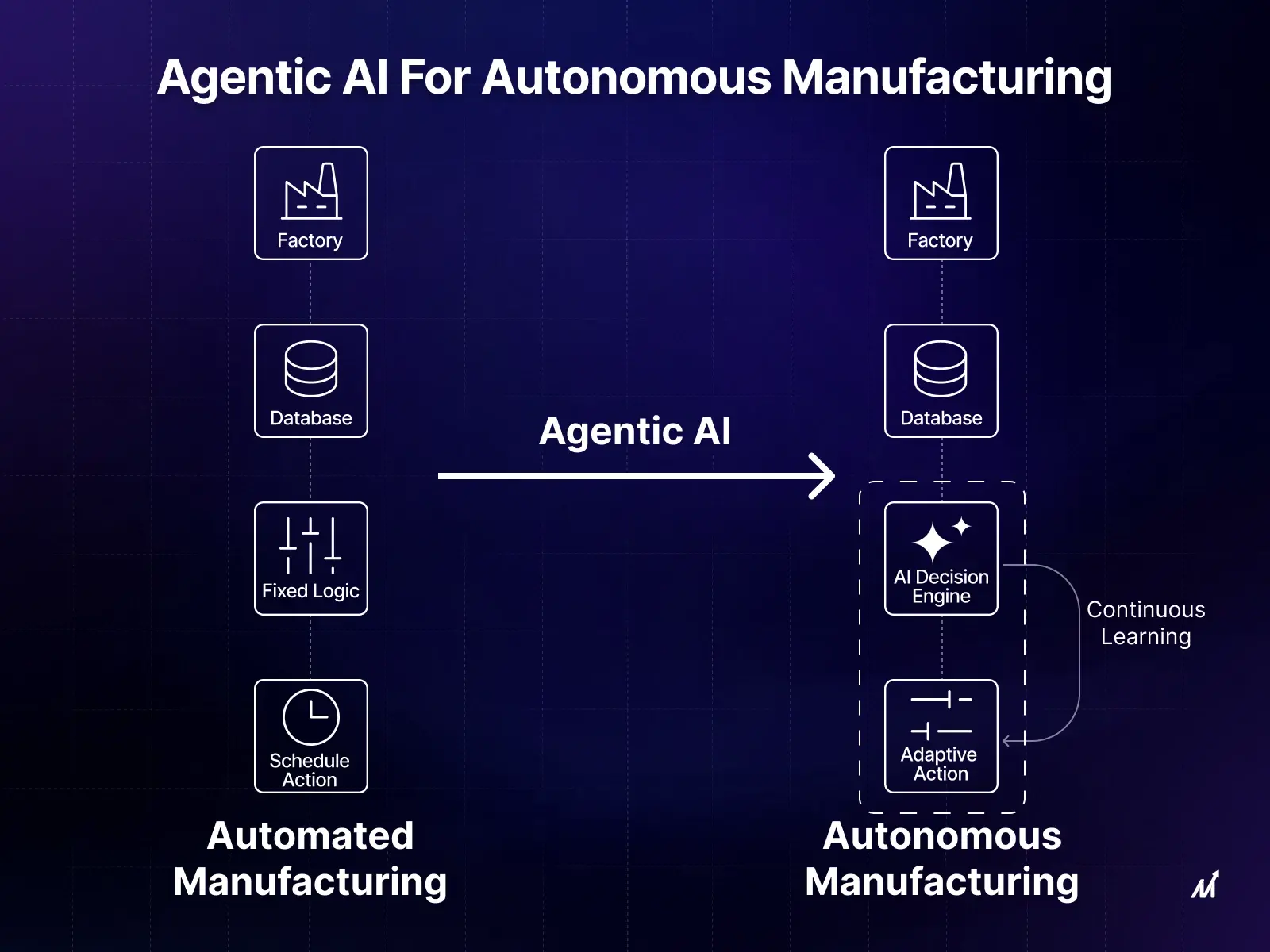
The simplest way to think about it: traditional automation runs a script. An AI agent handles a task with some judgment. An agentic OS manages multiple agents, keeps the whole process on track, and handles what happens when things do not go as planned.
Example
A concrete example makes this clearer. Take a vendor invoice process. Traditional automation can pull data from a structured PDF and push it to a spreadsheet — as long as the format never changes. The moment the invoice arrives differently, or the vendor name does not match the records, or the amount needs to go through a department-specific approval path, it stops.
A single AI agent handles more variability but still works in isolation. It does not know what happened earlier in the procurement cycle or what the downstream system expects.
An agentic OS runs the full process. It reads the invoice regardless of format, checks the vendor record, evaluates the amount against approval thresholds, routes to the right person, tracks the response, and closes out the record in the ERP — every step logged, every decision traceable.
The difference is not about which technology is more advanced. It is about which one was built to handle the full scope of the problem. For processes that are stable and predictable, traditional automation still does the job well. For processes that involve multiple systems, variable inputs, and decisions that depend on context, an agentic OS is the more practical choice. You can see this play out in real deployments in Markovate’s breakdown of agentic AI in manufacturing, where both approaches are used — each for the kind of work it handles best.
Enterprise Use Cases for an Agentic Operating System
The workflows below represent where enterprises are already running agentic OS deployments in 2026, not pilots, not prototypes. Each one follows the same pattern: a process that crosses multiple systems, involves variable inputs, and has historically relied on human coordination to hold it together.
1. Supply chain: autonomous inventory rebalancing
Supply chains do not break because data is missing. They break because acting on that data requires coordinating across procurement, warehouse, logistics, and finance at the same time, and by the time all those pieces are aligned manually, the window to respond has already passed.
An agentic OS monitors inventory levels, demand signals, and supplier lead times continuously. When stock drops below threshold in a distribution center, it does not raise a ticket for someone to act on. It evaluates supplier availability, initiates the reorder, updates the logistics schedule, and flags only the situations that fall outside defined parameters. The process moves at the speed of the data, not at the speed of the approval chain.
2. IT operations: self-healing infrastructure and incident response
Most IT alerts do not require creative problem-solving. They require the same diagnostic steps, run against the same systems, in a specific order, every time. The problem is that doing those steps manually takes longer than the incident warrants, and by the time the cycle repeats enough, the team is spending more time responding than preventing.
An agentic OS monitors infrastructure continuously, correlates signals across sources, and resolves known issue types without waiting for someone to initiate the process. For unfamiliar incidents, it assembles the relevant context, identifies the most likely cause, and routes to the right person with the diagnostic work already completed. Over time, repeated incident patterns become something the system addresses before they escalate.
3. Finance operations: reconciliation and month-end close
Finance teams spend a predictable amount of every month doing work that is mechanical — matching transactions, chasing approvals, compiling reports from data that already exists inside their systems. Month-end close involves the same sequence of steps every cycle, done manually because no single tool has ever connected all the pieces end to end.
An agentic OS runs reconciliation continuously, flags variances beyond set thresholds, routes exceptions for human review, and assembles reporting packages from live data. The work that used to take three days at month-end becomes something the system handles progressively, with human attention going to the variances that actually need it.
4. Customer operations: resolution without the queue
Customer-facing teams handle two types of requests that look the same in a queue but require very different effort: routine transactions that follow a known pattern and complex cases that need genuine judgment. The problem is that both types consume the same amount of a team member’s time when managed manually.
An agentic OS separates these streams at the point of entry. Routine requests, order status, refund processing, and account updates are handled end-to-end without human involvement. The system pulls the record, takes the action, confirms the resolution, and closes the case. Complex cases are escalated with full context already compiled, so the person receiving them does not start from scratch. Teams that have deployed an agentic AI assistant for this consistently report the same outcome: response times drop, and the team’s attention shifts to the work that actually requires it.
5. Document intelligence: feeding the agentic OS high-quality data
An agentic OS is only as reliable as the data it works with. In industries like manufacturing, construction, and engineering, a significant portion of that data lives in unstructured documents, technical drawings, blueprints, specifications, and compliance filings that cannot be fed into automated workflows without first being interpreted accurately.
Specialized document classifiers handle this upstream layer. Markovate’s AI Blueprint Classifier, for example, extracts structured data from engineering drawings and CAD files, bill of materials, part numbers, tolerances, and revision history, and converts it into clean output that downstream agents can act on directly. Without that extraction layer, agents working in a manufacturing environment are working with incomplete information. With it, quoting, procurement, and change order workflows run with the same reliability as any structured data process.
The pattern extends across industries. Contract intelligence feeds legal and finance agents. Medical document parsing feeds clinical coding workflows. In each case, the quality of the input layer determines how reliably the agentic OS performs downstream.
For a broader view of where AI agents are being deployed across industries, Markovate has documented 50+ AI agent use cases across enterprise functions.
Key Benefits of Adopting an Agentic OS
Enterprises that have moved beyond isolated AI tools to a coordinated agentic layer report a consistent set of outcomes:
- Faster execution across workflows — Multi-step processes that previously required manual handoffs between systems are completed in a fraction of the time, without waiting on human coordination at each stage.
- Fewer errors at system boundaries — Most process errors happen at handoff points between teams and systems. An agentic OS owns the handoff, so nothing falls through the gap.
- Human effort directed where it matters — Routine, predictable work is handled autonomously. People focus on decisions that require judgment, relationships, or context that the system does not have.
- Processes that improve over time — Long-term memory means the system learns from past workflows. Edge cases handled once become exceptions; the system knows how to manage going forward.
- A single audit trail across every action — Every agent decision is logged with full context. For regulated industries, this is not a secondary benefit — it is a prerequisite for deployment.
- Scalability without proportional headcount growth — Agentic workflows scale by adding capacity to the system, not by hiring for every new process volume. The same architecture that handles 500 invoices a month handles 5,000.
How to Choose the Right Agentic OS for Your Enterprise
The agentic OS market is moving fast, and the category language is ahead of the actual product differentiation. Several vendors that were selling workflow automation tools six months ago are now calling the same product an agentic OS. That makes evaluation harder than it should be, because the terminology does not reliably indicate what the platform actually does.
Five criteria separate platforms that will hold up in production from those that work well in a demo:
1. Execution depth — not just reasoning
A platform that can plan a workflow but cannot reliably execute it inside your existing systems is not ready for enterprise deployment. The question to ask is not “can it understand the task” but “can it complete the task end to end, inside our ERP, CRM, and internal tools, without requiring custom code for every new integration.” MCP support and the breadth of pre-built connectors are the clearest signals here.
2. Memory architecture
How the platform handles context across sessions and over time determines whether it gets meaningfully more useful with use or stays flat. Ask specifically: Does it maintain short-term context within a workflow and long-term institutional memory across workflows? Can that memory be scoped and governed — so one department’s context does not bleed into another’s?
3. Governance and audit controls
This is where most demos fall short. In a demo, agents work correctly because the inputs are controlled. In production, agents encounter edge cases, ambiguous instructions, and system errors. A production-ready platform defines what each agent is permitted to do before it runs, logs every action with enough context to reconstruct decisions later, and has clear escalation paths for situations outside defined boundaries. If a vendor cannot show you the audit trail from a live workflow, that is a gap worth taking seriously.
4. Integration breadth and reliability
The value of an agentic OS depends on how deeply it connects to your existing stack. Surface-level integrations are not enough. The platform needs to read data, write back, trigger approvals, and close loops. Evaluate integrations against your specific systems — not a general list.
5. Build vs. buy fit
Some enterprises can build on open-source frameworks like LangGraph or AutoGen. Most cannot. And those who often underestimate the cost of maintenance. The real question is simple: what should your team own, and what should come pre-built? Answer that before committing to an architecture — not after the first scaling attempt reveals its limits.
How Markovate Helps Enterprises Build Agentic AI Systems
Most enterprises know where they want to go with agentic AI. The gap is usually the same: which workflows to start with, how to fit the system into an existing stack, and how to build something that holds up in production.
Markovate works with enterprise teams across manufacturing, healthcare, insurance, construction, and real estate. We design and build agentic systems around the actual processes and data each business runs on. That means identifying the right entry points, building the integration and governance layers the deployment requires, and ensuring the system scales without breaking down.
If you are evaluating where an agentic OS fits in your organization, our agentic AI development team can help you move from assessment to a working system — without the overhead of building the foundational architecture from scratch. For organizations still in the strategy phase, our AI consulting services provide a structured way to map your highest-value workflows before any build begins.
Conclusion
Agentic operating systems are not the next version of automation. They are a different category entirely — one built for the complexity that traditional automation and standalone AI tools were never designed to handle.
The enterprises moving on this now are not doing it because it is new. The workflows that matter most cross systems, involve judgment, and depend on human coordination to hold together. Those workflows now have an infrastructure layer built to run them reliably.
The question is not whether an agentic OS belongs in your enterprise. For most organizations operating at scale, it already does. The question is where you start and how you build it to last.