


AI adoption is growing rapidly, and it’s not hard to see why. Gartner forecasts that worldwide AI spending will reach about $2.7 trillion in 2026, up 49.5% from 2025. As AI becomes integral to industries worldwide, businesses are eager to harness its potential. But the question remains: how much does it cost to build an AI system?
The answer isn’t straightforward. The cost can change greatly depending on factors like the project’s complexity, the type of AI system, the data needed, and the team’s skills.
In this blog, we will break down the various elements that influence AI development costs. We will give you a comprehensive understanding of what it takes to bring an AI solution to life and how to plan for a successful investment in AI development. Whether you want to develop a machine learning model or build an intelligent AI solution, understanding these costs will be key to making informed decisions. Let’s start!
Exploring AI Solutions: Custom vs. Pre-Built 
When considering AI solutions for your business, two key options typically emerge: custom AI solutions and pre-built AI solutions. Each comes with distinct pros and cons depending on your specific needs and business goals. Let’s explore these two approaches and their implications.
Custom AI Solutions: Built to Fit Your Unique Requirements
Custom AI solutions are designed from the ground up to meet the specific needs of a business. These AI models, whether using machine learning, natural language processing, or computer vision, are tailor-made for a particular set of challenges. The benefit of custom solutions lies in their ability to provide unique, high-performance results, especially for tasks that require specialized data and precise outcomes.
Why Custom AI Solutions?
Custom AI offers greater accuracy and control over the solution, with benefits such as ownership, specialized data handling, and tailored testing, all of which matter for businesses looking for long-term success.
- Full Ownership and Control: Own your AI software and intellectual property, giving you flexibility and the potential to monetize it if needed.
- Tailored to Your Specific Needs: A custom solution is built to meet the unique challenges and requirements of your business, ensuring it performs optimally.
- Enhanced Accuracy with Specialized Data: Custom AI excels in handling niche or specialized data sets, providing highly relevant and accurate predictions.
- No Vendor Licensing Fees: Once developed, the AI system is yours, so there are no per-seat or subscription fees to a third-party vendor. You will still pay for hosting and maintenance, which we cover below.
- Thorough Testing for Optimal Performance: Custom AI is rigorously tested to ensure it performs excellently under real-world conditions as per the business’s needs.
Custom AI solutions come with higher initial costs, typically ranging from $100K to $500K or more, depending on the complexity of the project and the technologies involved. They also take longer to deliver, often several months, and need ongoing maintenance. The need for skilled data scientists, machine learning engineers, and domain experts makes custom AI a significant long-term investment.
However, when you look at the long-term value, custom AI solutions shine in situations where precision, scalability, and control over the solution are critical. Businesses like Tesla, which uses custom AI for self-driving car technology, rely on bespoke solutions because their needs are far too specialized for off-the-shelf products. Similarly, a financial institution looking to implement predictive analytics for real-time trading decisions would demand the accuracy and adaptability that only a custom solution can provide.
Who Should Go for Custom AI?
Custom AI solutions are ideal for businesses that:
- Require high accuracy in specialized tasks (e.g., medical diagnostics, predictive maintenance, or financial modelling).
- Need tailored solutions that align with specific workflows, data sets, and goals.
- Plan to scale or evolve their AI solution as the business grows, without being restricted by the limitations of off-the-shelf tools.
Pre-Built AI Solutions: Fast and Affordable for Common Needs
Pre-built AI solutions, by contrast, are ready-to-use models developed by tech companies. These tools are designed to address general use cases such as image recognition, basic chatbots, and language processing.
Why Pre-Built AI Solutions?
Pre-built AI solutions offer some pros, especially in the short term:
- Lower Initial Costs: With pre-built AI, you are essentially paying for the ability to leverage a platform that has already been developed, tested, and optimized. These solutions typically cost less to implement, with average prices ranging from $5K to $50K.
- Quick Deployment: Because they are pre-configured, these solutions can be deployed within a matter of weeks, which can be suitable for businesses with immediate needs.
- No Infrastructure Overhead: Pre-built solutions often come with their hosting and maintenance, which means you don’t have to worry about scalability or infrastructure investment.
However, pre-built AI solutions are not always a perfect fit for businesses with specialized needs. The models are generally designed for more generic tasks, which might not always yield the same level of accuracy or quality when applied to specific business problems.
Who Should Go for Pre-Built AI Solutions?
Pre-built AI solutions are a good fit for businesses that:
- Have more generic needs, like basic customer service automation, general data analysis, etc.
- Have limited resources and require a quick solution without extensive customization.
- Need to deploy AI with minimal development time and have a relatively straightforward use case that doesn’t require complex, tailored solutions.
Ultimately, pre-built solutions might work well for simpler, more general use cases. Custom AI is the way forward for businesses that want to stay ahead of the curve and meet specific goals with a tailored approach. Such customization provides better control, performance, and long-term ROI.
However, the cost of AI development is not fixed for any of these solutions. It can be changed based on a range of factors: project scope, data requirements, algorithm selection, etc., required to build the solution. Let’s elaborate on this further!
Critical Factors in Estimating Custom AI Development Costs

When planning an AI development project, understanding the factors contributing to the overall cost is important. While each project is unique, certain key elements significantly impact or decide the cost. Here are the critical aspects that shape the expenses of custom AI development:
1. Data Requirements
Data is a foundational element of any AI project, and its collection, storage, processing, and security can significantly impact the overall development cost. The complexity of the data and the AI model’s specific needs play a crucial role in determining these costs.
a) Data Collection & Preparation
Collecting, cleaning, and labeling data is time-consuming and essential for effective AI training. The volume and complexity of the data required play a significant role in shaping the overall cost. For more specialized industries, like healthcare, gathering high-quality data can require additional effort and expense.
b) Data Labeling
Accurate labeling is a critical cost driver, especially for specialized sectors such as finance or healthcare. The accuracy required in these domains, along with the scale of the dataset, increases the cost of labeling, making it an important consideration when budgeting for your AI development.
c) Data Storage & Processing
Storing and processing large datasets requires a robust infrastructure. Depending on the size and needs of your AI model, cloud services or dedicated data centers may be necessary. This can add significant ongoing costs, especially when handling complex or real-time data.
d) Data Privacy & Security
Ensuring compliance with privacy regulations such as GDPR or HIPAA and implementing security measures can drive up costs when working with sensitive data. These safeguards mitigate data breaches, legal issues, and reputational damage risks.
To sum up, data-related costs can vary greatly depending on factors such as dataset size, complexity, and security requirements. While foundation models can reduce some expenses, highly specialized or sensitive applications can push data collection, labeling, and processing costs into the hundreds of thousands of dollars.
Partnering with a skilled AI development firm like Markovate can streamline this process. Expert guidance on data strategy keeps data management efficient and your project on budget while meeting industry standards.
2. Algorithm Selection and Model Development
The choice of an AI model and its complexity can significantly affect the development cost. Factors such as model selection, accuracy requirements, and the need for real-time performance all contribute to the final price.
a) Model Selection & Training
Choosing the right model, like regression, neural networks, and reinforcement learning, is essential. More complex models need a lot of data for training and require adjustments to improve their performance, which increases the cost.
b) Accuracy and Complexity
Higher accuracy in AI models requires advanced techniques and larger datasets. For example, predictive maintenance in manufacturing uses machine learning models that analyze data from sensors on machines to predict failures before they happen. These systems need huge amounts of data from different machine conditions, requiring complex models and real-time processing, which increases costs.
General Electric (GE) invested millions to develop such predictive systems for its industrial equipment, ensuring high accuracy to prevent downtime and optimize operations.
c) Real-Time Performance
Real-time performance demands optimized algorithms and specialized hardware to ensure speed and reliability, driving up development and operational costs.
For example, AI systems in autonomous delivery robots must process real-time data to navigate environments and avoid obstacles. Achieving this requires efficient algorithms, powerful processors, and continuous testing to ensure safe and reliable operation, increasing the overall cost of development and deployment.
d) Continuous Learning
AI systems that continuously learn, such as recommendation engines, require constant model updates and data processing. The infrastructure needed for continuous learning adds long-term costs for regular retraining and testing. For example, Amazon’s recommendation system needs regular retraining, adding substantial ongoing infrastructure and update costs.
To summarize, algorithm selection, model development, and optimization costs increase with model complexity, accuracy targets, real-time needs, and continuous learning requirements.
Partnering with an experienced AI development company, like Markovate, can help streamline the selection and optimization of algorithms to ensure you achieve the desired accuracy and performance while managing costs efficiently.
3. AI Type & Project Complexity
The type of AI you choose significantly impacts the development cost, as different AI systems require varying levels of complexity, resources, and time to build. As AI projects grow more complex, the costs rise accordingly.
Simpler AI solutions like rule-based systems are relatively inexpensive, while advanced projects like deep learning, computer vision, or NLP require greater data, resources, and expertise investment. Therefore, understanding the complexity and scope of the AI solution you require is essential in estimating your development costs. Here’s a breakdown of common AI types:
a) LLM-Based Generative AI Solutions
Generative AI solutions built on large language models (LLMs) handle tasks like content creation, chat assistants, document Q&A, and AI agents that take actions across tools. Building on an existing LLM API is usually the fastest and most cost-effective route; costs rise with retrieval (RAG) pipelines, fine-tuning, evaluation, guardrails, and ongoing token usage. See the generative AI cost breakdown below for typical ranges.
b) Machine Learning Models
Machine learning models, such as recommendation systems, are a common choice. These models typically start with foundational AI algorithms that learn from data, offering more straightforward development but still requiring sufficient data, training, and fine-tuning.
c) Deep Learning and Neural Networks
Deep learning, a subset of machine learning, uses multi-layered neural networks to handle highly complex data, such as images or speech. For example, an AI-based medical diagnostic tool that analyzes medical images (e.g., X-rays or MRIs) to detect signs of disease.
d) Natural Language Processing and Computer Vision
NLP enables AI systems to understand and generate human language, while computer vision focuses on interpreting and analyzing visual information. For example, an AI-driven transcription service that converts audio from meetings or podcasts into text, or an AI that scans invoices and extracts key data automatically.
As each AI project is unique, costs can only be accurately calculated once the actual requirements are clearly defined. This makes it essential to fully understand the needs and scope of your AI solution to determine a precise budget.
4. Infrastructure and Cloud Computing
AI development requires solid infrastructure, and choosing between cloud-based or on-premises hardware can have significant cost implications. Infrastructure typically accounts for a notable percentage of the overall development cost.
a) Cloud vs. On-Premises Hardware
Cloud platforms like AWS or Google Cloud provide scalable solutions, making them ideal for projects with fluctuating resource needs. On-premises hardware, while more costly upfront, may offer long-term savings, particularly for large-scale AI deployments.
b) Tools and Frameworks
Open-source frameworks like TensorFlow and PyTorch are free but require skilled developers, while managed platforms such as AWS SageMaker, Google Vertex AI, Microsoft Azure AI services, and IBM watsonx add convenience and enterprise features in exchange for usage-based fees.
c) LLM API and Usage-Based Costs
Hosted generative AI and LLM APIs charge based on usage, typically per input and output token, so costs grow with interaction volume. Open-weight models, such as those from Mistral AI or Meta’s Llama family, can lower per-request costs when self-hosted, but you take on GPU hosting, scaling, and maintenance.
d) Testing, Validation, and Deployment
AI systems, particularly complex ones, require significant testing, validation, and ongoing deployment costs, including scaling, monitoring, and updates.
AI infrastructure costs depend on your chosen tools, hardware, and cloud services. While cloud solutions offer flexibility, they can drive up costs, especially for large-scale or data-intensive projects. Proper budgeting for infrastructure is crucial in managing AI development expenses.
5. Legal and Compliance Costs
Security and compliance are crucial considerations in AI development, especially when dealing with sensitive or regulated data. Ensuring that your AI system adheres to legal and privacy standards adds an extra layer of cost, but it’s essential for safeguarding data and avoiding legal complications.
a) Security Measures
Securing an AI system goes beyond data privacy (covered above). Access controls, encryption, audit logging, penetration testing, and safeguards against AI-specific risks like prompt injection and model misuse all add engineering and testing effort, especially in industries like healthcare and finance.
b) Regulatory Compliance
Different industries have varying regulatory requirements that AI systems must comply with. These compliance measures can add complexity and cost, but they are necessary to mitigate risks related to legal penalties or loss of user trust. New AI-specific rules, such as the EU AI Act, also add documentation, risk assessment, and transparency requirements for certain use cases.
Compliance costs depend on your industry, the sensitivity of your data, and where your users are. Budgeting for security reviews, legal guidance, and compliance documentation early is far cheaper than retrofitting them after launch.
Markovate builds security and compliance into the development process from day one, helping you meet standards like GDPR and HIPAA without costly rework later.
6. System Integration
Integrating AI with existing systems adds complexity, particularly when ensuring compatibility with legacy infrastructure, connecting to CRMs, ERPs, or internal databases, or customizing AI for specific user experiences. The more systems involved, the more development and testing time the project needs.
7. Team Expertise and Location
Talent is often the largest single cost in an AI project. A typical team includes data scientists, ML engineers, backend developers, and a project manager, and rates vary widely by seniority and region. Building an in-house team adds recruiting, salaries, and tooling costs, while partnering with an experienced AI development company gives you a complete team without the long-term overhead.
When planning an AI project, it is important to analyze these factors and connect with a skilled AI development company that can help optimize costs while ensuring the required result.
AI Development Costs: What’s the Average Price?
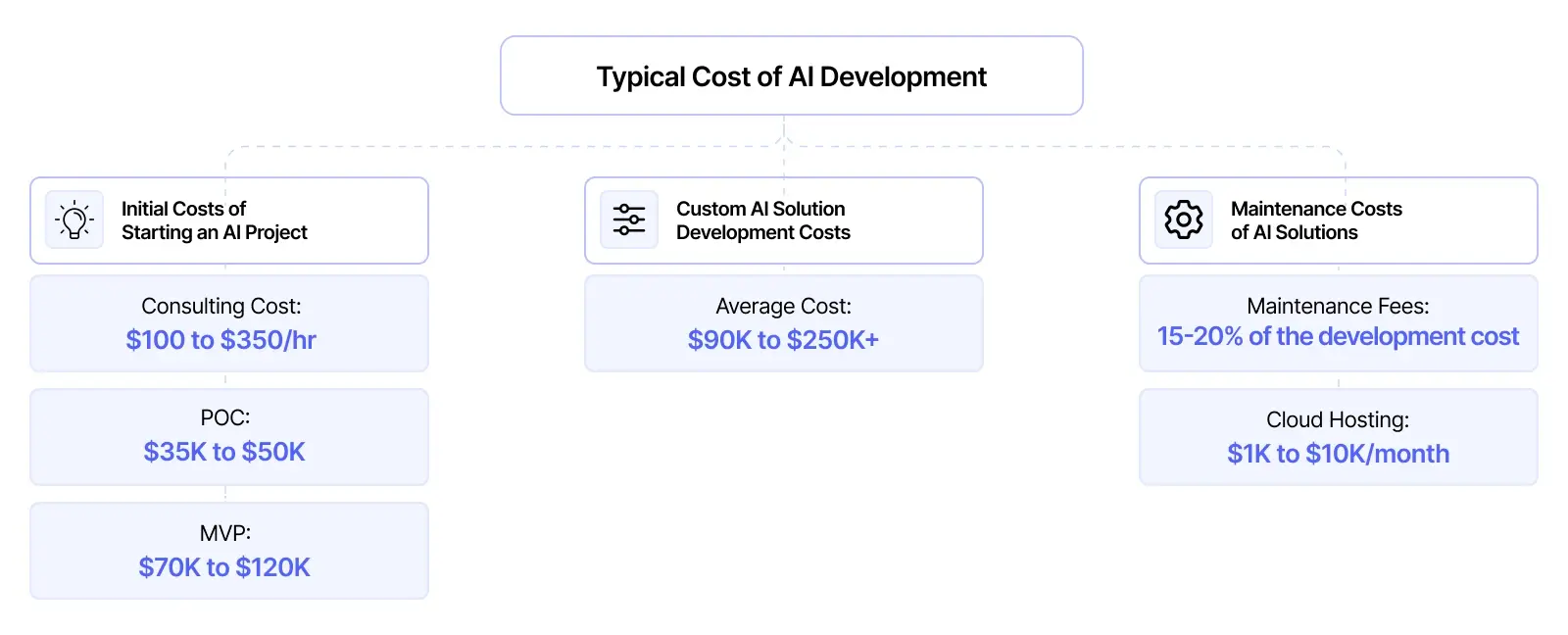
AI development costs can be divided into three key stages: project initiation, development, and maintenance. First, we will cover the initial costs, including feasibility studies and proof-of-concept development. Then, we will discuss the average development costs, which vary based on complexity, data, and infrastructure. Finally, we will explore ongoing maintenance costs, which are essential for keeping your AI solution running smoothly.
The overall cost can vary significantly depending on these stages, with some projects requiring more upfront investment for research and development, while others may incur higher ongoing costs for continuous optimization and updates.
As there’s no one-size-fits-all price tag for AI development, understanding the general cost spectrum can help set realistic expectations and guide decision-making.
AI Development Cost at a Glance
| Stage / project type | Typical cost | Typical timeline |
|---|---|---|
| AI consulting | $100–$350 per hour | 1–4 weeks |
| Pre-built AI solution | $5K–$50K | 2–6 weeks |
| Proof of concept (POC) | $35K–$50K+ | 4–8 weeks |
| Minimum viable product (MVP) | $70K–$120K | 2–4 months |
| Generative AI app (LLM API, RAG) | $20K–$150K | 1–3 months |
| AI agents and multi-step automation | $100K–$400K+ | 3–6 months |
| Full custom AI solution | $100K–$500K+ | 4–12 months |
| Annual maintenance | 15%–20% of build cost | Ongoing |
| Cloud hosting | $1K–$10K+ per month | Ongoing |
These are typical ranges. Your actual cost depends on the factors covered above.
Initial Costs of Starting an AI Project
When starting an AI project, the initial costs are often focused on feasibility studies, consulting, proof-of-concept (POC) development, and the creation of a minimum viable product (MVP). These early-stage costs can differ depending on the project’s complexity.
-
Consulting Cost
Before diving into development, businesses often require expert advice to analyze and evaluate the potential for AI implementation and determine the right approach. AI consulting services can cost between $100 – $350 per hour, as per the experience and reputation of the consultants.
-
Proof of Concept
A Proof of Concept is a crucial early-stage demonstration designed to validate the feasibility of an AI solution before full-scale development begins. It serves as a practical test to showcase the viability and potential impact of an idea, technology, or solution. The goal is to prove that the proposed approach works in real-world conditions, helping stakeholders assess risks and make informed decisions.
The cost of developing a POC typically ranges between $35,000 and $50,000, though it can go higher depending on several factors. Simpler POCs, which involve basic algorithms or smaller datasets, fall within the low range. However, for more complex POCs, such as those that involve advanced machine learning models, extensive data gathering, or advanced integrations with existing systems, the cost can be higher. These higher-end POCs typically require specialized expertise, more resources, and more intensive testing to ensure the proposed AI solution will deliver the expected value.
This phase usually involves several key steps, including data gathering, model selection, and basic testing to ensure that the AI solution can deliver the desired results. While this is a relatively small investment compared to full-scale AI projects, it provides valuable insights and can prevent costly mistakes in later stages.
-
Minimum Viable Product
After validating the concept with a POC, the next step is to create a Minimum Viable Product (MVP). The MVP is a scaled-down version of the final product designed to test the real-world application of the solution, gather user feedback, and refine its functionality before full deployment.
Developing an AI-based MVP typically costs between $70,000 and $120,000, depending on factors like AI functionality, data requirements, and the level of system integration. Simpler AI models and integrations may have lower costs, while more complex solutions, such as deep learning or real-time data processing, can push costs higher.
Average Custom AI Solution Development Costs
The cost of developing a custom AI solution typically ranges from $100,000 to $500,000 or more, depending on the factors discussed above. This total usually includes the earlier POC and MVP phases, since those are steps toward the full build rather than separate projects.
The lower range is generally for AI projects that involve straightforward applications like data analysis, basic automation, or relatively simple machine learning models. These projects typically require less specialized expertise, smaller datasets, and fewer custom integrations, which helps keep the cost more affordable.
On the higher end are more complex AI systems, such as deep learning-based medical imaging tools, real-time fraud detection, or large-scale AI integrations for financial systems. These projects involve advanced algorithms, larger datasets, specialized hardware, and regulatory compliance, all of which increase development time and expertise. Highly specialized programs like autonomous driving sit far outside this range, often costing tens or hundreds of millions of dollars.
The variation in AI development costs largely comes down to the complexity of the solution, the amount of data required, and the level of customization needed to meet specific business needs. Simple applications may cost less, while highly specialized and advanced AI systems come with a significantly higher price tag due to their technical demands.
Generative AI and AI Agent Development Costs
Most new AI projects today are built on large language models rather than trained from scratch. That lowers upfront cost but adds usage-based costs that grow with adoption. Typical ranges:
- Basic LLM assistant on an existing API: $20K–$60K
- Generative AI app with retrieval (RAG) over your own data: $40K–$150K
- Fine-tuned or domain-adapted model: $80K–$300K
- AI agents that plan, use tools, and act across systems: $100K–$400K+
On top of the build, budget for token or inference costs, evaluation and monitoring to catch inaccurate outputs, and guardrails for security. For high-volume use cases, choosing smaller or open-weight models and caching frequent responses can cut running costs significantly.
Maintenance Costs of AI Solutions
Ongoing maintenance is an essential aspect of AI development. AI models require continuous monitoring, updates, and retraining to have optimal performance and adapt to changing conditions. Maintenance costs depend on the complexity, scale of the solution, and the frequency of updates needed. Some considerations are:
-
Maintenance Fees
Maintenance typically includes model retraining, data updates, bug fixes, and regular performance checks. The average annual maintenance cost for an AI solution can range from 15% to 20% of the initial development cost. For example, if you spent $100,000 on developing your AI system, annual maintenance could cost between $15,000 and $20,000.
-
Cloud Hosting and Infrastructure
If your AI model is hosted on cloud platforms like AWS, Azure, or Google Cloud, ongoing hosting, storage, and compute power costs should also be considered. The cost can vary significantly based on factors such as data storage needs, processing power, and usage volume.
For example, smaller AI models may incur relatively low costs. More complex models, like those used in deep learning, can require substantial computational resources, resulting in higher expenses. On average, monthly costs for cloud hosting can range from $1,000 to $10,000, though they can exceed this for large-scale, resource-intensive systems.
In addition to infrastructure costs, token costs are a key factor when using services like LLM APIs. These services charge based on the number of tokens processed, with higher usage leading to increased costs.
Our LLM API Pricing Calculator helps you estimate token-based pricing for popular LLM APIs, including models from OpenAI and Anthropic. This enables more accurate financial planning and cost predictions.
For businesses looking to optimize costs while ensuring high-quality AI solutions, outsourcing is often the better choice. Markovate helps bridge this gap by developing cost-effective AI solutions without the overhead of building a full in-house team.
Let’s explore how Markovate can help you save costs and streamline your AI development process.
Markovate’s Approach to AI Development: Balancing Cost, Security, and Efficiency
When it comes to AI development, ensuring that the system is secure, compliant, and cost-effective is crucial. At Markovate, we understand that these are not just buzzwords but the pillars that shape a successful AI project. Our goal is to help you develop AI solutions that deliver high impact without breaking the bank, while also safeguarding your sensitive data and ensuring regulatory compliance.
Here’s how we make it happen:
1. Security & Compliance: Protecting What Matters Most
Security and compliance are at the heart of every AI solution we build, especially when dealing with industries that handle sensitive or regulated data like healthcare and finance. At Markovate, we prioritize implementing robust security protocols and adhering to data protection regulations like GDPR and HIPAA. While these requirements add a layer of complexity and cost to the development process, they are a necessary investment to protect your business from potential legal risks and reputational damage in the long run.
2. Tailored, Cost-Efficient AI Solutions
At Markovate, we are committed to developing personalized AI solutions that meet your specific business needs. By focusing on only the most relevant features, we help you avoid unnecessary costs associated with irrelevant functionalities.
We also recommend starting with a Minimum Viable Product, which allows us to build a scalable AI solution at a fraction of the initial cost. This approach enables businesses to launch core functionalities quickly, test them with real users, and then iterate based on feedback. This ultimately ensures a more efficient development cycle with fewer risks and surprises down the line.
3. Cloud Infrastructure for Flexibility and Scalability
For most projects, we use cloud platforms to keep infrastructure flexible, scalable, and free of heavy upfront investment. Where data residency, security, or sustained compute volume makes it more cost-effective, we also design on-premises or hybrid setups.
4. Efficient Data Management: Building on a Strong Foundation
We understand that high-quality data is the backbone of any successful AI system. At Markovate, we focus on using high-quality data for your AI solution and optimizing data processing to keep costs in check. Whether it’s for training models or improving system accuracy, we ensure that every piece of data is used efficiently to create a robust AI solution.
5. Expert Cost Optimization: Maximum Value with Minimum Overhead
Leveraging years of experience in AI development, Markovate knows how to balance quality and cost-effectiveness. We are experts at optimizing your AI development budget to ensure you get the most value out of every dollar spent. From the very beginning of the project to its ongoing maintenance, we work to maximize your investment and avoid unnecessary overhead.
6. Efficient Technology Stack Selection
Choosing the right technology stack is a major cost driver in AI development. Markovate ensures that the tools and platforms we select balance performance with cost-effectiveness. We help you pick the most suitable options, whether using open-source platforms like TensorFlow or efficient cloud computing resources. So, your AI project stays within budget without sacrificing quality.
7. Continuous Support & Iterative Development: For Long-term Value
Our partnership with you doesn’t end once the AI solution is deployed. We provide ongoing monitoring and support to ensure your AI solutions remain optimized and continue to evolve as your business grows. Also, our iterative development process means you only pay for what’s necessary at each stage. So, you can avoid overinvesting in untested features and focus on what truly drives value.
By combining these strategies (security, personalized solutions, cloud infrastructure, data efficiency, and expert cost optimization), Markovate helps businesses develop high-quality and scalable AI solutions that provide a significant return on investment, all while staying within budget and adhering to the highest security and compliance standards. Let us help you bring your AI vision to life cost-effectively and securely!
Conclusion: Navigating the Costs of AI Development
The cost of AI development can vary widely depending on various factors such as project complexity, data requirements, and team expertise. While initial investments may seem high, the long-term benefits of AI, like advanced automation and improved decision-making, often exceed the upfront costs.
For businesses looking to implement advanced AI solutions, partnering with Markovate ensures high-quality, customized AI applications that align with your unique needs.
FAQs
1. What factors influence the cost of AI development?
AI development costs depend on project complexity, the type of AI used, and the amount of data needed. Costs also vary based on the expertise required, infrastructure for training models, integration with existing systems, and whether third-party APIs or pre-trained models are used.
2. How do AI development costs vary by project type?
Costs vary most by the type of AI being built. Pre-built tools and simple LLM-based assistants are the most affordable, often $5K–$60K. Generative AI apps that retrieve answers from your own data typically cost $40K–$150K, while custom machine learning, computer vision, or AI agent projects range from $100K to $500K or more. Ongoing maintenance and cloud or token costs add recurring expenses on top.


