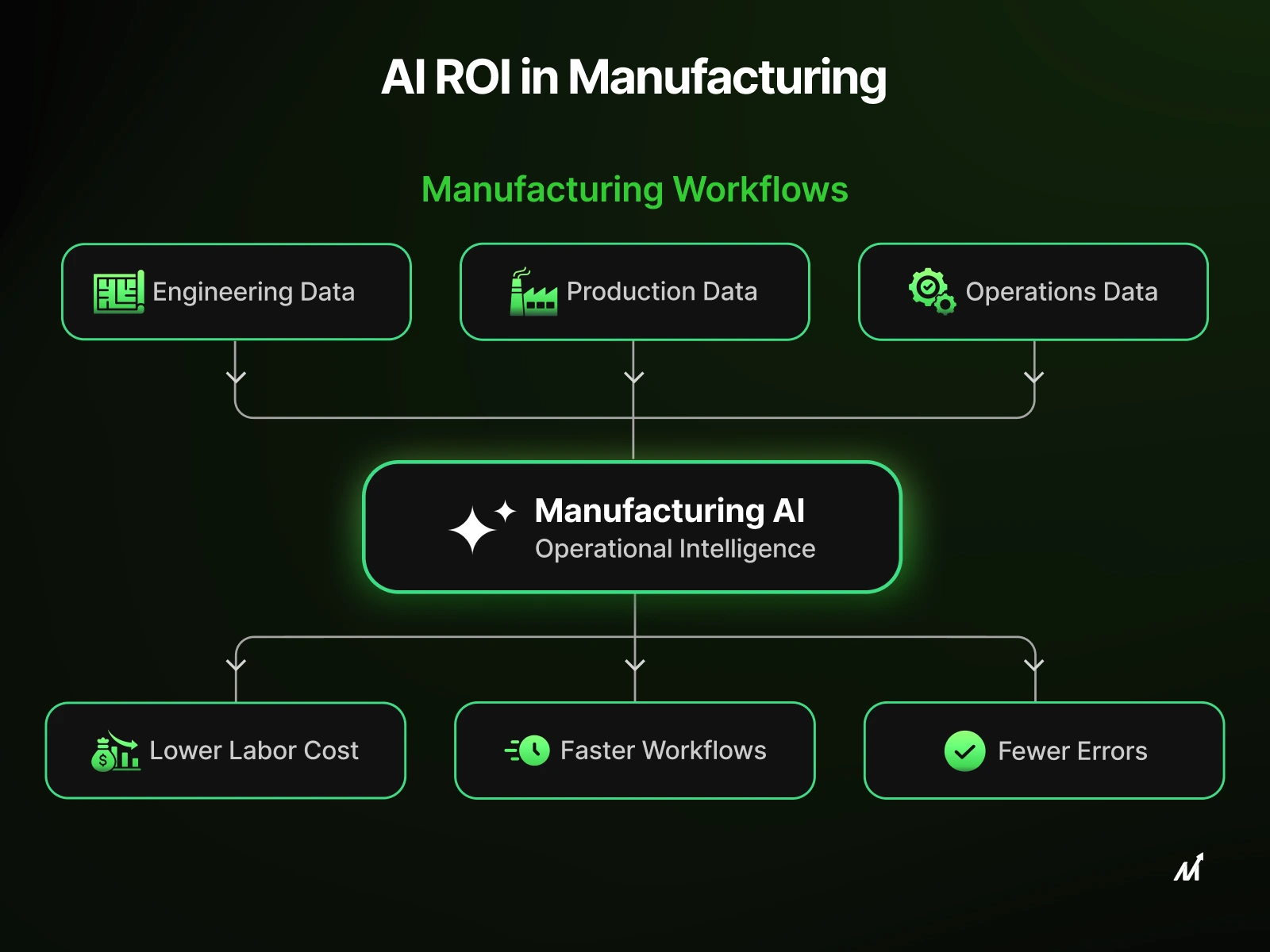


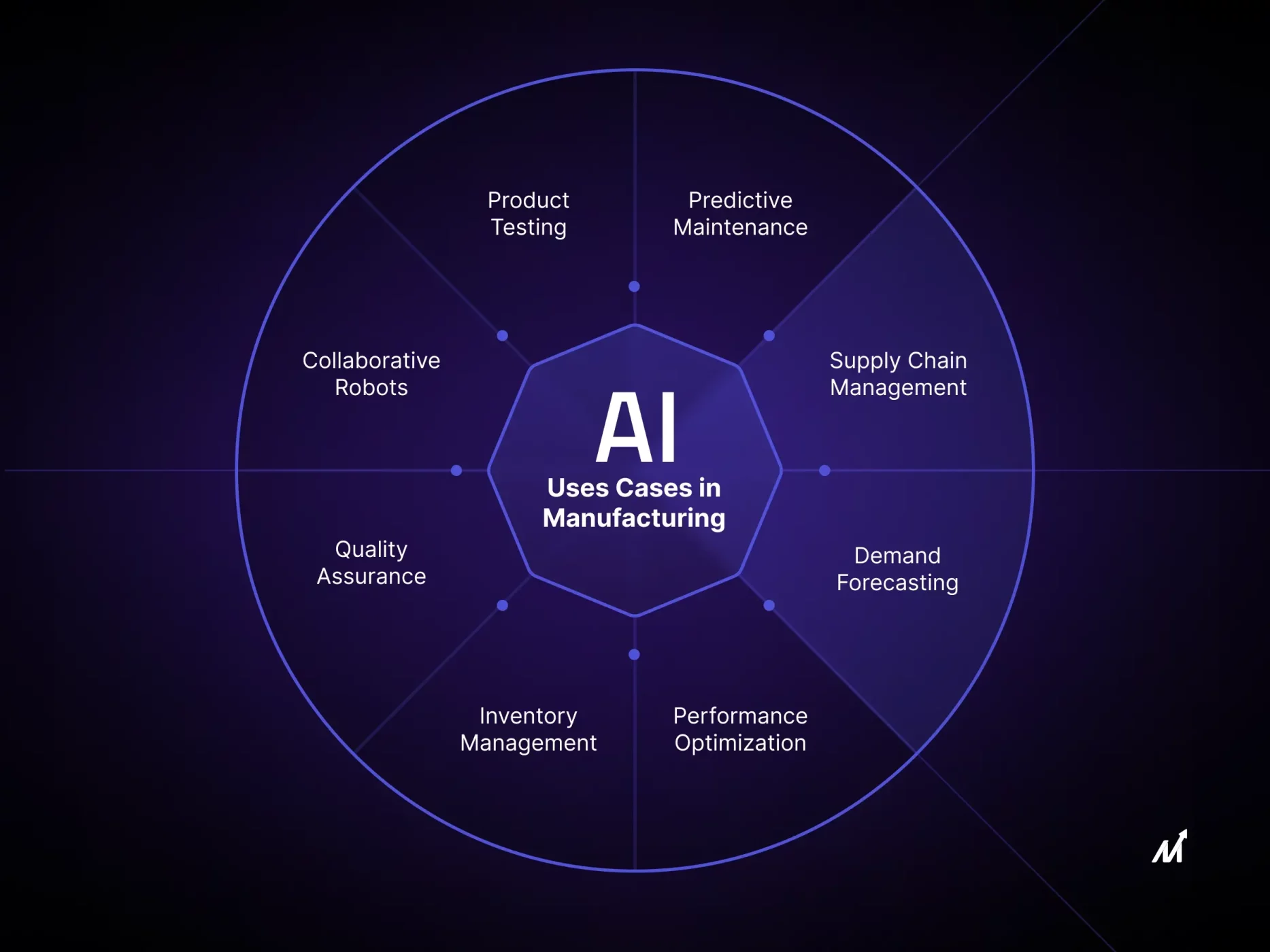
Manufacturers use AI across engineering, production, quality, planning, and supply chain operations.
Value doesn’t come from applying AI everywhere. It comes from identifying the right manufacturing problems and using AI where it can improve decisions, processes, or outcomes.
AI can analyze large volumes of operational and technical information, identify patterns, make predictions, and help teams act faster. Some applications focus on equipment and production. Others support quality, engineering, inventory, and supply chain decisions.
This blog explores key AI use cases in manufacturing and shows where different AI applications can deliver practical value across manufacturing operations.
AI Use Cases in Manufacturing: Top Applications
Manufacturers can apply AI across the production lifecycle, from engineering and planning to production, quality, and supply chain operations. The most useful applications address a specific process, decision, or business challenge.
1. Predictive Maintenance
Unexpected equipment failures can disrupt production, increase maintenance costs, and delay orders. Scheduled maintenance can also lead to unnecessary servicing when equipment remains in good condition.
AI can analyze sensor readings, equipment history, maintenance records, operating conditions, and production data to identify patterns that may indicate an upcoming failure. This gives maintenance teams better insight into equipment health and potential risks.
Teams can use these insights to investigate an asset, schedule service, replace a component, or monitor equipment more closely before a failure affects production.
Business outcome: Reduced unplanned downtime, better maintenance planning, and more reliable equipment performance.
2. AI Quality Inspection and Defect Detection
Quality inspection plays a critical role throughout manufacturing. Manual inspection becomes challenging as production volumes increase, especially when defects are small, inconsistent, or hard to identify.
Computer vision models can analyze images of parts, products, and assemblies to identify potential defects. AI can also classify defects and identify recurring patterns across historical inspection results.
Quality teams can use these insights to flag products for review, investigate recurring defects, and identify where quality problems may originate in the production process.
Business outcome: Earlier defect detection, less rework, more consistent inspection, and improved product quality.
3. Production Planning and Process Optimization
Production teams must balance orders, machine capacity, labor, materials, process requirements, and delivery schedules. A change in one area can quickly affect the rest of the production plan.
AI can analyze production schedules, machine availability, cycle times, process parameters, and historical production results. It can identify potential bottlenecks and help teams evaluate different production scenarios.
Teams can then adjust schedules, redistribute work, change process settings, or address constraints before they affect output.
Business outcome: Better production planning, improved resource utilization, higher throughput, and fewer production disruptions.
4. Demand Forecasting and Inventory Optimization
Manufacturers need enough materials and finished goods to meet demand without holding unnecessary inventory. Demand can change because of customer behavior, seasonality, market conditions, and other factors.
AI can analyze historical orders, sales patterns, inventory levels, lead times, and other demand signals to improve forecasting. It can also identify inventory patterns and help teams determine where adjustments may be needed.
Planning teams can use these insights to adjust purchasing, production quantities, reorder points, and inventory allocation.
Business outcome: Fewer stockouts, lower excess inventory, and more responsive production planning.
5. Supply Chain and Supplier Risk Management
Manufacturers rely on suppliers for materials, components, and services. Delays, shortages, quality issues, and supplier disruptions can affect production schedules and customer commitments.
AI can analyze supplier performance, delivery history, lead times, quality records, order data, and other supply chain information. It can identify patterns that may signal growing supplier or supply risks.
Teams can investigate high-risk suppliers, adjust sourcing plans, change order timing, or prepare alternative supply options before disruptions affect production.
Business outcome: Earlier risk identification, better supplier decisions, and greater supply chain resilience.
6. AI-Powered Robotics and Automation
Manufacturing environments include repetitive, precise, and physically demanding tasks. Traditional automation works well when processes remain predictable, but changing conditions can limit what fixed-rule systems can handle.
AI can help robots interpret their surroundings and respond to changing conditions. Computer vision and machine learning can support material handling, assembly, inspection, machine tending, and other applications.
Robotic systems can identify objects, adjust movements, select actions, and respond to changes in the production environment.
Business outcome: Greater automation flexibility, improved consistency, and increased productivity across repetitive or complex tasks.
7. Digital Twins and Manufacturing Simulation
Testing production changes on a live manufacturing line can be expensive and disruptive. Teams need ways to evaluate new configurations and processes before making physical changes.
Digital twins and simulation models can digitally represent equipment, processes, or production environments. AI can analyze simulation results and help identify potential bottlenecks or more effective operating strategies.
Manufacturers can test production scenarios, compare configurations, evaluate process changes, and understand their potential impact before implementation.
Business outcome: Better production decisions, fewer costly physical trials, and improved process planning.
8. AI for Product Design and Engineering
Engineering teams work with complex designs, specifications, requirements, constraints, and previous design information. Reviewing these inputs and exploring alternatives can take significant time.
AI can help engineers analyze design information, identify relevant patterns, compare alternatives, and make better use of existing engineering knowledge. Generative AI in manufacturing can support design exploration based on defined requirements.
Engineers can use these capabilities to compare design options, investigate potential issues, explore alternatives, and find relevant information from previous work.
Additive manufacturing can also benefit from these capabilities, particularly when engineers need to explore designs that traditional manufacturing methods may not easily support.
Business outcome: Faster engineering workflows, better use of design knowledge, and more informed product development decisions.
9. Engineering Drawing and Technical Document Intelligence
Engineering drawings contain critical information about parts, dimensions, materials, tolerances, notes, symbols, callouts, and other requirements. Manufacturing teams often need to review large drawing sets before moving to the next stage of a workflow.
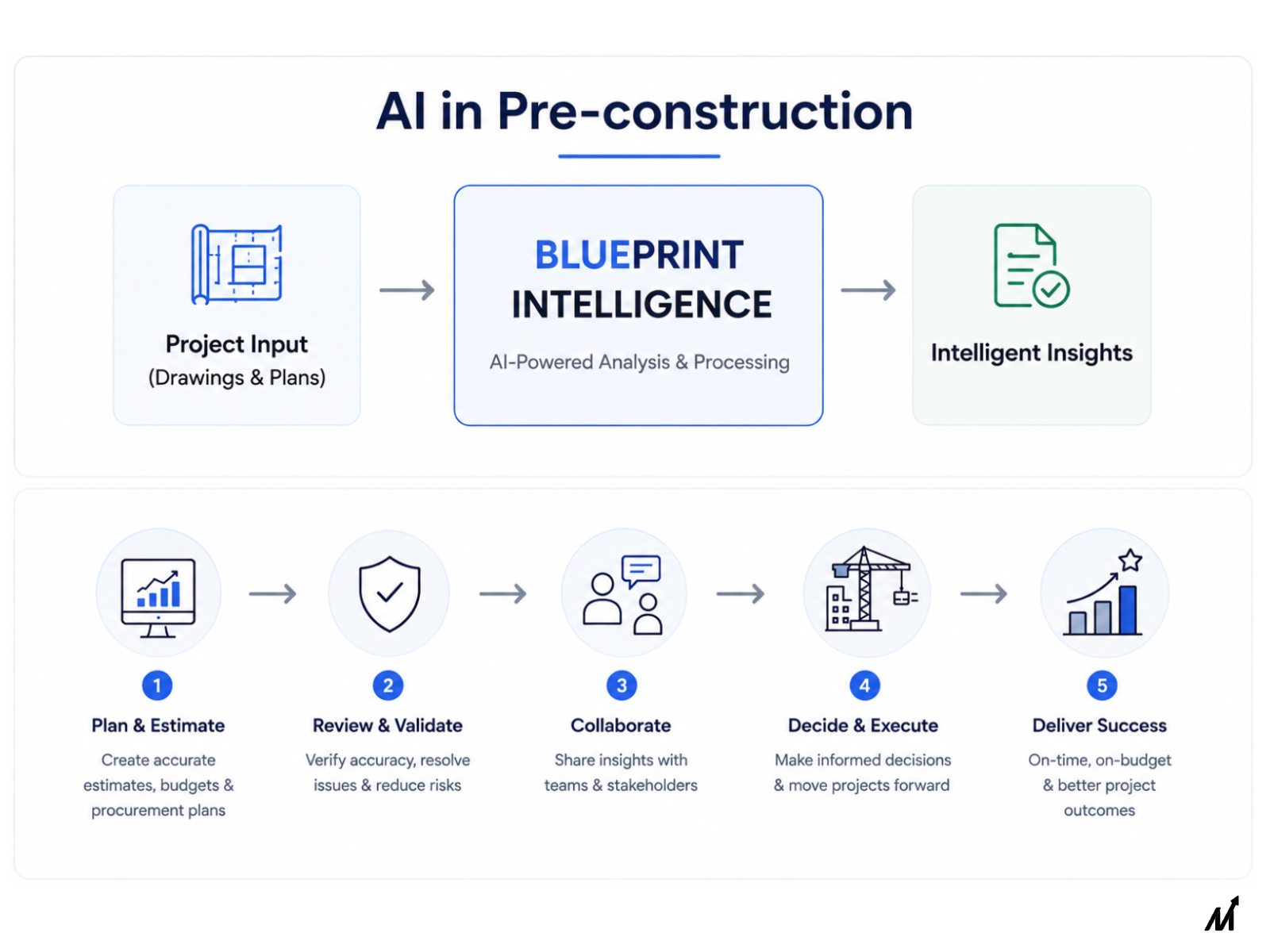
The challenge goes beyond finding text. Teams need to understand different drawing elements and the relationships between them. AI drawing intelligence platform can analyze engineering drawings and technical documents, identify relevant elements, and turn complex drawing information into structured data. This can support drawing analysis, information extraction, takeoff, and other document-driven workflows.
Generative AI in manufacturing can make this information easier to query, allowing teams to ask questions about dimensions, materials, notes, components, and other drawing details. Instead of repeatedly searching through drawings for specific information, teams can work from structured results and focus their time on decisions that require human review.
Business outcome: Less manual drawing review, faster access to engineering information, and more efficient document-driven workflows.
10. AI-Powered RFQ, BOM, and Quoting Workflows
Manufacturers often receive RFQs with drawings, specifications, BOMs, and supporting documents. Teams need to review this information carefully to understand requirements and prepare a quote.
AI can analyze RFQ packages and identify relevant information across engineering drawings and technical documents. It can support information extraction, part identification, BOM-related workflows, and quote preparation.
Teams can use these capabilities to find requirements, review parts and quantities, gather relevant information, and reduce repetitive document review during quoting.
AI can also help connect information extracted from technical drawings with BOM and quoting processes, reducing the need to review the same information repeatedly.
Business outcome: Faster RFQ processing, more consistent information gathering, and less manual effort during quote preparation.
AI Use Cases in Manufacturing at a Glance
| AI Use Case in Manufacturing | What it Helps Manufacturers Do |
| Predictive Maintenance | Predict equipment issues and improve maintenance planning |
| AI Quality Inspection | Detect and classify defects earlier |
| Production Optimization | Improve schedules, processes, and resource use |
| Demand and Inventory Optimization | Improve forecasts and inventory decisions |
| Supply Chain Risk Management | Identify supplier and supply risks earlier |
| Robotics and Automation | Automate flexible and complex tasks |
| Digital Twins and Simulation | Test production changes before implementation |
| Product Design and Engineering | Analyze designs and explore alternatives |
| Drawing Intelligence | Extract and analyze engineering drawing information |
| RFQ, BOM, and Quoting | Reduce document-heavy review and quote preparation |
How to Choose the Right AI Use Case in Manufacturing
Not every AI application will deliver the same value for every manufacturer. The right starting point depends on the problem, available data, existing systems, and expected business outcome.
Before choosing an AI use case, consider:
- Business impact: Which process creates the biggest cost, delay, quality issue, or operational bottleneck?
- Manual effort: Which tasks require significant time from skilled employees?
- Data availability: What production, equipment, quality, engineering, inventory, or supply chain data already exists?
- System fit: Can the AI solution work with your existing manufacturing and business systems?
- Measurable outcome: Can you measure improvement in downtime, quality, production time, cost, accuracy, or another relevant metric?
Once you have identified the right criteria, the next step is deciding which use case to prioritize first.
Where Should Manufacturers Start?
Manufacturers do not need to apply AI across every process at once. A focused starting point makes it easier to validate the technology and measure results.
The right first use case depends on the problem a manufacturer needs to solve. A manufacturer dealing with unexpected equipment failures may start with predictive maintenance. A team facing high inspection volumes may evaluate AI-powered quality inspection. A manufacturer spending significant time reviewing engineering drawings may explore drawing intelligence. Others may prioritize demand forecasting, inventory planning, production optimization, or quoting.
Start with one process, define the expected outcome, and measure the results. Once a use case proves its value, manufacturers can evaluate similar applications across other plants, processes, or business functions.
How Markovate Helps Apply AI Use Cases in Manufacturing
Manufacturing teams can apply AI to many processes, but the right solution depends on the data, systems, and business problem involved.
One example is engineering drawing intelligence. AI Blueprint Classifier, a Markovate product, helps manufacturers analyze engineering drawings and extract the information needed for downstream processes.
It can identify drawing elements such as dimensions, materials, symbols, notes, callouts, and components. Teams can use this information for drawing analysis, takeoff, BOM-related processes, quoting, and other engineering and manufacturing tasks.
By bringing drawing information into a more usable format, AI Blueprint Classifier can reduce repetitive document review and help teams access engineering information faster.
This is one example of how manufacturers can apply AI to an existing process without changing their entire manufacturing operation.
Conclusion: AI Use Cases in Manufacturing
AI in manufacturing is no longer limited to robotics or predictive maintenance. Manufacturers can apply AI across engineering, production, quality, planning, inventory, and supply chain workflows.
The strongest opportunities start with a specific problem. They use available information to improve a decision or action. They also produce measurable outcomes.
For many manufacturers, the next step is not adding AI everywhere. It is finding one workflow where better information can lead to a better decision.
From predictive maintenance and quality inspection to engineering drawing intelligence and AI-assisted quoting, manufacturers can start with focused applications and expand as they prove value.
FAQs: AI Use Cases in Manufacturing
1. What are the most common AI use cases in manufacturing?
Common AI use cases include predictive maintenance, quality inspection, production optimization, demand forecasting, inventory optimization, supply chain risk management, robotics, digital twins, product engineering, and technical document intelligence.
2. How is generative AI used in manufacturing?
Generative AI can help manufacturers interpret and create information. Applications include technical document search, summarization, work instructions, troubleshooting, engineering support, and RFQ analysis.
3. What data is needed for implementing AI use cases in manufacturing?
The data depends on the use case. It may include equipment sensor data, production records, quality data, inventory information, supplier records, engineering drawings, CAD data, technical documents, or historical business data.
4. How should a manufacturer start using AI?
Start with a specific workflow that has a clear problem, usable data, and a measurable outcome. A focused pilot can help validate value before expanding AI across additional processes.
5. What are the benefits of implementing AI in manufacturing?
AI can help manufacturers reduce downtime, improve quality, optimize production, strengthen supply chain decisions, accelerate engineering processes, and reduce repetitive work. The benefits depend on the use case and the business outcome being targeted.