

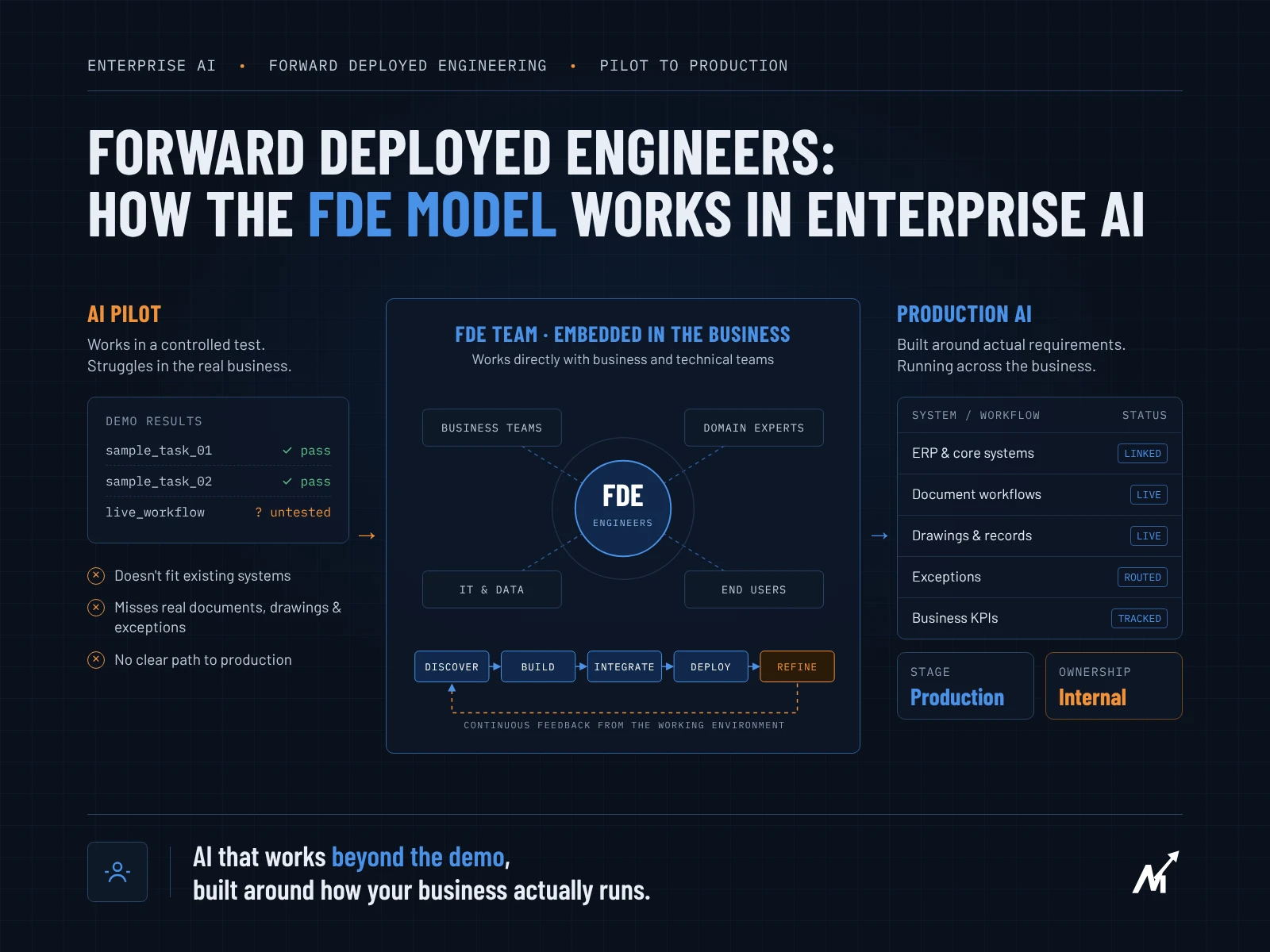
A team may approve an AI solution after seeing it successfully handle a few tasks. But getting that solution to work across the business is a different challenge. It needs to fit existing systems, account for how people work, and handle real documents, drawings, and exceptions that a controlled test does not cover. This is where Forward Deployed Engineers (FDEs) bring a different approach.
They work directly with business and technical teams, understand how the organization operates, and build solutions around its actual requirements. Their involvement extends beyond development to integration, deployment, and refinement in the working environment.
In this blog, we will explore how the FDE model works in enterprise AI, what makes it different from conventional engineering approaches, and when businesses should consider it. We will also look at how Markovate’s forward-deployed AI engineers apply this approach to enterprise requirements.
What Are Forward Deployed Engineers?
A Forward Deployed Engineer is a software engineer who works closely with a business to solve problems that standard software products cannot fully address. They collaborate directly with business and technical teams, working onsite, remotely, or through a hybrid model, depending on project requirements.
Unlike product engineers, who typically build features around a product roadmap, FDEs start with the customer’s specific business problem. They determine what needs to be developed, adapted, or integrated to address it.
In enterprise AI, their role can span solution architecture, AI application and agent development, data engineering, enterprise integrations, testing, and production deployment. They also work with internal teams to support adoption, ongoing optimization, and knowledge transfer.
Why Do Enterprises Need Forward Deployed Engineers?
Enterprise AI projects often face challenges that go beyond model performance. Existing systems, internal processes, data access, and business requirements all affect whether a solution delivers value to the company.
Forward Deployed Engineers help enterprises address these challenges by bringing engineering work closer to the people, systems, and operations involved. Here are some of the reasons to choose FDEs.
1. Connecting AI With Existing Business Systems
Company teams often use different systems to manage their data. Each system has its own formats and access rules. In engineering teams, for example, a PDF drawing and a CAD file for the same part may not match after a revision. FDEs study these systems and build the integrations needed to connect them with AI solutions. This allows businesses to use AI alongside their existing systems.
Without the right connections, employees may still need to switch between applications or enter information manually. This limits the value of introducing AI in their companies.
2. Making AI Fit Actual Business Workflows
A solution that works in a demonstration may not account for the way employees handle everyday tasks. Different teams often follow specific approval processes, business rules, and exception procedures.
If an AI application ignores these requirements, employees may need to work around it rather than rely on it. Enterprises need solutions that fit their operations instead of forcing teams to change established processes unnecessarily.
3. Preparing AI for Production Use
A successful proof of concept does not automatically make an AI solution ready for enterprise use. Production environments introduce requirements around security, data permissions, reliability, performance, and user access.
These requirements need attention before a solution reaches everyday users. Enterprises also need clear ways to handle errors, uncertain outputs, and situations that require human review.
4. Measuring the Value of AI Investments
Enterprises need to know whether an AI solution improves the process it was built to support. A successful implementation should deliver measurable results, not just demonstrate that the technology works.
Depending on the use case, businesses may measure processing time, manual effort, output accuracy, operating costs, or employee productivity. These measures help teams assess the solution’s impact and identify where further improvements are needed.
Markovate’s forward-deployed AI engineers work across these business and technical requirements, from understanding the initial problem to implementing and supporting the solution in its operating environment. Let’s learn more about how this model actually works.
How Does the Forward Deployed Engineering Model Work?
The forward deployed engineering model brings business teams and engineers together throughout an AI project. FDEs work with stakeholders to define the problem, develop a solution, and ensure it fits within the company’s existing environment.
The process varies by project, but most engagements follow five stages.
Step 1: Identify the Business Problem and Priorities
FDEs begin by speaking with the people involved in the process. They learn how teams handle their work, what information they use, and where delays or manual effort occur. They also review the company’s existing applications, data sources, and infrastructure.
For example, a manufacturer’s purchasing team may spend hours checking supplier details, production schedules, and inventory records. A forward-deployed engineer studies how buyers make these decisions and identifies which tasks AI could support.
Expected outcome: A clearly defined business problem, a prioritized use case, and measurable objectives.
Step 2: Define the Solution and Validate Its Approach
With the requirements in place, FDEs define how the solution should work. This includes choosing suitable AI models, planning data flows, identifying required integrations, and deciding whether the use case needs an AI application, agent, or workflow automation.
The team may also build an initial prototype and test it with representative business data. This helps confirm the technical approach before development moves forward.
Expected outcome: A validated solution design with clear technical requirements and success criteria.
Step 3: Build the Solution Around Existing Systems
Forward-deployed engineers build the application and connect it to the systems the business already uses. This work may involve software development, API integrations, data pipelines, model configuration, and workflow automation.
For example, an engineering company may receive RFQs containing drawings, specifications, and material requirements in PDF, CAD, and scanned formats. An FDE could develop a workflow to extract these details, organize them for estimators, and flag unclear or conflicting information for review. At Markovate, we can build this around the client’s own drawings, documents, and estimating process.
Engineers also account for data permissions, access controls, and business rules during development.
Expected outcome: A working solution connected to the required enterprise systems and workflows.
Step 4: Validate Performance Before Production Launch
Before launch, FDEs test the solution against actual business scenarios. They check output quality, accuracy, reliability, and performance. They also examine how the system handles exceptions and situations where it cannot provide a reliable answer.
For example, an AI customer support agent should recognize refund exceptions or questions that fall outside company policy. It should route these cases to a human rather than provide an unsupported answer. We build human review and escalation into the workflow, so the team knows which outputs to check first. Once the solution meets the agreed requirements, the team deploys it to production.
Expected outcome: A tested solution ready for use in the business environment.
Step 5: Improve Performance and Prepare Teams for Ownership
FDEs continue to review the solution after deployment. They track performance, examine user feedback, and address issues that appear during everyday use.
A supply chain team, for example, might initially use an application to check inventory levels. As the team starts using it, planners may request supplier delay information or demand forecasts. FDEs can assess these requirements and extend the application where appropriate.
They also document the implementation and share technical knowledge with internal teams. This helps the business maintain the solution and plan future improvements.
Expected outcome: A solution that internal teams can operate, maintain, and extend as business needs change.
While this process explains how FDEs take an enterprise AI project from requirements to production, it’s also important to understand how their role differs from that of traditional software engineers and AI consultants.
Forward Deployed Engineers vs. Software Engineers vs. AI Consultants
These roles contribute to enterprise technology projects in different ways. The main difference lies in their responsibilities and involvement in implementation.
| Area | Forward Deployed Engineers | Software Engineers | AI Consultants |
| Primary Focus | Business problem-solving and implementation | Software Development | AI strategy and recommendations |
| Requirements | Help define business requirements | Work from defined requirements | Identify business needs and AI use cases |
| Main Role | Build and implement custom solutions | Develop and maintain software | Assess opportunities and guide adoption |
| Business involvement | Work directly with users & stakeholders | Work mainly with product and engineering teams | Work with business leaders |
Here’s how the responsibilities of Forward Deployed Engineers differ from those of software engineers and AI consultants.
Forward Deployed Engineers vs. Software Engineers
Software engineers generally build applications based on defined requirements. FDEs also help define those requirements by working directly with the teams facing the problem. They stay involved in shaping and implementing the solution within the business environment.
Forward Deployed Engineers vs. AI Consultants
AI consultants identify suitable AI opportunities and recommend strategies. FDEs take a more hands-on engineering role, helping to develop the solution and address implementation requirements. Both can work together, with consultants guiding the approach and FDEs handling technical delivery.
Where These Roles Work Together
An enterprise project may involve all three roles. AI consultants help set direction, software engineers contribute development expertise, and FDEs connect technical work to business requirements.
What Expertise Do Forward Deployed Engineers Bring to Enterprise AI?
Forward Deployed Engineers need more than software development experience. They must understand how AI systems behave, what it takes to run them reliably, and how business teams will use the results. Three areas of expertise are particularly important.
1. Applied AI and Model Expertise
FDEs need to understand how different AI technologies work and where each approach fits. This helps them choose appropriate methods rather than relying on a single model for every business problem.
Their expertise may include:
- Large language models: This helps them understand how models process information and generate responses for different business applications.
- Retrieval-augmented generation (RAG): This helps AI applications find and use relevant information from internal documents and knowledge sources.
- AI agents: This allows them to build systems that can access information, use tools, and complete tasks within defined boundaries.
- Model evaluation: This helps them test output quality, check accuracy, and identify situations where human review is needed.
The right approach depends on the use case, available data, and the level of accuracy the business requires.
2. Production Engineering and Governance
An AI solution must perform reliably beyond initial testing. FDEs need to understand the infrastructure and controls required to run applications in production.
This includes cloud environments, application deployment, containers, and performance monitoring. They must also account for data governance, security requirements, access controls, and operational oversight. Some industries also need AI to run inside their own network, which shapes how models and infrastructure are chosen.
These considerations help businesses maintain reliable AI applications and manage risks as usage grows.
3. Business Understanding and Problem-Solving
FDEs work with people who understand the business problem but may not have a technical background. They need to ask the right questions, understand operational priorities, and explain technical decisions clearly.
They must also respond when requirements change, or testing reveals that an initial approach does not work. This calls for practical problem-solving, adaptability, and close collaboration with business and technical teams.
The strongest forward-deployed engineers combine these capabilities with sound engineering judgment. They can assess a business requirement, choose an appropriate technical approach, and make decisions that support the intended outcome.
Business Benefits and Key Considerations of the FDE Model
The value of the forward-deployed engineering model goes beyond building a working application. The right implementation can improve daily operations, help teams make better use of their time, and give businesses greater control over how AI develops.
Business Benefits of FDE Models
1. A Clearer Link Between AI Investment and Business Results
FDEs work on specific business problems rather than developing technology without a defined outcome. This helps enterprises connect AI initiatives to measurable goals, such as reducing processing time, improving accuracy, or lowering operating costs.
2. Solutions That Reflect Actual Business Needs
A solution built around a company’s requirements is more likely to address the problems employees face every day. Teams can use AI to support their existing processes rather than changing their work around a generic application.
3. Less Manual Work and Better Productivity
AI applications can handle repetitive tasks, retrieve information faster, and support processes that involve multiple steps. Employees can then spend less time on routine work and more time on decisions that require their experience.
4. Better Collaboration and Long-Term Knowledge
FDEs bring business stakeholders and technical teams into the same development process. This gives engineers a clearer understanding of operational needs and helps business teams understand the solution.
Documentation and knowledge transfer also help internal teams maintain the application, address future requirements, and plan further improvements.
Key Considerations for Successful Implementation
The FDE model can deliver these benefits, but businesses need to plan for a few important factors.
1. Involve the Right Domain Experts
FDEs bring engineering and AI expertise, but internal teams understand the business context. Involving employees who know the workflow helps identify important requirements, exceptions, and decisions that the solution must support.
2. Plan for Scalability
A solution that works for one team may need changes before other departments can use it. Businesses should consider future demand during the design stage. Reusable components and modular architecture can make expansion easier without rebuilding the entire application.
3. Define Long-Term Ownership
Businesses should agree on who will manage the solution after deployment. Responsibilities may include maintenance, monitoring, updates, and user support. Documentation and knowledge transfer should be part of the engagement, not an afterthought.
4. Balance Customization With Reusability
Some business requirements call for tailored features. However, building every component from scratch can increase development and maintenance costs.
FDE teams should identify which parts need customization and which can be reused across workflows. This helps businesses meet specific requirements while keeping future development manageable.
How to Measure the Business Impact
Enterprises should define success metrics before development begins. The right measures depend on the problem the AI solution is intended to address.
| Business Objective | Metrics to Track |
| Improve processing speed | Average task completion time, turnaround time |
| Reduce manual effort | Hours spent per task, manual steps eliminated |
| Improve accuracy | Error rate, validation rate, exception frequency |
| Increase productivity | Tasks completed per employee, overall throughput |
| Improve system reliability | Uptime, failure rate, response time |
| Increase adoption | Active users, usage frequency, workflow adoption |
| Control operating costs | Cost per transaction, infrastructure and support costs |
For example, a company automating invoice processing can compare processing time and manual review effort before and after implementation. A customer support team can track resolution times, escalation rates, and the number of queries handled successfully.
We agree on these measures with the client before development begins and report against them after launch.
The important step is to establish a baseline and set realistic targets before implementation. After launch, businesses can compare actual results against those targets. This shows whether the solution delivers meaningful operational value, not just meets technical requirements.
Here are some scenarios any company can consider to determine whether it should adopt an FDE model.
When Should Enterprises Consider the FDE Model?
The need for an FDE team often depends on the kind of work a business wants AI to handle. Some projects call for close collaboration with internal teams, while others require engineers to work through specific technical and operational requirements. Here are a few situations where the FDE model can be a good fit.
1. Existing AI Tools Do Not Fit Your Business Requirements
Off-the-shelf AI tools may not support specialized workflows, proprietary data, or industry-specific requirements. An FDE team can help develop a solution around these needs.
2. Your AI Pilot Is Not Reaching Production
A prototype may work well in testing but still needs further engineering before employees can use it in their daily work. FDEs can help address the gaps and prepare the solution for production.
3. Your Business Has Specialized Data Requirements
Some businesses work with proprietary documents, internal knowledge bases, or industry-specific datasets. These projects often need engineers who can understand the data and develop an AI solution suited to its requirements.
4. Your AI Project Needs Close Collaboration With Internal Teams
Your internal IT or engineering team may understand the business systems but need additional AI expertise for a particular project. FDEs can work alongside them, contribute specialized skills, and support implementation.
5. You Want to Expand a Successful AI Implementation
An AI solution that works well for one team may need further development before other departments can use it. FDEs can help adapt the solution to new requirements and support wider adoption.
We can also start with one focused workflow and expand it once it proves its value.
The right engagement model ultimately depends on the project’s goals, technical requirements, and the level of engineering collaboration the business needs.
How to Choose the Right Forward Deployed Engineering Partner
The right forward-deployed engineering partner should understand your business goals as well as the technology required to achieve them. You should look for a team that can work across business workflows, AI development, enterprise systems, and production deployment.
Here are a few areas to evaluate when choosing a partner.
1. Understanding of Business Workflows
Your engineering partner should understand how your teams work before recommending an AI solution. They should identify operational gaps, existing processes, data dependencies, and the outcomes your business expects.
At Markovate, we begin by understanding these requirements and identifying where AI can address practical business challenges. This helps us build solutions around actual workflows rather than introducing technology without a clear business purpose.
2. Experience With Enterprise AI Development
Building an AI prototype requires different skills from those required to deliver a production-ready enterprise solution. Your partner should have experience with custom AI applications, AI agents, data infrastructure, and integrations with existing business systems.
Markovate brings full-stack AI engineering experience across custom enterprise applications, LLM integration, intelligent workflow automation, and multi-agent systems. Our engineers select models, frameworks, and infrastructure based on project requirements rather than following a fixed technology stack.
3. Ability to Handle Integration and Deployment
An AI solution must work with your existing applications, databases, and infrastructure. Evaluate whether the partner can manage system integrations, deployment requirements, security considerations, and production readiness.
Markovate’s forward-deployed engineers build AI solutions that fit into existing enterprise environments. We consider integration complexity, human oversight, validation, and deployment requirements throughout development. Depending on your needs, we can also support cloud, private cloud, hybrid, and on-premises deployment approaches.
4. Focus on Long-Term Performance
A successful deployment is not the end of an AI project. Models, business requirements, and workflows change over time. Your partner should be able to monitor performance, address issues, and improve the solution as your requirements evolve.
Markovate supports AI implementation beyond development, including production deployment, performance optimization, and ongoing engineering support. We also consider documentation and knowledge transfer to enable internal teams to manage and extend the solution.
5. Flexible Collaboration and Engagement Models
Every enterprise has different collaboration needs. Onsite engineers suit intensive discovery and sensitive integrations. A dedicated remote team suits projects with established requirements and accessible systems. Hybrid combines both.
Markovate offers onsite, hybrid, and dedicated remote engagement models. This flexibility allows businesses to choose the level of engineering involvement that suits their project scope, internal capabilities, and implementation requirements.
Explore Markovate’s Forward Deployed AI Engineering services to see how our engineers support enterprise AI development, integration, and deployment.
Conclusion: Forward Deployed Engineers
Forward deployed engineers help enterprises turn AI capabilities into working business solutions. They bring engineering closer to the people, systems, and processes that determine whether an implementation succeeds.
From identifying business requirements to integrating systems and supporting production deployment, FDEs connect technical development with operational needs.
The right approach starts with a clear business problem, suitable engineering expertise, and measurable objectives. With these elements in place, enterprises can move beyond isolated AI experiments and build solutions that support everyday operations.
If you are planning an AI initiative or need engineering support to move an existing solution into production, contact us to discuss your requirements.
FAQs
1. Are forward-deployed engineers only useful for AI projects?
No. The FDE model can support broader software and technology implementations. However, it has gained attention in enterprise AI because businesses often need custom integrations, workflow changes, and hands-on deployment support.
2. What industries can benefit from forward-deployed engineering?
Manufacturing, financial services, healthcare, retail, logistics, construction, and other enterprise sectors can benefit. The model is particularly useful when organizations have specialized workflows, complex systems, or unique data requirements.
3. Can forward-deployed engineers work inside our network or on-premises?
Yes. Depending on technical feasibility, we can deploy AI in cloud, private cloud, hybrid, or on-premises environments, so your data stays within the infrastructure your policies require.
4. What do we need to provide at the start of an engagement?
Access to the people who run the workflow, representative data, and the systems the solution will connect to. A business owner who can make decisions helps keep the work moving.
5. How long does a forward-deployed engineering project take?
The timeline depends on the business problem, data readiness, integration complexity, and deployment requirements. A focused workflow may require less engineering effort than a solution involving multiple enterprise systems and departments.
6. Can forward-deployed engineers work with an existing IT team?
Yes. FDEs often collaborate with internal software engineers, data teams, IT administrators, and business stakeholders. This allows organizations to add specialized engineering expertise while keeping internal teams involved.
7. What should businesses measure in an FDE engagement?
Businesses should track metrics that relate directly to the problem being solved. These may include processing time, manual effort, error rates, workflow throughput, system reliability, user adoption, and operating costs.
8. Do forward-deployed engineers support solutions after deployment?
They can support monitoring, optimization, documentation, and knowledge transfer throughout the engagement. The exact responsibilities depend on the agreed scope and ongoing support model.