

A company can have firewalls, endpoint protection, and security monitoring in place and still overlook risks that matter most to its business. A customer database might have strong access controls, for example, while an old supplier account still has access to sensitive records. A cybersecurity risk assessment helps uncover these gaps.
It identifies the systems and data that matter, examines what could put them at risk, and helps prioritize security improvements based on their potential business impact.
This guide explains what a cybersecurity risk assessment covers, which frameworks can help, and how to conduct one in seven steps. It also explores how to assess the AI systems and applications businesses increasingly rely on.
What Is a Cybersecurity Risk Assessment?
A cybersecurity risk assessment is a structured process for identifying an organization’s important assets, evaluating the threats and vulnerabilities that could affect them, and estimating the likelihood and impact of potential incidents. It helps the organization decide which risks need attention and what security measures can address them.
The output is a prioritized record of risks: the business impact, existing controls, and the action needed for each. Common risk treatment options include avoiding a risk, reducing it, transferring or sharing it, and accepting it. Transferring risk, such as through insurance, does not remove the organization’s responsibility for managing it.
A good assessment answers four questions:
- What do we have that’s worth protecting?
- What could harm it, and how?
- How likely is that, and how serious would the impact be?
- What should we do about it, and in what order?
Why Is a Cybersecurity Risk Assessment Important?
1. Prioritizes security spending
Without a clear view of risk, businesses can spend money on visible security problems while overlooking weaknesses with greater business impact. An assessment helps direct resources toward the issues that matter most.
2. Supports compliance and audits
Certain regulations and standards require documented risk analysis or risk management processes. For example, HIPAA requires covered entities and business associates to conduct an accurate and thorough risk analysis of electronic protected health information. ISO 27001 also requires organizations to establish and maintain an information security risk assessment and treatment process. SOC 2’s criteria include a risk assessment component, and PCI DSS requires organizations to formally identify, evaluate, and manage risks to the environment that handles card data.
3. Gives leadership a clearer view of security risks
A prioritized risk register helps decision-makers understand which systems face exposure, what the consequences could be, and where the business needs to invest.
4. Tracks security improvements
Repeated assessments help organizations see whether controls work, whether risks have changed, and which issues remain unresolved.
Cybersecurity Risk Assessment Frameworks
You don’t need to invent a method. Established frameworks and standards provide guidance for identifying risks, evaluating security controls, and deciding what to address. Common options include:
- NIST Cybersecurity Framework (CSF) 2.0. Organizes cybersecurity outcomes into six functions: Govern, Identify, Protect, Detect, Respond, and Recover. It gives organizations a flexible structure for managing cybersecurity risk rather than prescribing one specific assessment method.
- NIST SP 800-30. Provides detailed guidance for conducting risk assessments. It covers assessment preparation, risk analysis, communication of results, and ongoing maintenance. It’s particularly useful when building a repeatable assessment process.
- ISO/IEC 27001 and ISO/IEC 27005. ISO 27001 defines requirements for an information security management system (ISMS), including risk assessment and treatment. ISO 27005 provides guidance on information security risk management and supports organizations implementing an ISMS.
- CIS Critical Security Controls. Provides a prioritized set of cybersecurity safeguards that organizations can use to strengthen their defenses. These controls help translate assessment findings into practical security improvements.
You can choose one primary framework or methodology for your assessment. You can map findings to additional standards when needed, but document how your scoring and control mapping work. This keeps the results consistent and easier for security teams, leadership, and auditors to review.
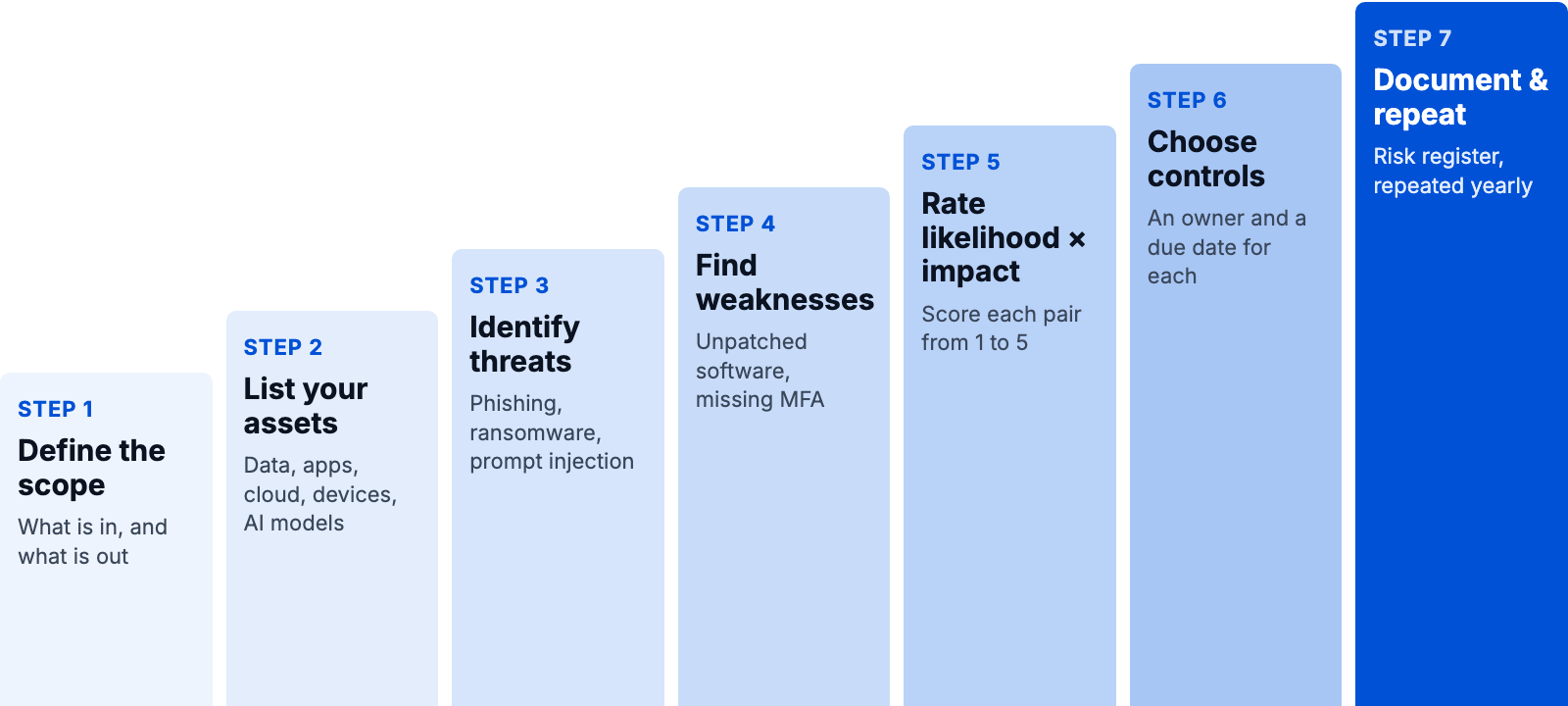
How to Do a Cybersecurity Risk Assessment in 7 Steps
Step 1: Define the Scope of the Assessment
Decide what the assessment covers: the whole company, one business unit, or a specific system such as a customer portal. Identify the locations, applications, data, networks, cloud environments, and third-party services included in the review.
Note what falls outside the scope so no one assumes the assessment covered it. Also agree on the assessment criteria, including how your team will rate likelihood, impact, and acceptable risk.
Step 2: Identify and Inventory Your Assets
Build an inventory of what matters: customer and employee data, applications, cloud accounts, devices, networks, third-party services and, increasingly, AI models and the data they use.
For each asset, record its owner, location, business purpose, data sensitivity, and importance to daily operations. Also identify which systems depend on it and who can access it.
This context helps teams evaluate risk more accurately. A vulnerability in a public-facing customer portal may create greater exposure than the same vulnerability in an isolated test environment.
Step 3: Identify Cybersecurity Threats
List what could harm each asset. Common threats include phishing and stolen credentials, ransomware, misconfigured cloud services, insider misuse, supplier compromise and, for AI systems, prompt injection and data leakage.
Don’t stop at general threat categories. Consider how each threat could affect a specific asset in your environment. For example, a stolen employee account could expose customer records if the account has excessive access permissions.
Use threat intelligence relevant to your industry rather than relying only on a generic threat list. Review previous incidents, known attack methods, supplier dependencies, and changes to your technology environment.
Step 4: Identify System Vulnerabilities
Find the weaknesses those threats could exploit: unpatched software, weak access controls, missing multi-factor authentication, exposed services, and poor logging.
Review existing security controls as well. A vulnerability may create a different level of risk when effective safeguards already limit access or reduce the potential impact.
This is where a vulnerability assessment or penetration test can provide useful evidence. A vulnerability assessment identifies technical weaknesses, while a penetration test checks whether testers can exploit selected weaknesses under agreed rules. Neither replaces the broader business analysis in a cybersecurity risk assessment.
Step 5: Evaluate Risk Likelihood and Impact
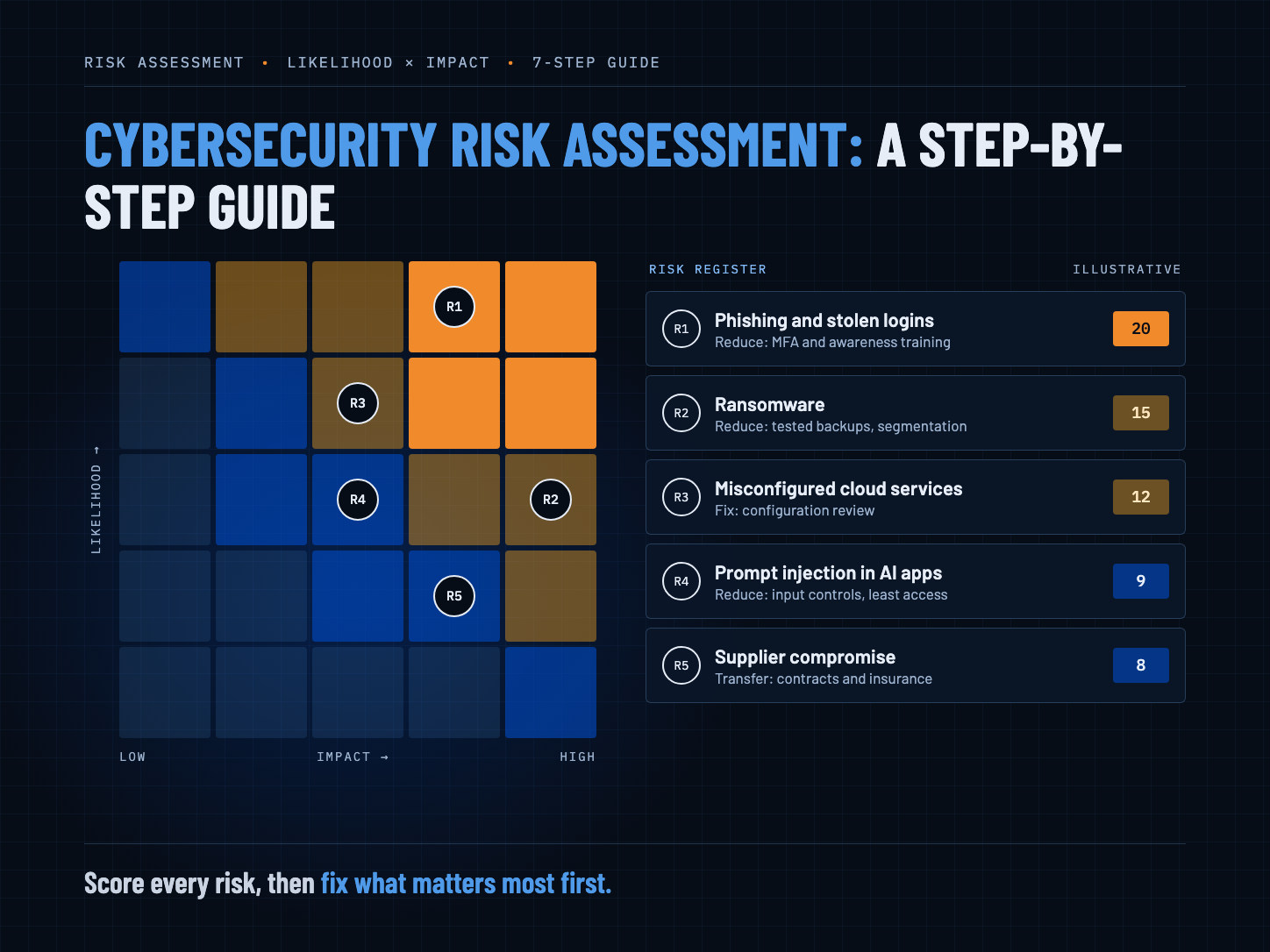
For each threat and vulnerability combination, estimate how likely an incident is and how much damage it could cause. You can use a simple 1-to-5 scale for likelihood and impact, provided you define what each rating means.
Impact should cover more than direct financial loss. Consider operational disruption, data exposure, legal obligations, customer trust, and reputational damage.
| Likelihood × Impact | Low impact (1–2) | Medium impact (3) | High impact (4–5) |
| High likelihood (4–5) | Medium | High | Critical |
| Medium likelihood (3) | Low | Medium | High |
| Low likelihood (1–2) | Low | Low | Medium |
This matrix is an example, not a universal scoring standard. Define the thresholds before the assessment and apply them consistently. A score helps prioritize decisions, but it shouldn’t replace professional judgment or business context.
Consider a supplier account that can access customer records. If the account lacks multi-factor authentication and the business rarely reviews its activity, the likelihood of unauthorized access may increase. The potential impact depends on the sensitivity and volume of records the account can reach.
A useful risk statement connects the cause, event, and consequence:
Because a supplier account lacks multi-factor authentication, an attacker could compromise it and access customer records, resulting in data exposure and potential regulatory consequences.
Step 6: Select Security Controls and Assign Risk Owners
For each significant risk, decide whether to avoid, reduce, transfer, or accept it. Then identify the controls needed to manage it and assign responsibility for the next action.
Typical controls include multi-factor authentication, patching programs, network segmentation, tested backups, logging and monitoring, and security awareness training.
Don’t select a control simply because it appears on a security checklist. Choose measures that address the specific risk and consider their cost, effectiveness, and operational impact.
Assign a risk owner who remains accountable for the risk decision and an action owner who will implement the fix. Record a target date and define how the team will verify that the control works.
Step 7: Document Findings and Review Risks Regularly
Record the findings in a risk register. Include the asset, threat scenario, vulnerability, likelihood, impact, risk rating, existing controls, treatment decision, owner, and status.
For example, don’t record only that a server has an unpatched vulnerability. Document what business data the server holds, whether attackers can reach it, what safeguards exist, and who will address the issue.
Summarize the highest-priority risks for leadership in a short report. Highlight the potential business impact, recommended actions, resource requirements, and any risks the organization has chosen to accept.
Review the assessment regularly and whenever significant changes occur, such as a cloud migration, acquisition, major system upgrade, new supplier, security incident, or new AI system going live. The review schedule should reflect the organization’s risk exposure and applicable requirements rather than follow one fixed frequency.
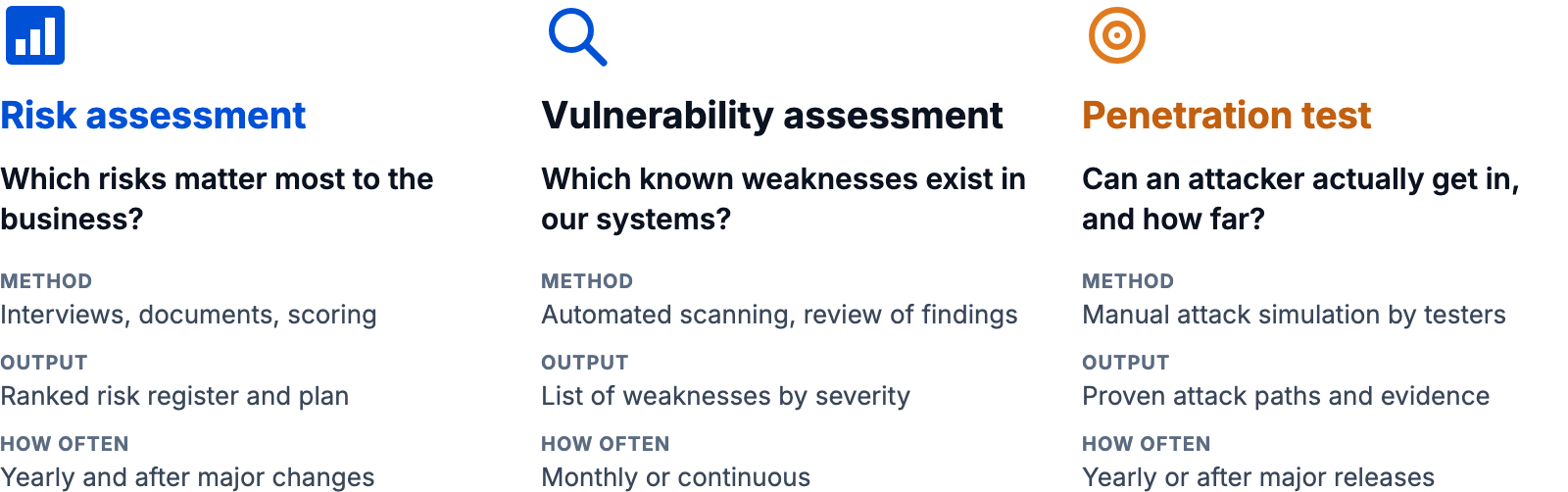
Risk Assessment vs Vulnerability Assessment vs Penetration Test
These activities often get confused, but they answer different questions.
| Risk assessment | Vulnerability assessment | Penetration test | |
|---|---|---|---|
| Question it answers | Which risks matter most to the business? | Which known weaknesses exist in our systems? | Can an attacker actually get in, and how far? |
| Method | Interviews, documents, scoring | Automated scanning, review of findings | Manual attack simulation by testers |
| Output | Ranked risk register and plan | List of weaknesses by severity | Proven attack paths and evidence |
| How often | Yearly and after major changes | Monthly or continuous | Yearly or after major releases |
These are typical frequencies. Your requirements may set a different schedule.
A risk assessment decides which issues matter most to the business. Vulnerability assessment services and penetration tests supply the technical evidence that feeds it.
How to Assess AI Systems and LLM Security Risks
Organizations should include AI systems in their cybersecurity risk assessments, just like cloud platforms, applications, and third-party services. However, AI introduces risks that traditional security checklists may not fully address.
Common risks include:
- Prompt injection: Malicious instructions in a document, email, or web page manipulate an AI application into ignoring its intended instructions or exposing information.
- Data leakage: An AI application may expose confidential business data through prompts, outputs, logs, or connected data sources.
- Excessive permissions: AI agents connected to email, files, databases, or business applications may have more access than they need. A manipulated or incorrect action could affect connected systems.
- Supply chain and data risks: Third-party models, plugins, datasets, and other components may introduce security weaknesses or compromised data.
- Vector and embedding weaknesses: Retrieval-augmented generation (RAG) systems may expose information across users or retrieve content from untrusted or incorrectly permissioned data sources.
Include more than the AI model in your assessment. Review the application, training or retrieval data, connected tools, user permissions, hosting environment, and third-party services.
For example, if an AI assistant retrieves internal documents, check whether it respects document-level access permissions. Also consider what could happen if a malicious prompt causes it to retrieve or share information a user shouldn’t see.
When to Hire a Cybersecurity Risk Assessment Consultant
You can run a first assessment in-house with the steps above. However, an external cybersecurity consultant can provide specialist skills or an independent perspective when the risks or requirements exceed your team’s experience. Cybersecurity assessment services make sense when:
- You’re preparing for a SOC 2, ISO 27001, or HIPAA audit and need help documenting risk assessment and treatment activities.
- Your team is too close to the systems to identify gaps objectively.
- You need penetration testing or an AI security review that requires specialist skills.
- Leadership wants an independent view of cybersecurity risks and priorities.
Markovate’s cybersecurity consulting services cover risk assessments, penetration testing, compliance readiness, and AI security assessments. These services help organizations identify security gaps and prioritize improvements based on their requirements.
Conclusion: Cybersecurity Risk Assessment
A cybersecurity risk assessment is useful only when its findings lead to action. Identifying threats and assigning scores is just the beginning. Organizations also need to understand the business impact, choose appropriate controls, and assign people to address the risks.
Start with the assets that matter most, assess how attackers could compromise them, and prioritize the issues that could cause the greatest disruption. Review the results as your systems, suppliers, and business requirements change.
If you need help assessing your security posture or addressing the risks you uncover, explore Markovate’s managed security services and book a consultation.
Cybersecurity Risk Assessment FAQs
1. How often should we do a cybersecurity risk assessment?
At least once a year, and again after major changes such as a cloud migration, acquisition, security incident, or new AI system. If you handle sensitive data or your environment changes quickly, review your top risks quarterly. Regulations or customer contracts may set a minimum, so check yours.
2. How long does a cybersecurity risk assessment take?
A single application usually takes a few days to a couple of weeks. A full company assessment typically takes three to six weeks, including interviews, evidence collection, technical testing, and reporting. Having your asset list and documentation ready shortens it.
3. How much does a cybersecurity risk assessment cost?
Doing it in-house costs staff time and possibly a tool. Outside assessments are priced by scope: the number of systems, users, locations, and frameworks involved. Ask for a fixed-scope quote so you know what’s included.
4. What is the difference between a risk assessment and a vulnerability assessment?
A vulnerability assessment lists known weaknesses in your systems. A risk assessment decides which of those matter most to the business and what to do about them. The first feeds the second.
5. What is the difference between a risk assessment and a security audit?
A risk assessment identifies and ranks risks so an organization can decide how to address them. A security audit evaluates whether the organization meets defined requirements, standards, or internal policies. An audit may review risk assessment records as part of its evaluation, but the two activities serve different purposes.
6. Who should be involved in a cybersecurity risk assessment?
Involve the people who understand the systems, own the business processes, and can approve security decisions. This usually includes IT and security staff, owners of key applications and data, legal or compliance teams, procurement or vendor management, and a leadership sponsor. AI product owners should also participate when AI systems fall within the assessment scope.
7. Can AI help with cybersecurity risk assessments?
Yes. AI can help organize asset information, analyze security logs, summarize vulnerability findings, and identify patterns across large volumes of data. It can also support risk reporting and documentation. However, AI-generated findings need human validation. Teams must still assess business impact, verify evidence, and decide which risks to treat or accept.